
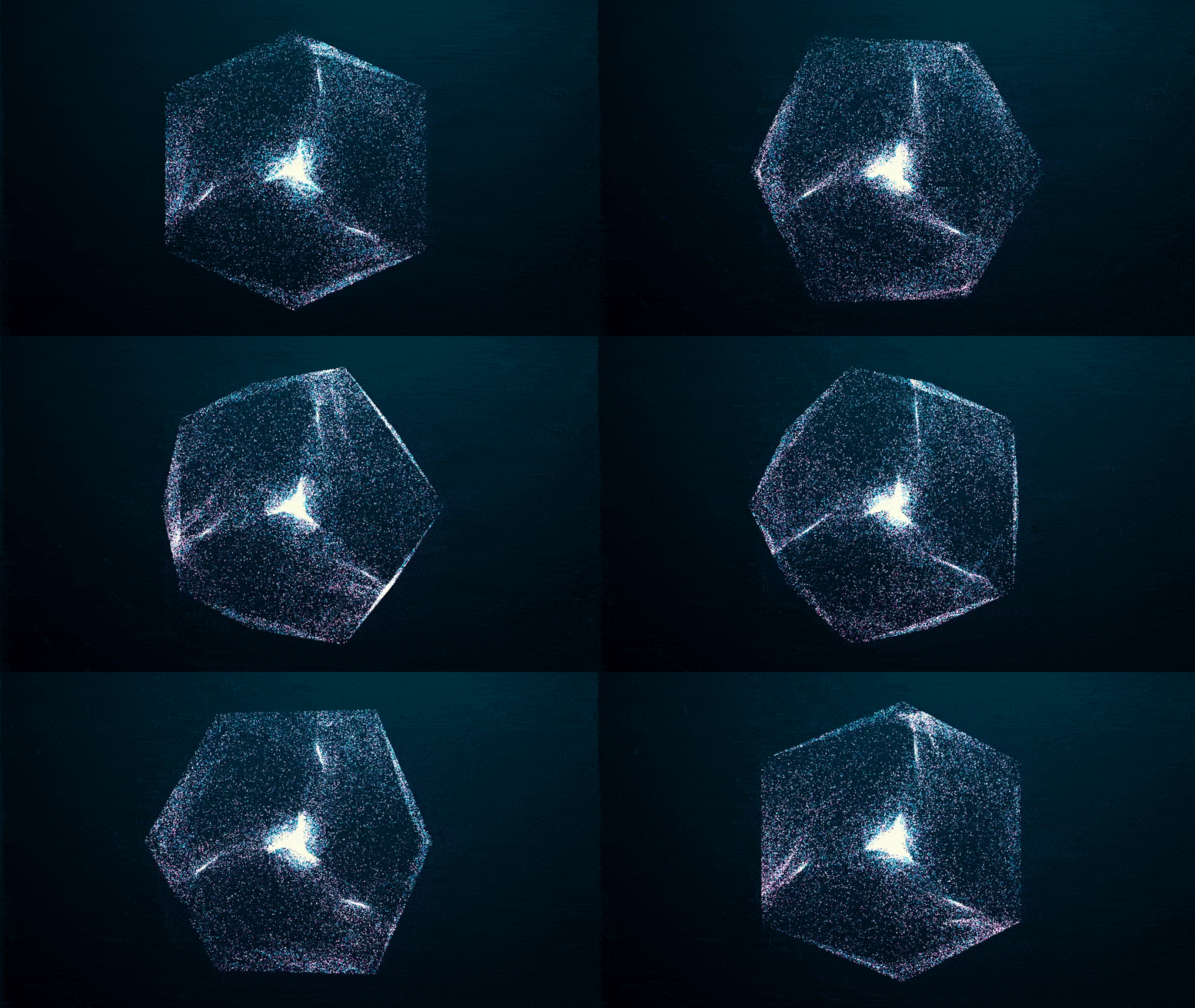
Time crystals that persist indefinitely at room temperature could have applications in precision timekeeping.
We have all seen crystals, whether a simple grain of salt or sugar, or an elaborate and beautiful amethyst. These crystals are made of atoms or molecules repeating in a symmetrical three-dimensional pattern called a lattice, in which atoms occupy specific points in space. By forming a periodic lattice, carbon atoms in a diamond, for example, break the symmetry of the space they sit in. Physicists call this “breaking symmetry.”
Symmetry Breaking in the Time Domain
Scientists have recently discovered that a similar effect can be witnessed in time. Symmetry breaking, as the name suggests, can arise only where some sort of symmetry exists. In the time domain, a cyclically changing force or energy source naturally produces a temporal pattern.
Breaking of the symmetry occurs when a system driven by such a force faces a déjà vu moment, but not with the same period as that of the force. ‘Time crystals’ have in the past decade been pursued as a new phase of matter, and more recently observed under elaborate experimental conditions in isolated systems. These experiments require extremely low temperatures or other rigorous conditions to minimize undesired external influences.
In order for scientists to learn more about time crystals and employ their potential in technology, they need to find ways to produce time crystalline states and keep them stable outside the laboratory.
New Breakthrough: Time Crystals in an Open System
Cutting-edge research led by UC Riverside and published this week in Nature Communications has now observed time crystals in a system that is not isolated from its ambient environment. This major achievement brings scientists one step closer to developing time crystals for use in real-world applications.
“When your experimental system has energy exchange with its surroundings, dissipation and noise work hand-in-hand to destroy the temporal order,” said lead author Hossein Taheri, an assistant research professor of electrical and computer engineering in UC Riverside’s Marlan and Rosemary Bourns College of Engineering. “In our photonic platform, the system strikes a balance between gain and loss to create and preserve time crystals.”
Advancing the notion pondered a decade ago by Nobel Laureate Frank Wilczek, a team of researchers led by UC Riverside Assistant Research Professor Hossein Taheri demonstrates new time crystals which persist indefinitely at room temperature, despite noise and energy loss.
The all-optical time crystal is realized using a disk-shaped magnesium fluoride glass resonator one millimeter in diameter. When bombarded by two laser beams, the researchers observed subharmonic spikes, or frequency tones between the two laser beams, that indicated breaking of temporal symmetry and creation of time crystals.
The UCR-led team utilized a technique called self-injection locking of the two lasers to the resonator to achieve robustness against environmental effects. Signatures of the temporally repeating state of this system can readily be measured in the frequency domain. The proposed platform therefore simplifies the study of this new phase of matter.
Without the need for a low temperature, the system can be moved outside a complex lab for field applications. One such application could be highly accurate measurements of time. Because frequency and time are mathematical inverses of each other, accuracy in measuring frequency enables accurate time measurement.
“We hope that this photonic system can be utilized in compact and lightweight radiofrequency sources with superior stability as well as in precision timekeeping,” said Taheri.
Reference: “All-optical dissipative discrete time crystals” by Hossein Taheri, Andrey B. Matsko, Lute Maleki and Krzysztof Sacha, 14 February 2022, Nature Communications.
DOI: 10.1038/s41467-022-28462-x
Taheri was joined in the research by Andrey B. Matsko at NASA’s Jet Propulsion Laboratory, Lute Maleki at OEwaves Inc. in Pasadena, California, and Krzysztof Sacha at Jagiellonian University in Poland.
Never miss a breakthrough: Join the SciTechDaily newsletter.
Follow us on Google and Google News.
3 Comments
I wonder how time crystals would react in space. Anyone know?
Just imagine Rubik’s cube with barcoded info.
A small hole in the symmetry?