
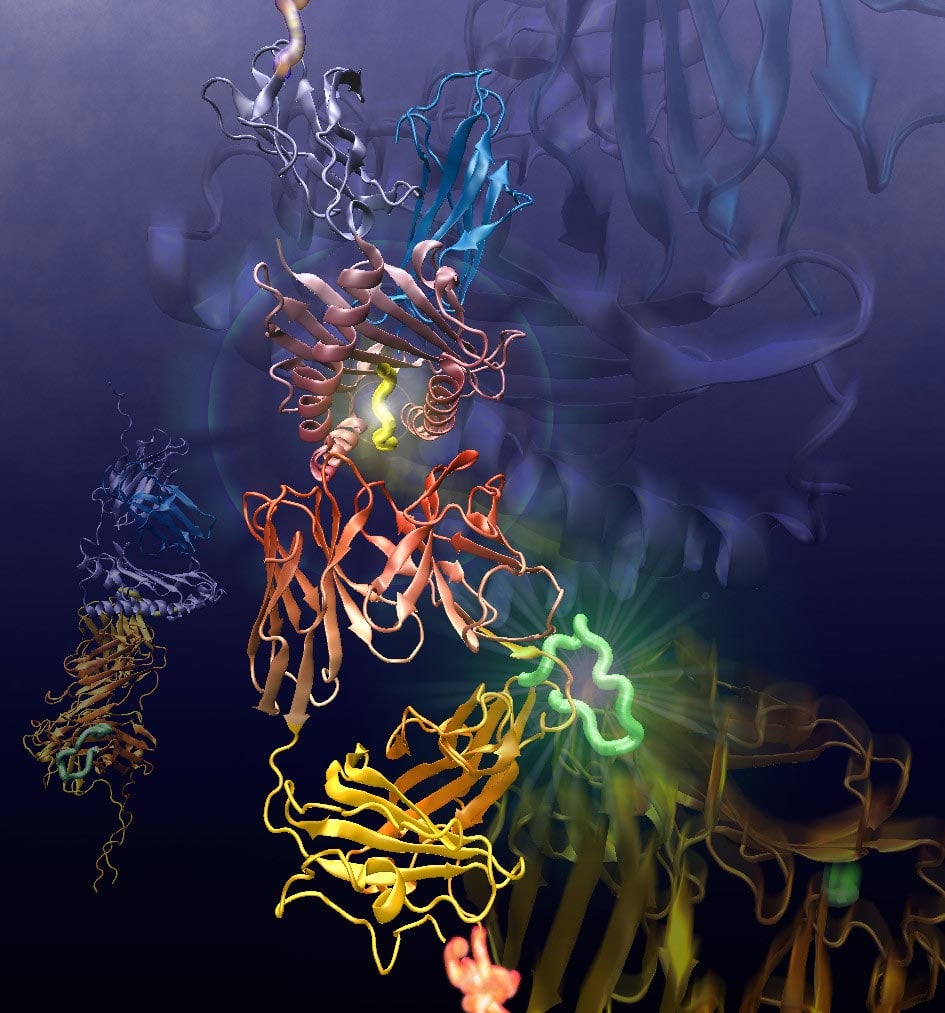
Research led by Texas A&M University Associate Professor Wonmuk Hwang has led to a better understanding of how components of the body’s immune system find intruding or damaged cells, which could lead to novel approaches to viral and cancer treatments.
Hwang, associate professor in the Department of Biomedical Engineering at Texas A&M University, has written about this in an article recently published in the journal Proceedings of the National Academy of Sciences.
When viruses enter the body, the immune system kicks into gear to seek out and destroy the intruder. T-cells are one component of the immune system, and they seek out viruses hiding in host cells, acting as an ultimate line of defense against antigens, or foreign bodies. T-cells probe the surface of other cells, examining materials scooped from inside the cell and presented by the major histocompatibility complex (MHC) molecules on the surface of the cells.
“The problem is there are hundreds of thousands of MHC molecules displaying peptides, and only a few are from invading cells, if at all,” Hwang said. “The rest of them are normal products of cellular metabolism, which means the T-cell needs to be able to see that needle in the haystack.”
Researchers have discovered that T-cells increase their detection power mechanically: when T-cells probe the surface of other cells, there is a natural contact force created. If the cell is infected by an antigen, the applied force results in a “catch bond” between the T-cell receptors (TCRs) and MHC molecules, which strengthens the contact. This bond does not occur between TCRs and MCH molecules that do not carry specific antigens.
However, it is almost impossible to see this interaction in atomic details experimentally, so Hwang developed a computer simulation that could realistically demonstrate and analyze the interaction between TCRs and MHC molecules when force is applied.
“Only the simulation can see and analyze molecular motion under load. A lab experiment doesn’t have the resolution,” Hwang said. “Experimentally determined atomic structures of proteins are static snapshots, but when the molecule moves, you have basically no way to see the motion.”
What Hwang discovered was how the motion between the parts of the TCR controls their interaction with the MHC molecules. When force is applied, the motion is suppressed only when the MHC molecule has the matching antigen, thereby stabilizing the entire complex. Other cases will refuse to interlock with the TCR, and the constant motion between the two eventually leads to them disconnecting. It is like a lock-and-key system where the lock and key constantly change shape, and only with a perfect match and under an adequate level of force, can the molecules interlock.
Hwang said the knowledge of which parts of the molecule respond to force can help tailor T-cells for certain applications. Other than fighting infections, TCRs are also the rising stars of cancer therapy.
“If you can train the T-cell to see those cancerous antigens, it’ll be really specific therapy,” Hwang said. “Chemotherapy kills all the cells. But T-cells you can train to recognize cancer cells with extreme accuracy.”
Hwang said the next step is to investigate what is general and what pertains to specific T-cell receptor systems.
“To see how this principle applies to different T-cell receptors, I’m going to expand this initial finding,” Hwang said. “This is the very first work that has found the operation mechanism of T-cell receptors under force.”
Reference: “The αβTCR mechanosensor exploits dynamic ectodomain allostery to optimize its ligand recognition site” by Wonmuk Hwang, Robert J. Mallis, Matthew J. Lang and Ellis L. Reinherz, 13 August 2020, Proceedings of the National Academy of Sciences.
DOI: 10.1073/pnas.2005899117
Hwang collaborated with researchers from Vanderbilt University and Harvard Medical School, and the research was supported by grants from the National Institutes of Health.
Never miss a breakthrough: Join the SciTechDaily newsletter.
Follow us on Google and Google News.