
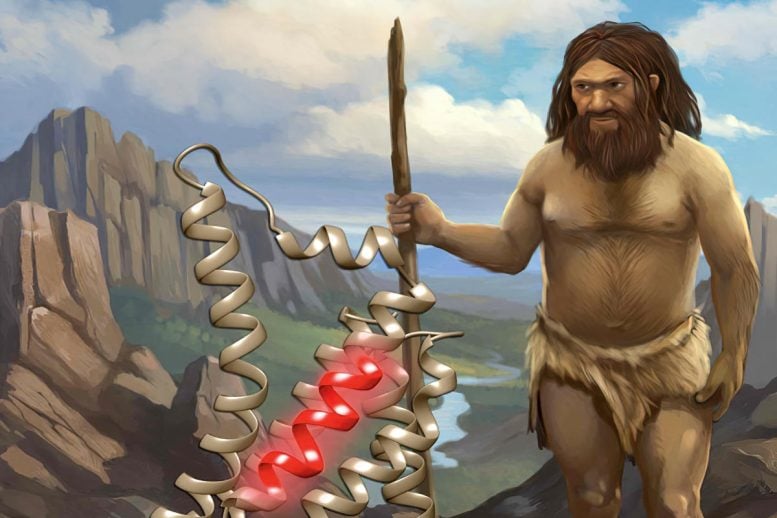
Researchers have used AI to resurrect antimicrobial peptides from extinct human ancestors, opening new doors for antibiotic development while raising critical bioethical considerations.
Researchers have delved into molecular “de-extinction,” studying ancient genomes for potential antibiotics. Their work unearthed antimicrobial molecules from Neanderthals and Denisovans, challenging traditional notions of protein functions and raising bioethical queries.
“We need to think big in antibiotics research,” says Cesar de la Fuente. “Over one million people die every year from drug-resistant infections, and this is predicted to reach 10 million by 2050. There hasn’t been a truly new class of antibiotics in decades, and there are so few of us tackling this issue that we need to be thinking about more than just new drugs. We need new frameworks.”
De la Fuente is Presidential Assistant Professor in the Department of Bioengineering and the Department of Chemical and Biomolecular Engineering at the University of Pennsylvania School of Engineering and Applied Science. He holds additional primary appointments in Psychiatry and Microbiology in the Perelman School of Medicine.
De la Fuente’s lab, the Machine Biology Group, creates these new frameworks using potent partnerships in engineering and the health sciences, drawing on the “power of machines to accelerate discoveries in biology and medicine.”
Marrying artificial intelligence with advanced experimental methods, the group has mined the ancient past for future medical breakthroughs. In a recent study published in Cell Host and Microbe, the team has launched the field of “molecular de-extinction.”
Our genomes – our genetic material – and the genomes of our ancient ancestors, express proteins with natural antimicrobial properties. “Molecular de-extinction” hypothesizes that these molecules could be prime candidates for safe new drugs. Naturally produced and selected through evolution, these molecules offer promising advantages over molecular discovery using AI alone.
Resurrecting Antibiotic Molecules from Extinct Ancestors
In this paper, the team explored the proteomic expressions of two extinct organisms –Neanderthals and Denisovans, archaic precursors to the human species – and found dozens of small protein sequences with antibiotic qualities. Their lab then worked to synthesize these molecules, bringing these long-since-vanished chemistries back to life.
“The computer gives us a sequence of amino acids,” says de la Fuente. “These are the building blocks of a peptide, a small protein. Then we can make these molecules using a method called ‘solid-phase chemical synthesis.’ We translate the recipe of amino acids into an actual molecule and then build it.”
The team next applied these molecules to pathogens in a dish and in mice to test the veracity and efficacy of their computational predictions.
“The ones that worked, worked quite well,” continues de la Fuente. “In two cases, the peptides were comparable – if not better – than the standard of care. The ones that didn’t work helped us learn what needed to be improved in our AI tools. We think this research opens the door to new ways of thinking about antibiotics and drug discovery, and this first step will allow scientists to explore it with increasing creativity and precision.”
Surprising Insights into Immunity and Protein Function
This new universe of research is especially rich. In addition to offering an entirely new framework for drug discovery, their work has yielded unexpected insights into our immune system. Remarkably, some of the peptide sequences in question had no previously known role in immunity.
In fact, the group’s previous research had already shown that some of the antimicrobial molecules they found were hidden away, encrypted within proteins associated with completely different systems and functions in the body.
“One thing that surprised me,” says de la Fuente, “is that our lab found sequences in every system of the body – cardiovascular, nervous, digestive, etc. What we didn’t recognize before is that proteins or peptides playing roles in one system could also be contributing to immunity in general.”
The traditional view in biology is that one gene encodes for one protein, and each protein has one function. But what the team and their talented collaborators found is that one protein can have multiple functions.
“We are opening an entirely new avenue for learning about the ways our bodies prevent and fight diseases,” says de la Fuente.
With de-extinction established for these molecules, the Penn Engineering research team is now thoughtfully exploring the consequences of resurrecting the past.
The Bioethical Dilemmas of Resurrecting Molecular Life
“We’re in conversation with bioethicists about what it means to bring genetic material back to life,” says de la Fuente. “We’re doing it for medicine, but what if someone else resurrects something toxic or harmful? We’re also collaborating with patent lawyers. Current peptide sequences are not patentable by law. But what about those we recreate from extinct organisms?”
A simple molecule, thousands of years old, lives – and is helping us ask questions we’ve never asked before.
Reference: “Molecular de-extinction of ancient antimicrobial peptides enabled by machine learning” by Jacqueline R.M.A. Maasch, Marcelo D.T. Torres, Marcelo C.R. Melo and Cesar de la Fuente-Nunez, 28 July 2023, Cell Host & Microbe.
DOI: 10.1016/j.chom.2023.07.001
Never miss a breakthrough: Join the SciTechDaily newsletter.
Follow us on Google and Google News.
1 Comment
SUPER AMAZING FULL OF BEAUTIFUL COLOR’S, IT’S FUN, FULL OF EXCITEMENT AND EVERYTHING YOU NEED TO KEEP YOU BUSY THANK YOU FOR HAVING THE INCREDIBLE