
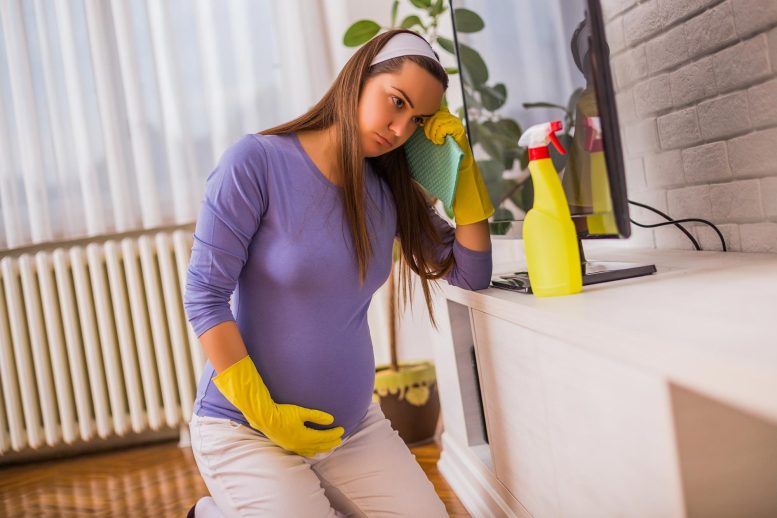
Use of disinfectants by pregnant women may be a risk factor for asthma and eczema in their children, finds a population study, published online in Occupational & Environmental Medicine.
Disinfectants are used frequently in hospitals and other medical facilities, and the COVID-19 pandemic has led to an increase in their use in medical settings and also more widely, including by the general population.
Exposure to disinfectants in the workplace has been linked to asthma and dermatitis previously in the workers exposed, but few studies have looked at the impact of disinfectant use during pregnancy and the subsequent development of allergic disease in children.
The authors used data on 78 915 mother-child pairs who participated in the Japan Environment and Children’s Study to examine whether mothers’ exposure to disinfectants in the workplace was associated with increased risk of diagnosis of allergic diseases in their children when aged 3 years.
The odds of children having asthma or eczema were significantly higher if their mothers used disinfectant one to six times a week compared with the odds in children of mothers who never used disinfectants.
Exposure-Dependent Risk
There was an exposure-dependent relationship between prenatal exposure to disinfectants and the odds of children experiencing these allergic conditions, with the children of mothers exposed to disinfectants every day having the highest odds of a diagnosis – 26% greater for asthma and 29% greater for eczema than children of mothers who were never exposed to disinfectants.
There were no significant associations between disinfectant use and food allergies.
This is an observational study, and as such, can’t establish cause. The authors also noted some limitations, including that the information on disinfectant use by mothers was self-reported with specific disinfectants not identified. Diagnoses of allergic diseases in children were also reported by mothers.
Nevertheless, the authors conclude, “Our findings indicate that exposure [to disinfectants] during pregnancy exerts an effect on allergies in offspring regardless of whether the mother returns to work when the child is 1 year old, and suggest an effect by exposure during pregnancy alone.”
They add, “Given the current increased use of disinfectants to prevent new coronavirus infections, it is of great public health importance to consider whether prenatal disinfectant exposure is a risk for the development of allergic diseases.”
Potential Mechanisms Behind the Increased Risk
Several mechanisms that could explain the increased risk of allergic disease in children following their mothers’ exposure to disinfectants during pregnancy were suggested by the authors.
They included microbiome-mediated (disinfectants impact the gut and skin microflora of the mother and subsequently the child), immune-mediated (exposure to some chemical compounds during pregnancy impacts the immune response in the fetus), postnatal exposure (children inhaled or touched molecules of disinfectant on the skin of their mothers), or bias (mothers who use medical disinfectants frequently are likely to be more medically knowledgeable and have better access to healthcare).
Reference: “Prenatal occupational disinfectant exposure and childhood allergies: the Japan Environment and Children’s study” by Reiji Kojima, Ryoji Shinohara, Megumi Kushima, Sayaka Horiuchi, Sanae Otawa, Hiroshi Yokomichi, Yuka Akiyama, Tadao Ooka, Kunio Miyake and Zentaro Yamagata, 28 March 2022, Occupational and Environmental Medicine.
DOI: 10.1136/oemed-2021-108034
Never miss a breakthrough: Join the SciTechDaily newsletter.
Follow us on Google and Google News.
3 Comments
This is another reason why mothers should be taking PREbiotics during pregnancy!
Prebiotics feed the healthful bacteria to counteract the detrimental effects of toxins, pollution, stress, and bad diet. By keeping healthful bacteria at high levels, they maintain the immune system and keep inflammation in check.
5 grams of GOS/day is recommended.
So…let’s define “disinfectant” a bit more clearly for us here among the Great Unwashed. How are you supposed to clean your house if you can’t use disinfectants — i.e. cleaning products? Is Lysol out? How about Windex? Clorox? Toilet bowl cleaners? Dishwasher tabs? If you hire a housekeeper who uses your products and she happens to be pregnant, are you legally liable if her kids turn out to have allergies? Conversely, if you’re pregnant and she brings her own products, is she liable if your kids are chronically ill with allergies? And if we can’t use disinfectants that are proven to kill dangerous bacteria and viruses, are we thrown back on having to follow the wacky advice of the folks who subscribe to folkloric theories?
hello