
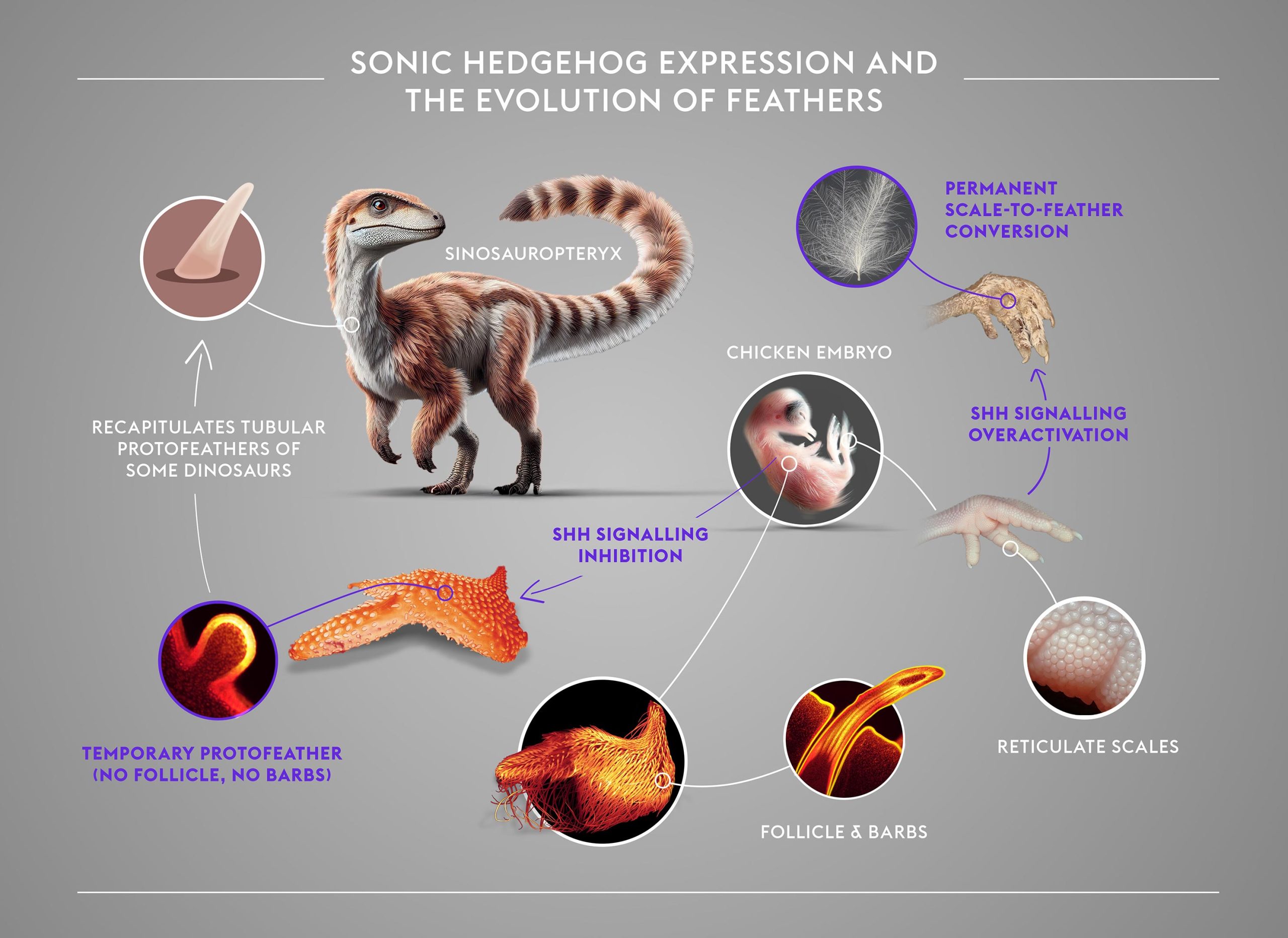
Chickens treated to inhibit the sonic hedgehog (Shh) pathway during development grow feathers that resemble ancient protofeathers—unbranched and underdeveloped.
While some recovery occurs after hatching, these findings reveal how critical Shh signaling is to feather patterning and offer compelling insights into how feathers might have evolved from simpler skin structures. The study also hints at the resilience of biological systems, as disrupted feather follicles can reactivate weeks later.
Disrupting a Key Pathway in Feather Formation
Blocking the sonic hedgehog (Shh) signaling pathway significantly disrupts feather development in chickens, limiting the growth, folding, and branching of feather buds. This finding comes from a study published on March 20th in PLOS Biology by Rory Cooper and Michel Milinkovitch of the University of Geneva, Switzerland.
Feathers are complex structures that vary widely in shape across different bird species, body regions, and life stages. Their intricate forms make them an excellent model for studying how tissues develop in embryos. While the Shh pathway is known to play a key role in feather growth and patterning, direct experimental evidence of its function during feather formation has been scarce, until now.
Visualizing Feather Growth with Advanced Imaging
To fill this knowledge gap, Cooper and Milinkovitch used light sheet fluorescence microscopy imaging to study the normal patterning of embryonic feathers and how their shape develops. The authors also used precise intravenous injections of sonidegib to pharmacologically inhibit Shh pathway signaling during feather development at embryonic day 9, which precedes feather-bud outgrowth on the wings.
This treatment temporarily modified Shh expression to produce striped domains instead of spots on the skin, temporarily stopped feather development, and resulted in unbranched and non-invaginated feather buds, akin to putative proto-feathers,until embryonic day 14.
Feather Recovery and Evolutionary Implications
Although feather development partially recovered later during development, hatched sonidegib-treated chickens exhibited naked regions of the skin surface with perturbed follicles. Remarkably, these follicles were subsequently reactivated by seven weeks post-hatching, highlighting the robustness of feather patterning as a developmental process.
Overall, the study provides comprehensive functional evidence for the role of the Shh pathway in mediating feather development in chickens, supporting the idea that modified Shh signaling has contributed to the evolutionary diversification of feathers and other skin appendages such as feet scales. According to the authors, the study also demonstrates the importance of in-vivo experiments for obtaining a comprehensive understanding of developmental systems.
Future Questions in Feather and Scale Evolution
The authors add, “Our experiments show that while a transient disturbance in the development of feet scales can permanently turn them into feathers, it is much harder to disrupt feather development itself. The big challenge now is to understand how these genetic interactions have changed to allow for the emergence of protofeathers early in the evolution of dinosaurs.”
Explore Further: How Chickens Grew Dinosaur Feathers (Then Changed Back)
Reference: “In vivo sonic hedgehog pathway antagonism temporarily results in ancestral proto-feather-like structures in the chicken” by Rory L. Cooper and Michel C. Milinkovitch, 20 March 2025, PLOS Biology.
DOI: 10.1371/journal.pbio.3003061
Never miss a breakthrough: Join the SciTechDaily newsletter.
Follow us on Google and Google News.
5 Comments
Never a good sign when a paper uses Ai as its header image.
Agreed. Immediately offputting, plus it’s very poor paleoart.
I want to raise some dino-chickens! Now work on getting the toe claw back.
Get some rattites, fewer steps away
So essentially a degradation of pre-existing information produces pseudo-scale like texture. Well, what we need to see is a definitive increase in complex functional specified information, not a degradation. Really nothing to see here. It is kind of neat though.