
Close Menu
    Facebook X (Twitter) Instagram
    SciTechDaily
    • Biology
    • Chemistry
    • Earth
    • Health
    • Physics
    • Science
    • Space
    • Technology
    Facebook X (Twitter) Pinterest YouTube RSS
    SciTechDaily
    Home»Space»Distinguishing Black Holes from Naked Singularities
    Space

    Distinguishing Black Holes from Naked Singularities

    By Harvard-Smithsonian Center for AstrophysicsFebruary 17, 20142 Comments3 Mins Read
    Facebook Twitter Pinterest Telegram LinkedIn WhatsApp Email Reddit
    Share
    Facebook Twitter LinkedIn Pinterest Telegram Email Reddit
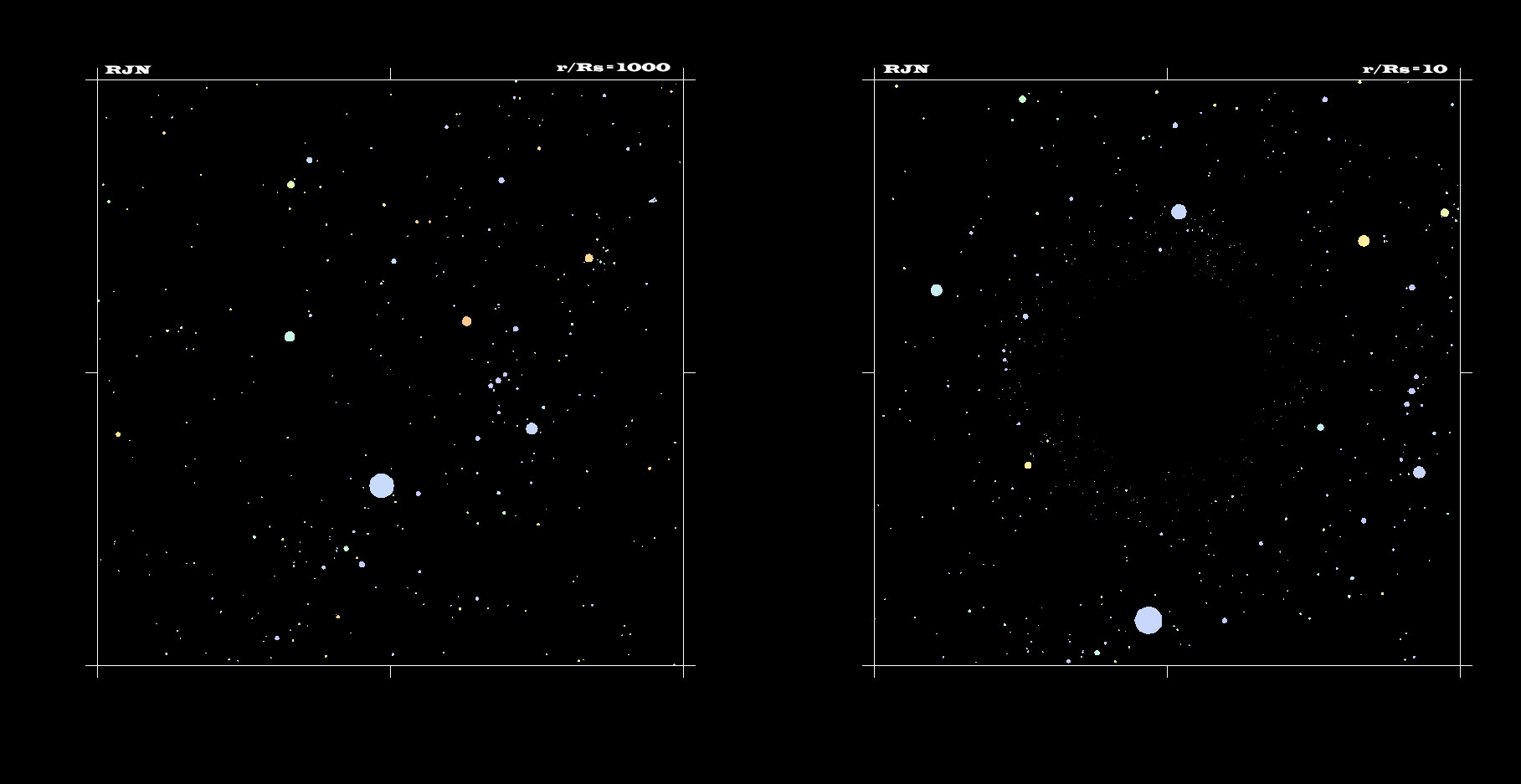
    Distinguishing Black Holes from Naked Singularities
    A computer-generated image of a star field (left) as seen by an astronaut close to a black hole in the center of the field-of-view (right). The gravity of the black hole creates visual distortions, some quite unusual. Credit: Robert Nemeroff, MTU

    A new theoretical paper from researchers at the Harvard-Smithsonian Center for Astrophysics finds there is a way in principle to make a black hole with no event horizon, a so-called “naked singularity.”

    Black holes with masses of millions or even billions of suns appear to reside at the nuclei of galaxies. In dramatic cases like quasars they are thought to be responsible for the spectacular phenomena like the ejection of narrow jets of particles at nearly the speed of light. Such outflows are thought to be driven by matter accreting onto a hot disk around the black hole. Much smaller black holes, closer in size to one solar mass, are thought to form as the result of the cataclysmic death of a star in a supernova.

    A black hole in the traditional theory is characterized by having “no hair”; that is, it is so simple that it can be completely described by just three parameters, its mass, its spin, and its electric charge. Even though it may have formed out of a complex mix of matter and energy, all the specific details are lost when it collapses to a singular point. In the standard paradigm, the black hole is surrounded by a “horizon,” and once anything – matter or light (energy) – falls within that horizon, it cannot escape. Hence, the singularity appears black. Outside this horizon an accreting disk (if there is one) can radiate freely.

    This picture may be appealing, but there is no direct proof as yet that any suspected galactic nuclei candidates are necessarily black holes and have horizons. The equations describing the collapse of matter in general relativity allow for other solutions, and do not require in every case that the final end-state must be a black hole. If, for example, matter were to condense very gradually instead of rapidly in a supernova, theory suggests that it is possible for the final point-like product to lack an event horizon. Such an object is called a “naked singularity” (“singularity” because, like a black hole, it has point-like dimensions, but naked because it lacks an event horizon and so light can escape its vicinity – it is not black).

    Harvard-Smithsonian Center for Astrophysics (CfA) astronomer Ramesh Narayan and two colleagues have devised a way, at least in theory, for such a gradually collapsing process to form a naked singularity. Moreover, they then explore ways in which it might be observationally possible to distinguish one from a black hole by using the character of the radiation emitted from a disk around it. The results are not only fun to think about, they help astronomers probe how these bizarre objects may have formed in the first place.

    Reference: “Distinguishing Black Holes from Naked Singularities Through Their Accretion Disc Properties” by Pankaj S. Joshi, Daniele Malafarina and Ramesh Narayan, 14 November 2013, Classical and Quantum Gravity.
    DOI: 10.1088/0264-9381/31/1/015002
    arXiv:1304.7331


    Never miss a breakthrough: Join the SciTechDaily newsletter.
    Follow us on Google and Google News.

    Astronomy Astrophysics Black Hole Harvard-Smithsonian Center for Astrophysics Popular
    Share. Facebook Twitter Pinterest LinkedIn Email Reddit

    Related Articles

    Black Hole Lights Up Years After Ripping Star to Shreds – “We’ve Never Seen Anything Like This Before”

    Scientists Have Spotted the Farthest Galaxy Ever – It May Be Home to the Oldest Stars in the Universe

    Astronomers Spy Quartet of Enormous Cavities From Giant Black Holes

    Astronomers Use “X-Ray Magnifying Glass” To Enhance View of Distant Black Holes

    Astronomers Spot Unusual, Enormous Rings Around a Black Hole

    Telescopes Unite in Unprecedented Observations of Famous Black Hole Across the Entire Electromagnetic Spectrum

    Massive X-ray Jet – Extending for 160,000 Light-Years – Spied From Supermassive Black Hole in Early Universe

    Astronomers Detect a Supermassive Black Hole on the Move – Unusual Motion Thus Far Unexplained

    Stranger Than Fiction: The Monster in the Middle of the Milky Way Is…Spinning Slowly?

    2 Comments

    1. Kelley Travis on July 3, 2020 11:59 am

      We thoroughly enjoyed that one. I honestly do not understand how may
      you produce this kind of high-quality articles each time!
      It sort of reminded me regarding http://www.rtjournal.org/college-interview-tips/, yet this specific
      seems to possess even more level. Thank you with regard to always
      sharing your current knowledge!

      Reply
    2. Charles Johnson on October 24, 2024 2:57 am

      This is a fascinating topic! Understanding the difference between black holes and naked singularities is crucial for our grasp of the universe. Black holes are hidden by their event horizons, while naked singularities challenge our ideas about gravity and space. If you’re exploring these complex concepts in writing, https://myperfectwords.com/ is a great resource. Their essay writing service can help simplify tough subjects and ensure your ideas are presented clearly. It’s a handy tool for anyone looking to dive deeper into astrophysics or any other challenging topic!

      Reply
    Leave A Reply Cancel Reply

    • Facebook
    • Twitter
    • Pinterest
    • YouTube

    Don't Miss a Discovery

    Subscribe for the Latest in Science & Tech!

    Trending News

    Scientists May Have Discovered How To Heal Damaged Kidneys

    Interstellar Visitor 3I/ATLAS Is Bursting With an Unexpected Chemical

    Scientists Just Found All 5 Genetic “Letters” of DNA and RNA on an Asteroid

    The 4,000-Year-Old City That Defied History’s Rules on Wealth and Power

    The World’s Biggest Population Fear Has Flipped – and It Could Change Everything

    This “Fake” Pill Improved Memory and Physical Performance in Just 3 Weeks

    Scientists Say Frequent Ejaculation May Improve Sperm Quality and Fertility

    Scientists Have Found “The Heaven Sword” After Years of Looking

    Follow SciTechDaily
    • Facebook
    • Twitter
    • YouTube
    • Pinterest
    • Newsletter
    • RSS
    SciTech News
    • Biology News
    • Chemistry News
    • Earth News
    • Health News
    • Physics News
    • Science News
    • Space News
    • Technology News
    Recent Posts
    • Europe’s First TES Spectrometer Makes Previously Impossible X-Ray Experiments Possible
    • This Sodium Battery From China Matched Tesla in a Surprising Head-to-Head Test
    • Common Laxative May Help Reverse Depression-Related Brain Fog
    • The Surprising Reason Frozen Fruit May Be Just As Nutritious as Fresh
    • Scientists Discover the Oldest Known Fossils of Humans’ Closest Invertebrate Relatives
    Copyright © 1998 - 2026 SciTechDaily. All Rights Reserved.
    • Science News
    • About
    • Contact
    • Editorial Board
    • Privacy Policy
    • Terms of Use

    Type above and press Enter to search. Press Esc to cancel.