
Close Menu
    Facebook X (Twitter) Instagram
    SciTechDaily
    • Biology
    • Chemistry
    • Earth
    • Health
    • Physics
    • Science
    • Space
    • Technology
    Facebook X (Twitter) Pinterest YouTube RSS
    SciTechDaily
    Home»Space»Distortion of Space-Time Helps Astronomers Set New Magnification Record
    Space

    Distortion of Space-Time Helps Astronomers Set New Magnification Record

    By Dr. Harald Ebeling, University of Hawaii at ManoaFebruary 7, 2018No Comments3 Mins Read
    Facebook Twitter Pinterest Telegram LinkedIn WhatsApp Email Reddit
    Share
    Facebook Twitter LinkedIn Pinterest Telegram Email Reddit
    Astronomers Set New Magnification Record with Natural Telescope
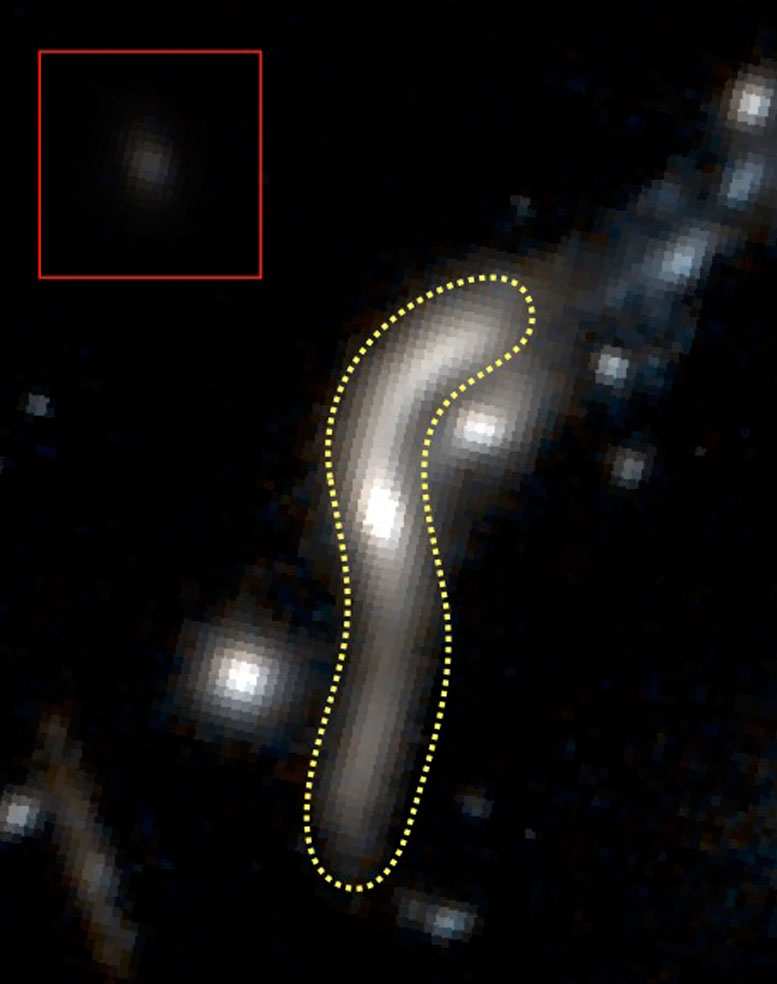
    The quiescent galaxy eMACSJ1341-QG-1 as seen by the Hubble Space Telescope. The yellow dotted line traces the boundaries of the galaxy’s gravitationally lensed image. The inset on the upper left shows what eMACSJ1341-QG-1 would look like if we observed it directly, without the cluster lens. The dramatic amplification and distortion caused by the intervening, massive galaxy cluster (of which only a few galaxies are seen in this zoomed-in view) is apparent. Credit: Harald Ebeling, UH IfA

    Extremely distant galaxies are usually too faint to be seen, even by the largest telescopes. But nature has a solution: gravitational lensing, predicted by Albert Einstein and observed many times by astronomers. Now, an international team of astronomers, led by Harald Ebeling of the Institute for Astronomy at the University of Hawaii at Manoa, has discovered one of the most extreme instances of magnification by gravitational lensing.

    Using the Hubble Space Telescope to survey a sample of huge clusters of galaxies, the team found a distant galaxy, eMACSJ1341-QG-1, that is magnified 30 times thanks to the distortion of space-time created by the massive galaxy cluster dubbed eMACSJ1341.9-2441.

    The underlying physical effect of gravitational lensing was first confirmed during the solar eclipse of 1919, and can dramatically magnify images of distant celestial sources if a sufficiently massive object lies between the background source and observers.

    Galaxy clusters, enormous concentrations of dark matter, and hot gas surrounding hundreds or thousands of individual galaxies, all bound by the force of gravity, are valued by astronomers as powerful “gravitational lenses.” By magnifying the galaxies situated behind them, massive clusters act as natural telescopes that allow scientists to study faint and distant sources that would otherwise be beyond the reach of even the most powerful man-made telescopes.

    “The very high magnification of this image provides us with a rare opportunity to investigate the stellar populations of this distant object and, ultimately, to reconstruct its undistorted shape and properties,” said team member Johan Richard of the University of Lyon, who performed the lensing calculations.

    Although similarly extreme magnifications have been observed before, the discovery sets a record for the magnification of a rare “quiescent” background galaxy–one that, unlike our Milky Way, does not form new stars in giant clouds of cool gas.

    Explained UH team leader Ebeling, “We specialize in finding extremely massive clusters that act as natural telescopes and have already discovered many exciting cases of gravitational lensing. This discovery stands out, though, as the huge magnification provided by eMACSJ1341 allows us to study in detail a very rare type of galaxy.”

    Reference: “Thirty-fold: Extreme Gravitational Lensing of a Quiescent Galaxy at z = 1.6” by H. Ebeling, M. Stockmann, J. Richard, J. Zabl, G. Brammer, S. Toft and A. Man, 27 December 2017, The Astrophysical Journal Letters.
    DOI: 10.3847/2041-8213/aa9fee

    Never miss a breakthrough: Join the SciTechDaily newsletter.
    Follow us on Google and Google News.

    Astronomy Astrophysics Cosmology Gravitational Lensing Hubble Space Telescope University of Hawaii
    Share. Facebook Twitter Pinterest LinkedIn Email Reddit

    Related Articles

    Hubble Telescope Reveals Most Distant Star Ever Observed

    New Research Supports Faster Than Expected Expansion of the Universe

    New Phoenix Cluster Observations Provide A Fresh Perspective

    Astronomers Discover Supernovae in ‘Wrong Place at Wrong Time’

    Hubble Reveals Diffusion of Stars Through the Core of the Globular Cluster 47 Tucanae

    Hubble Finds Small Galaxy More Than 13 Billion Light-Years Away

    Hubble Discovers the Farthest Lensing Galaxy to Date

    Astronomers Map Galaxy Cluster More Precisely Than Ever Before

    Study Suggest Spiral Galaxies Are Larger Than Previously Thought

    Leave A Reply Cancel Reply

    • Facebook
    • Twitter
    • Pinterest
    • YouTube

    Don't Miss a Discovery

    Subscribe for the Latest in Science & Tech!

    Trending News

    Scientists Uncover Potential Brain Risks of Popular Fish Oil Supplements

    Scientists Discover a Surprising Way To Make Bread Healthier and More Nutritious

    After 60 Years, Scientists Uncover Unexpected Brain Effects of Popular Diabetes Drug Metformin

    New Research Uncovers Hidden Side Effects of Popular Weight-Loss Drugs

    Scientists Rethink Extreme Warming After Surprising Ocean Discovery

    Landmark Study Links Never Marrying to Significantly Higher Cancer Risk

    Researchers Discover Unknown Beetle Species Just Steps From Their Lab

    Largest-Ever Study Finds Medicinal Cannabis Ineffective for Anxiety, Depression, PTSD

    Follow SciTechDaily
    • Facebook
    • Twitter
    • YouTube
    • Pinterest
    • Newsletter
    • RSS
    SciTech News
    • Biology News
    • Chemistry News
    • Earth News
    • Health News
    • Physics News
    • Science News
    • Space News
    • Technology News
    Recent Posts
    • Scientists Discover Caffeine Can Repair Key Memory Circuits After Sleep Loss
    • Strange 65-Foot Dinosaur Discovered in Argentina
    • Researchers Uncover Source of Strange Deformation in Earth’s Largest Continental Rift
    • Scientists Solve Mystery of Where the Colorado River Vanished Millions of Years Ago
    • Not Just Alzheimer’s: Scientists Uncover Clues to a Second, Overlooked Disorder
    Copyright © 1998 - 2026 SciTechDaily. All Rights Reserved.
    • Science News
    • About
    • Contact
    • Editorial Board
    • Privacy Policy
    • Terms of Use

    Type above and press Enter to search. Press Esc to cancel.