
Close Menu
    Facebook X (Twitter) Instagram
    SciTechDaily
    • Biology
    • Chemistry
    • Earth
    • Health
    • Physics
    • Science
    • Space
    • Technology
    Facebook X (Twitter) Pinterest YouTube RSS
    SciTechDaily
    Home»Science»Divide and Conquer: Random Effects Key to Containing Epidemics
    Science

    Divide and Conquer: Random Effects Key to Containing Epidemics

    By American Institute of PhysicsNovember 1, 2020No Comments3 Mins Read
    Facebook Twitter Pinterest Telegram LinkedIn WhatsApp Email Reddit
    Share
    Facebook Twitter LinkedIn Pinterest Telegram Email Reddit
    Divide and Conquer Epidemic
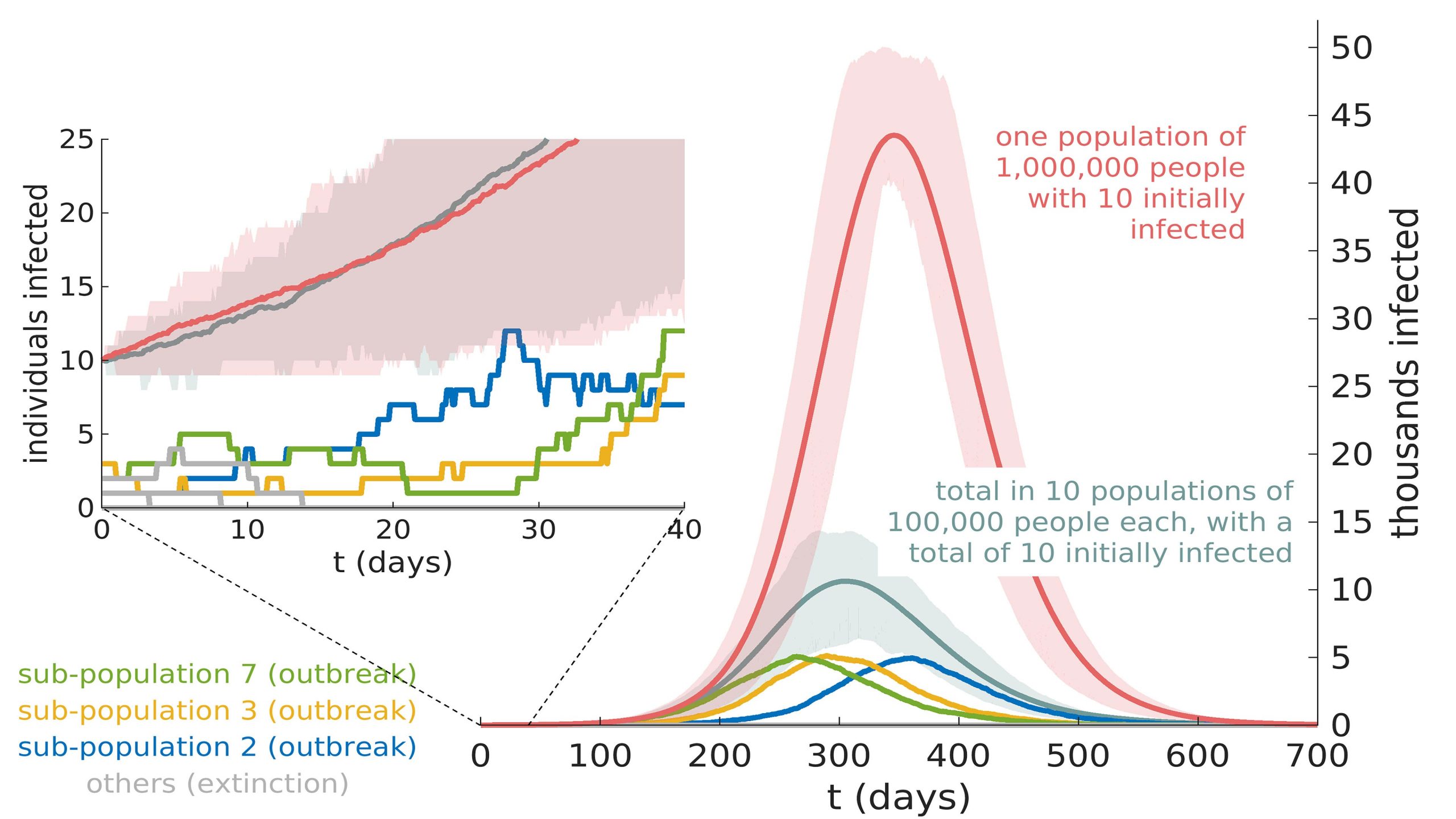
    Divide and conquer: Red curve shows the effect of 10 infected individuals in a population of 1 million people. If the population is broken into groups of 100,000 each, three subpopulations experience desynchronized outbreaks (shorter colored curves). In the remaining seven subgroups, gray curve, the outbreak is extinguished. Credit: Philip Bittihn and Ramin Golestanian

    The inherent randomness of contacts between infected and healthy individuals enhances the benefit of dividing a population into smaller communities for the control of epidemics.

    To control an epidemic, authorities will often impose varying degrees of lockdown. In a paper in the journal Chaos, by AIP Publishing, scientists have discovered, using mathematics and computer simulations, why dividing a large population into multiple subpopulations that do not intermix can help contain outbreaks without imposing contact restrictions within those local communities.

    “The key idea is that, at low infection numbers, fluctuations can alter the course of the epidemics significantly, even if you expect an exponential increase in infection numbers on average,” said author Ramin Golestanian.

    When infection numbers are high, random effects can be ignored. But subdividing a population can create communities so small that the random effects matter.

    “When a large population is divided into smaller communities, these random effects completely change the dynamics of the full population. Randomness causes peak infection numbers to be brought way down,” said author Philip Bittihn.

    To tease out the way randomness affects an epidemic, the investigators first considered a so-called deterministic model without random events. For this test, they assumed that individuals in each subpopulation encounter others at the same rate they would have in the large population. Even though subpopulations are not allowed to intermix, the same dynamics are observed in the subdivided population as in the initial large population.

    If, however, random effects are included in the model, dramatic changes ensue, even though the contact rate in the subpopulations is the same as in the full one.

    A population of 8 million individuals with 500 initially infected ones was studied using an infectious contact rate seen for COVID-19 with mild social distancing measures in place. With these parameters, the disease spreads exponentially with infections doubling every 12 days.

    “If this population is allowed to mix homogeneously, the dynamics will evolve according to the deterministic prediction with a peak around 5% infected individuals,” said Bittihn.

    However, if the population is split into 100 subpopulations of 80,000 people each, the peak percentage of infected individuals drops to 3%. If the community is split up even further to 500 subgroups of 16,000 each, the infection peaks at only 1% of the initial population.

    The main reason subdividing the population works is because the epidemic is completely extinguished in a significant fraction of the subgroups. This “extinction effect” occurs when infection chains spontaneously terminate.

    Another way subdividing works is by desynchronizing the full population. Even if outbreaks occur in the smaller communities, the peaks may come at different times and cannot synchronize and add up to a large number.

    “In reality, subpopulations cannot be perfectly isolated, so local extinction might only be temporary,” Golestanian said. “Further study is ongoing to take this and suitable countermeasures into account.”

    Reference: “Stochastic effects on the dynamics of an epidemic due to population subdivision” by Philip Bittihn and Ramin Golestanian, 27 October 2020, Chaos.
    DOI: 10.1063/5.0028972

    Never miss a breakthrough: Join the SciTechDaily newsletter.
    Follow us on Google and Google News.

    Infectious Diseases Mathematics Public Health Statistics
    Share. Facebook Twitter Pinterest LinkedIn Email Reddit

    Related Articles

    Huge Decrease in Second-Wave COVID Mortality in Wealthier Areas

    “Miracle” of How the Warsaw Ghetto Beat the Infectious Disease Typhus Finally Revealed

    Fear to Anger: Global Sentiments Towards COVID-19 Shift

    New Research Shows COVID-19 Herd Immunity Could Be Achieved With Fewer People Being Infected

    100-Year-Old Physics Problem Finally Solved – Accurately Predicts Transmission of Infectious Diseases

    New Model Predicts the Peaks of the COVID-19 Pandemic Around the World

    Paradoxes of Probability & Statistical Strangeness

    Evolution in COVID-19 Spread Predicted by Mathematical Curves

    Collecting All Pennies From 1959 to 1997 Is Easily Feasible

    Leave A Reply Cancel Reply

    • Facebook
    • Twitter
    • Pinterest
    • YouTube

    Don't Miss a Discovery

    Subscribe for the Latest in Science & Tech!

    Trending News

    First-of-Its-Kind Discovery: Homer’s Iliad Found Embedded in a 1,600-Year-Old Egyptian Mummy

    Beyond Inflammation: Scientists Uncover New Cause of Persistent Rheumatoid Arthritis

    A Simple Molecule Could Unlock Safer, Easier Weight Loss

    Scientists Just Built a Quantum Battery That Charges Almost Instantly

    Researchers Unveil Groundbreaking Sustainable Solution to Vitamin B12 Deficiency

    Millions of People Have Osteopenia Without Realizing It – Here’s What You Need To Know

    Researchers Discover Boosting a Single Protein Helps the Brain Fight Alzheimer’s

    World-First Study Reveals Human Hearts Can Regenerate After a Heart Attack

    Follow SciTechDaily
    • Facebook
    • Twitter
    • YouTube
    • Pinterest
    • Newsletter
    • RSS
    SciTech News
    • Biology News
    • Chemistry News
    • Earth News
    • Health News
    • Physics News
    • Science News
    • Space News
    • Technology News
    Recent Posts
    • Breakthrough Technology Reveals New Treatment Targets for Cancer
    • Scientists Discover New Way To Make Drug-Resistant Cancer Treatable Again
    • This Simple Exercise Trick Builds Muscle With Less Effort, Study Finds
    • Middle Age Is Becoming a Breaking Point in America, Study Reveals
    • Scientists Discover How Coffee Impacts Memory, Mood, and Gut Health
    Copyright © 1998 - 2026 SciTechDaily. All Rights Reserved.
    • Science News
    • About
    • Contact
    • Editorial Board
    • Privacy Policy
    • Terms of Use

    Type above and press Enter to search. Press Esc to cancel.