
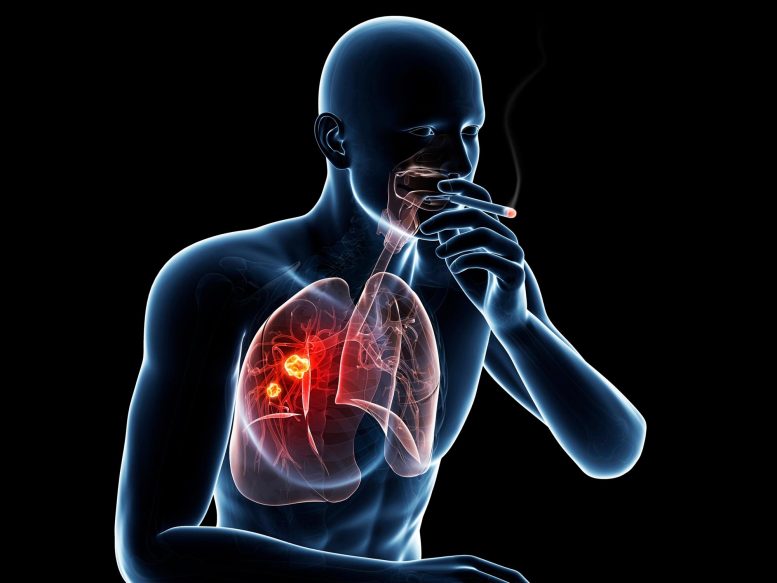
A new study suggests that some heavy smokers may be naturally protected from lung cancer due to efficient DNA repair mechanisms that limit mutations.
Cigarette smoking is overwhelmingly the main cause of lung cancer, yet only a minority of smokers develop the disease. A study led by scientists at Albert Einstein College of Medicine and published online on April 11, 2022, in Nature Genetics suggests that some smokers may have robust mechanisms that protect them from lung cancer by limiting mutations. The findings could help identify those smokers who face an increased risk for the disease and therefore warrant especially close monitoring.
“This may prove to be an important step toward the prevention and early detection of lung cancer risk and away from the current herculean efforts needed to battle late-stage disease, where the majority of health expenditures and misery occur,” said Simon Spivack, M.D., M.P.H., a co-senior author of the study, professor of medicine, of epidemiology & population health, and of genetics at Einstein, and a pulmonologist at Montefiore Health System.
Overcoming Obstacles to Study Cell Mutations
It’s long been assumed that smoking leads to lung cancer by triggering DNA mutations in normal lung cells. “But that could never be proven until our study, since there was no way to accurately quantify mutations in normal cells,” said Jan Vijg, Ph.D., a study co-senior author and professor and chair of genetics, professor of ophthalmology and visual sciences, and the Lola and Saul Kramer Chair in Molecular Genetics at Einstein (also at the Center for Single-Cell Omics, Jiaotong University School of Medicine in Shanghai, China). Dr. Vijg overcame that obstacle a few years ago by developing an improved method for sequencing the entire genomes of individual cells.
Single-cell whole-genome sequencing methods can introduce sequencing errors that are hard to distinguish from true mutations—a serious flaw when analyzing cells containing rare and random mutations. Dr. Vijg solved this problem by developing a new sequencing technique called single-cell multiple displacement amplification (SCMDA). As reported in Nature Methods in 2017, this method accounts for and reduces sequencing errors.
The Einstein researchers used SCMDA to compare the mutational landscape of normal lung epithelial cells (i.e., cells lining the lung) from two types of people: 14 never-smokers, ages 11 to 86; and 19 smokers, ages 44 to 81, who had smoked a maximum of 116 pack years. (One pack year of smoking equals 1 pack of cigarettes smoked per day for one year.) The cells were collected from patients who were undergoing bronchoscopy for diagnostic tests unrelated to cancer. “These lung cells survive for years, even decades, and thus can accumulate mutations with both age and smoking,” said Dr. Spivack. “Of all the lung’s cell types, these are among the most likely to become cancerous.”

Mutations Caused by Smoking
The researchers found that mutations (single-nucleotide variants and small insertions and deletions) accumulated in the lung cells of non-smokers as they age—and that significantly more mutations were found in the lung cells of the smokers. “This experimentally confirms that smoking increases lung cancer risk by increasing the frequency of mutations, as previously hypothesized,” said Dr. Spivack. “This is likely one reason why so few non-smokers get lung cancer, while 10% to 20% of lifelong smokers do.”
Another finding from the study: The number of cell mutations detected in lung cells increased in a straight line with the number of pack years of smoking—and, presumably, the risk for lung cancer increased as well. But interestingly, the rise in cell mutations halted after 23 pack years of exposure.
“The heaviest smokers did not have the highest mutation burden,” said Dr. Spivack. “Our data suggest that these individuals may have survived for so long in spite of their heavy smoking because they managed to suppress further mutation accumulation. This leveling off of mutations could stem from these people having very proficient systems for repairing DNA damage or detoxifying cigarette smoke.”
The finding has led to a new research direction. “We now wish to develop new assays that can measure someone’s capacity for DNA repair or detoxification, which could offer a new way to assess one’s risk for lung cancer,” said Dr. Vijg.
Reference: “Single-cell analysis of somatic mutations in human bronchial epithelial cells in relation to aging and smoking” by Zhenqiu Huang, Shixiang Sun, Moonsook Lee, Alexander Y. Maslov, Miao Shi, Spencer Waldman, Ava Marsh, Taha Siddiqui, Xiao Dong, Yakov Peter, Ali Sadoughi, Chirag Shah, Kenny Ye, Simon D. Spivack and Jan Vijg, 11 April 2022, Nature Genetics.
DOI: 10.1038/s41588-022-01035-w
The study is titled, “Single-cell analysis of somatic mutations in human bronchial epithelial cells in relation to aging and smoking.” Additional Einstein authors include: Zhenqiu Huang, Ph.D., Shixiang Sun, Ph.D., Moonsook Lee, M.S., Yakov Peter, Ph.D., Ali Sadoughi, M.D., Chirag Shah, M.D., and Kenny Ye, Ph.D., Miao Shi, Ph.D., Spencer Waldman, B.S., Ava Marsh, B.A., Taha Siddiqui, M.B.B.S., Alexander Y. Maslov, M.D., Ph.D. (also at Voronezh State University of Engineering Technology, Voronezh, Russia), and Xiao Dong, Ph.D. (also at University of Minnesota, Minneapolis MN).
This study was supported by grants from the National Institutes of Health (U01 ES029519-01, U01HL145560, AG017242, and AG056278).
Never miss a breakthrough: Join the SciTechDaily newsletter.
Follow us on Google and Google News.
9 Comments
This makes so much sense to me, as everyone who has died of lung cancer I know we’re non smokers.
What proof do you have that the cigarettes companies paid from the publication of this article
Good, this is something to hope for…
Well, well… I find it (incredible) that people just never think Humans are the ONLY lifeform that smokes! And that has been here since we invented fire! Any deep selective disadvantage to inhaling smoke was weeded out (…) by selection long ago. Maybe we now have to weed out the people who adulterate smoking herbs.
My lungs were destroyed by COVID 19 I had smoked but quit 2 years before I came down with covid, they said my lungs were crystalized by COVID . Well my doctors were all surprised when all of a sudden my lungs started working and they said it was impossible but here I was my lungs were working with no medical reason it was truly a miracle. They couldn’t find any other reason for them to work they told me I should look for a lung transplant. I know God gave me new lungs and they had to admit some how they were working with no explanation for my lungs to be working. I can only praise God for his healing touch.
Most smokers DO GET cancer.
This is paid article by cigarettes maker companies.
Smoking is good for your health, i knew it!
It would make sense if the body naturally became immune to or built up a heavy tolerance to something which would essentially kill it, had it no defense system. A key piece I didn’t see here was the way carbon monoxide, the smoke from cigarettes, interacts with the human body inside and outside. This article disproves the theory that cancer is biological. It would appear it is circumstancial and environmental.
Ask Google what percentage of lung cancer patients are smokers.
Assuming people will just believe whatever text is placed before them in this information age is the oddest hill to die on. Especially for anyone who can read and write.