
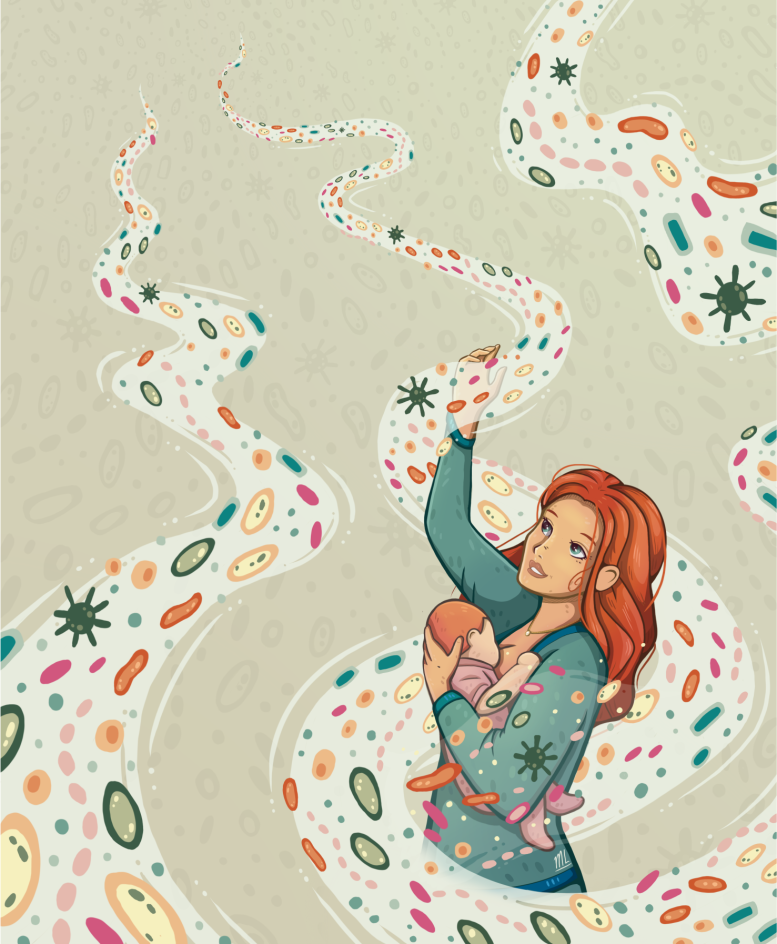
Breastfeeding compensates for cesarean-born babies’ reduced microbial transfer, ensuring essential microbiome development.
Is it true that cesarean-born babies lack crucial microbes? Recent evidence indicates that the answer is “no.”
In a report published in the journal Cell Host & Microbe, researchers have revealed that mothers can transfer microbes to their infants through other compensatory methods. Despite receiving less of their mother’s gut microbiome during birth, babies born via cesarean section can make up for this deficit by consuming their mother’s microbes through breastfeeding.
While microbiome research has primarily centered on the gut, our bodies harbor beneficial microbial communities in other regions, including our respiratory tracts and skin. This study offers insights into how babies, previously believed to be sterile before birth, acquire vital microbes for their various microbiomes.
“We wanted to have a better idea of how the infant microbiome develops in different parts of their bodies and how it’s influenced by factors such as birth mode, antibiotic use, and lack of breastfeeding,” says senior author Wouter de Steenhuijsen Piters, a physician and data scientist at the University Medical Center Utrecht in the Netherlands.
To understand how the microbiome develops during the first month of life, the team recruited and repeatedly sampled 120 Dutch mothers and soon-to-be-born babies. From the babies, they collected skin, nose, saliva, and gut microbiome samples two hours after they were born and when they were one day old, one week old, two weeks old, and one month old.
The team also collected six different types of microbiome samples from the mothers—skin, breastmilk, nose, throat, fecal, and vaginal—to determine which of these sources were “seeding” the babies’ various microbiomes. Then, they analyzed these results in the context of several factors that are thought to impact microbiome transfer, including mode of delivery, antibiotic use, and breastfeeding.
Compensation Mechanisms in Microbiome Development
“We saw that many niches of the mother are important for the transmission of microbes, and if some of these pathways are blocked for one reason or another—in this case, we saw that happening with the cesarean section—then these microbes can still reach the infant through other paths,” says de Steenhuijsen Piters.
Regardless of birth route, the researchers found that approximately 58.5% of a baby’s microbiome is derived from its mother. However, different maternal microbial communities contributed to different infant microbiomes. Cesarean-born babies received fewer microbes from their mother’s vaginal and fecal microbiomes, but—seemingly in compensation—acquired more microbes from breastmilk.
“Microbiome transfer and development are so important that evolution has ensured that those microbes are transferred one or another way from mother to child,” says first author Debby Bogaert, a physician-scientist at the University of Edinburgh. “Breastfeeding becomes even more important for children born by cesarean section who do not receive gut and vaginal microbes from their mom.”
“It’s a smart system, and it makes sense from an evolutionary perspective that these types of pathways are redundant to ensure that the child can begin life with the appropriate ‘starter kit,’” says de Steenhuijsen Piters.
Exploring Non-Maternal Microbiome Contributions
Now, the team wants to know more about non-maternal influences on infant microbiome development. “We could see that the maternal microbiome explains almost 60% of the infant’s total microbiome, but there’s still 40% that we don’t know about,” says de Steenhuijsen Piters. “It would be interesting to stratify that unknown fraction to see where all the microbes come from; whether fathers contribute, for example, or siblings, or the environment.”
Ultimately, the researchers want to understand how microbiome development in infants relates to long-term health. “Next, we want to explore whether this early life process, influenced by mom, is affecting not only short-term infection risk in the first year of life but also longer-term health in terms of things like allergies and asthma,” says Bogaert. “In the future, we might be able to utilize this knowledge to help prevent, diagnose, or treat health problems.”
Reference: “Mother-to-infant microbiota transmission and infant microbiota development across multiple body sites” by Debby Bogaert, Gina J. van Beveren, Emma M. de Koff, Paula Lusarreta Parga, Carlos E. Balcazar Lopez, Lilian Koppensteiner, Melanie Clerc, Raiza Hasrat, Kayleigh Arp, Mei Ling J.N. Chu, Pieter C.M. de Groot, Elisabeth A.M. Sanders, Marlies A. van Houten and Wouter A.A. de Steenhuijsen Piters, 8 March 2023, Cell Host & Microbe.
DOI: 10.1016/j.chom.2023.01.018
The study was funded by the Netherlands Organisation for Scientific Research and the Chief Scientist Office.
Never miss a breakthrough: Join the SciTechDaily newsletter.
Follow us on Google and Google News.