
Close Menu
    Facebook X (Twitter) Instagram
    SciTechDaily
    • Biology
    • Chemistry
    • Earth
    • Health
    • Physics
    • Science
    • Space
    • Technology
    Facebook X (Twitter) Pinterest YouTube RSS
    SciTechDaily
    Home»Health»Doctors Complete Hip Surgery with 3D Printed Implant and Bone Stem Cell Graft
    Health

    Doctors Complete Hip Surgery with 3D Printed Implant and Bone Stem Cell Graft

    By University of SouthamptonMay 19, 2014No Comments3 Mins Read
    Facebook Twitter Pinterest Telegram LinkedIn WhatsApp Email Reddit
    Share
    Facebook Twitter LinkedIn Pinterest Telegram Email Reddit
    Doctors Complete Hip Surgery with 3D Printed Implant and Bone Stem Cell Graft
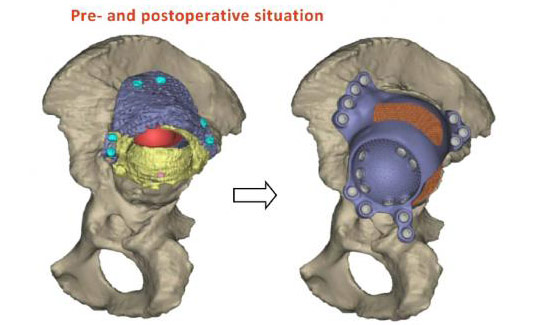
    The purple area is the 3D-printed implant and the orange is the stem cell graft. Credit: University of Southampton

    A team of researchers from the University of Southampton have completed their first hip surgery with a 3D-printed implant and bone stem cell graft.

    Doctors and scientists in Southampton have completed their first hip surgery with a 3D-printed implant and bone stem cell graft.

    The 3D printed hip, made from titanium, was designed using the patient’s CT scan and CAD CAM (computer-aided design and computer-aided manufacturing) technology, meaning it was designed to the patient’s exact specifications and measurements.

    The implant will provide a new socket for the ball of the femur bone to enter. Behind the implant and between the pelvis, doctors have inserted a graft containing bone stem cells.

    The graft acts as a filler for the loss of bone. The patient’s own bone marrow cells have been added to the graft to provide a source of bone stem cells to encourage bone regeneration behind and around the implant.

    Southampton doctors believe this is a game changer. Douglas Dunlop, Consultant Orthopaedic Surgeon, conducted the operation at Southampton General Hospital. He says: “The benefits to the patient through this pioneering procedure are numerous. The titanium used to make the hip is more durable and has been printed to match the patient’s exact measurements – this should improve fit and could reduce the risk of having to have another surgery.

    “The bone graft material that has been used has excellent biocompatibility and strength and will fill the defect behind the bone well, fusing it all together.”

    Over the past decade Mr Dunlop and Professor Richard Oreffo, at the University of Southampton, have developed a translational research program to drive bone formation using patient skeletal stem cells in orthopedics.

    The graft used in this operation is made up of a bone scaffold that allows blood to flow through it. Stem cells from the bone marrow will attach to the material and grow new bone. This will support the 3D-printed hip implant.

    Professor Oreffo comments: “The 3D printing of the implant in titanium, from CT scans of the patient and stem cell graft is cutting edge and offers the possibility of improved outcomes for patients.

    “Fractures and bone loss due to trauma or disease are a significant clinical and socioeconomic problem. Growing bone at the point of injury alongside a hip implant that has been designed to the exact fit of the patient is exciting and offers real opportunities for improved recovery and quality of life.”

    For the patient, Meryl Richards, from Hampshire, the procedure means an end to her hip troubles. In 1977 she was involved in a traffic accident and since then has had to have six operations to mend her hip.

    She says: “The way medicine has evolved is fantastic. I hope that this will be the last time that I have to have a hip operation. I feel excited to have this pioneering surgery and I can see what a benefit it will have to me.”


    Never miss a breakthrough: Join the SciTechDaily newsletter.
    Follow us on Google and Google News.

    3d Orthopedic Research University of Southampton
    Share. Facebook Twitter Pinterest LinkedIn Email Reddit

    Related Articles

    Landmark Study Finds Alternative Autism Therapies Lack Scientific Proof

    Scientists Discover New Long-Term Benefits of Taking Vitamin D During Pregnancy

    British Researchers Have Discovered Depression “Hot Spots”: Do You Live in One?

    New Research Suggests That Surgeons Should Rethink a Common Practice

    Python Power: New Bio-Inspired Device Doubles Strength of Rotator Cuff Repairs

    Researchers Identify Potential Target for Treating Inner-Ear Bone Erosion

    Breaking the Cycle: A New Approach To Sleep and Mental Health

    ACL Surgery Delays: Risky for Children, Safer for Adults, Johns Hopkins Study Reveals

    Back Pain Breakthrough: Existing Drug That Kills Off Sleeping Bone Cells Could Provide Relief

    Leave A Reply Cancel Reply

    • Facebook
    • Twitter
    • Pinterest
    • YouTube

    Don't Miss a Discovery

    Subscribe for the Latest in Science & Tech!

    Trending News

    1.4-Million-Year-Old Footprints Reveal a Giant Human Relative

    Astronomers May Have Found the First Moon Beyond Our Solar System

    Underwater Cameras Expose the Secret Lives of Whale Sharks

    Why Dreaming Leaves the Brain Running Low on Energy

    CERN Experiments Detect Signs of the Universe’s Primordial Matter

    Study Finds a Surprising Link Between Gut Microbes and Aging

    Frequent Cannabis Users Wake Up With More “Stress Hormone”

    Scientists Reveal Hidden DNA Traces in the Shroud of Turin

    Follow SciTechDaily
    • Facebook
    • Twitter
    • YouTube
    • Pinterest
    • Newsletter
    • RSS
    SciTech News
    • Biology News
    • Chemistry News
    • Earth News
    • Health News
    • Physics News
    • Science News
    • Space News
    • Technology News
    Recent Posts
    • Spain’s Largest Wildfire on Record Burned an Area the Size of New York City
    • Meet the 30-Million-Year-Old Dog That Climbed Trees Instead of Chasing Sticks
    • Two Mysterious ‘Ghost’ Ancestors Are Hiding in Our DNA
    • Gut Bacteria May Leave a Lasting “Protective Memory” in the Intestine
    • New Antivenom Strategy Is 10 Times More Potent Than a Current Treatment
    Copyright © 1998 - 2026 SciTechDaily. All Rights Reserved.
    • Science News
    • About
    • Contact
    • Editorial Board
    • Privacy Policy
    • Terms of Use

    Type above and press Enter to search. Press Esc to cancel.