
Close Menu
    Facebook X (Twitter) Instagram
    SciTechDaily
    • Biology
    • Chemistry
    • Earth
    • Health
    • Physics
    • Science
    • Space
    • Technology
    Facebook X (Twitter) Pinterest YouTube RSS
    SciTechDaily
    Home»Space»Hubble Views Auroral Lights at Saturn’s North Pole
    Space

    Hubble Views Auroral Lights at Saturn’s North Pole

    By Hubble Space TelescopeMay 19, 20141 Comment3 Mins Read
    Facebook Twitter Pinterest Telegram LinkedIn WhatsApp Email Reddit
    Share
    Facebook Twitter LinkedIn Pinterest Telegram Email Reddit
    New Images of the Dancing Auroral Lights at Saturns North Pole
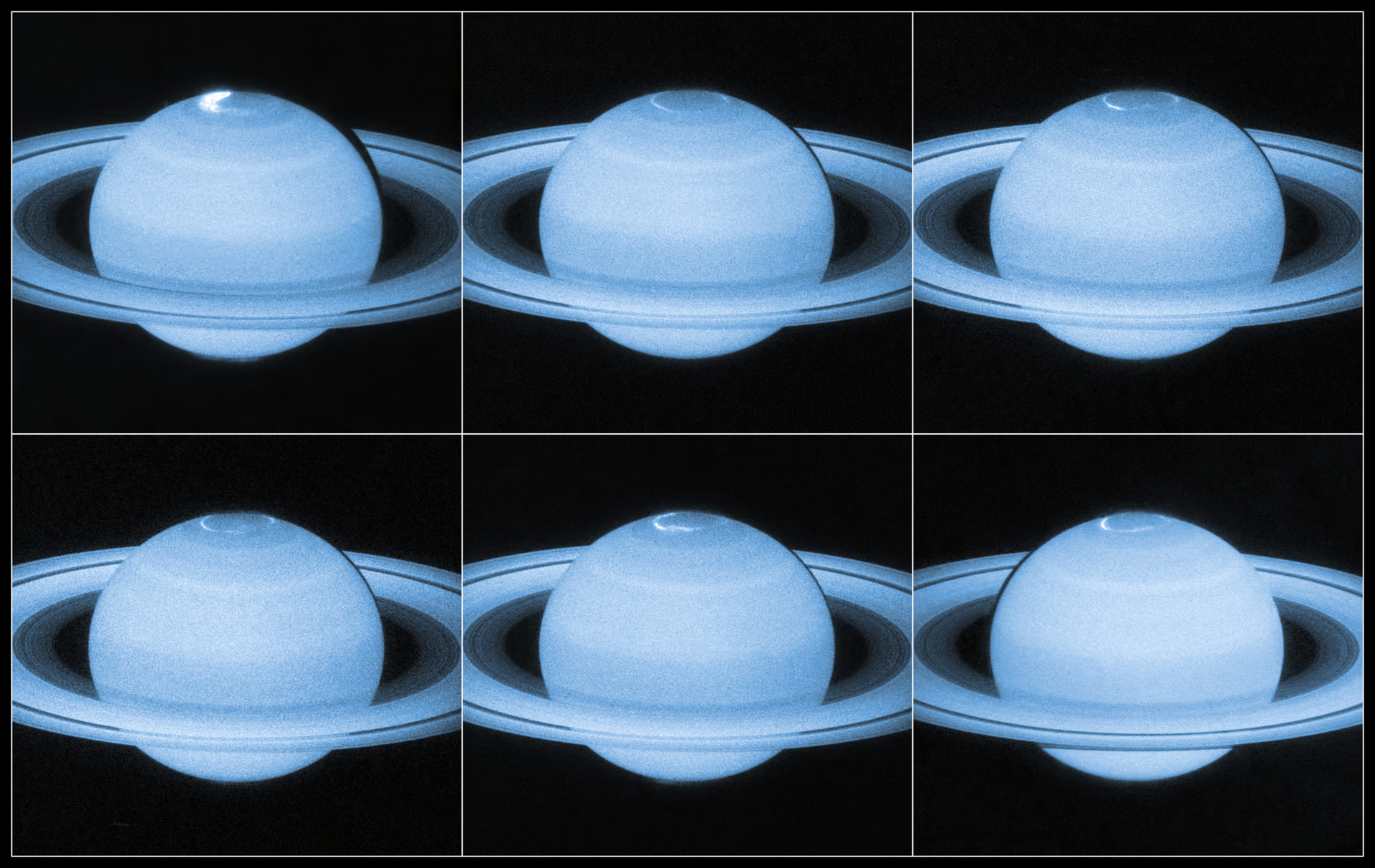
    Astronomers using the Hubble Space Telescope have captured new images of Saturn’s auroral lights at the north pole. These images, taken from Earth’s orbit, reveal previously unseen dynamics in Saturn’s aurorae, shedding light on the mystery of their changing patterns. The images show moments when Saturn’s magnetic field is influenced by solar particles, adding new insight to this phenomenon. Credit: NASA, ESA; Acknowledgement: J. Nichols (University of Leicester)

    New images taken by Hubble’s super-sensitive Advanced Camera for Surveys provide a detailed look at Saturn’s stormy aurorae, revealing previously unseen dynamics in the choreography of the auroral glow.

    Astronomers using the NASA/ESA Hubble Space Telescope have captured new images of the dancing auroral lights at Saturn’s north pole. Taken from Hubble’s perspective in orbit around the Earth, these images provide a detailed look at Saturn’s stormy aurorae — revealing previously unseen dynamics in the choreography of the auroral glow.

    The cause of the changing patterns in Saturn’s aurorae is an ongoing mystery in planetary science. These ultraviolet images, taken by Hubble’s super-sensitive Advanced Camera for Surveys, add new insight by capturing moments when Saturn’s magnetic field is affected by bursts of particles streaming out from the Sun.

    Saturn has a long, comet-like magnetic tail known as a magnetotail — as do Mercury, Jupiter, Uranus, Neptune, and Earth [1]. This magnetotail is present around planets that have a magnetic field, caused by a rotating core of magnetic elements. It appears that when bursts of particles from the Sun hit Saturn, the planet’s magnetotail collapses and later reconfigures itself, an event that is reflected in the dynamics of its aurorae.

    Some of the bursts of light seen shooting around Saturn’s polar regions traveled at over three times faster than the speed of the gas giant’s rotation!

    The new images also formed part of a joint observing campaign between Hubble and NASA’s Cassini spacecraft, which is currently in orbit around Saturn itself. Between them, the two spacecraft managed to capture a 360-degree view of the planet’s aurorae at both the north and south poles. Cassini also used optical imaging to delve into the rainbow of colors seen in Saturn’s light shows. On Earth, we see green curtains of light with flaming scarlet tops. Cassini’s imaging cameras reveal similar auroral veils on Saturn, that are red at the bottom and violet at the top.

    Notes

    [1] A magnetosphere is the area of space around an astronomical object in which charged particles are controlled by that object’s magnetic field. The magnetosphere is compressed on the side of the sun, and on the other side it extends far beyond the object. It is this extended region of the magnetosphere that is known as the magnetotail.


    Never miss a breakthrough: Join the SciTechDaily newsletter.
    Follow us on Google and Google News.

    Astronomy Hubble Space Telescope NASA Planetary Science Saturn
    Share. Facebook Twitter Pinterest LinkedIn Email Reddit

    Related Articles

    A Tale of Four Worlds: Hubble’s Ten-Year Hunt for Secrets in the Outer Solar System

    Massive Saturn Storm Churns Up Water Ice from Great Depths

    Hubble Data Reveals a New Neptune Moon

    Hubble Reveals Actual Visible-Light Color of Exoplanet HD 189733b

    Cassini Views a Spinning Vortex at Saturn’s North Pole

    Cassini Observes Meteors Colliding With Saturn’s Rings

    Storm Spawns the Largest Tropospheric Vortex Ever Seen on Saturn

    Asteroid Belts and Their Potential Significance for Life

    New Study Revives Doubted Exoplanet Fomalhaut b

    1 Comment

    1. Madanagopal.V.C. on May 20, 2014 4:42 am

      It is surprising to note the strength of solar particles at such a great distance as that of Saturn’s Poles, to give a grand spectacle of Auroral Displays as we find on Earth’s Poles. But… we know that the magnetic field of Saturn is many thousand times higher than our tiny Earth, so that the solar particles are grabbed by Saturn on its Poles to enact the spectacle. Thank You.

      Reply
    Leave A Reply Cancel Reply

    • Facebook
    • Twitter
    • Pinterest
    • YouTube

    Don't Miss a Discovery

    Subscribe for the Latest in Science & Tech!

    Trending News

    Bone-Strengthening Discovery Could Reverse Osteoporosis

    Scientists Uncover Hidden Trigger Behind Stem Cell Aging

    Scientists Find Way to Reverse Fatty Liver Disease Without Changing Diet

    Could Humans Regrow Limbs? New Study Reveals Promising Genetic Pathway

    Scientists Reveal Eating Fruits and Vegetables May Increase Your Risk of Lung Cancer

    Scientists Reverse Brain Aging With Simple Nasal Spray

    Scientists Uncover Potential Brain Risks of Popular Fish Oil Supplements

    Scientists Discover a Surprising Way To Make Bread Healthier and More Nutritious

    Follow SciTechDaily
    • Facebook
    • Twitter
    • YouTube
    • Pinterest
    • Newsletter
    • RSS
    SciTech News
    • Biology News
    • Chemistry News
    • Earth News
    • Health News
    • Physics News
    • Science News
    • Space News
    • Technology News
    Recent Posts
    • The Neanderthal “Love Story” Isn’t What It Seems
    • Scientists Unlock Hidden Secrets of 2,300-Year-Old Mummies Using Cutting-Edge CT Scanner
    • Men vs. Women: Scientists Uncover Dramatic Differences in How the Immune System Ages
    • Eating Chili Peppers Linked to Longer Life
    • Bread Might Be Making You Gain Weight Even Without Eating More
    Copyright © 1998 - 2026 SciTechDaily. All Rights Reserved.
    • Science News
    • About
    • Contact
    • Editorial Board
    • Privacy Policy
    • Terms of Use

    Type above and press Enter to search. Press Esc to cancel.