
Study confirms evolutionary link between social structure and selfishness.
One of nature’s most prolific cannibals could be hiding in your pantry, and biologists have used it to show how social structure affects the evolution of selfish behavior.
Researchers revealed that less selfish behavior evolved under living conditions that forced individuals to interact more frequently with siblings. While the finding was verified with insect experiments, Rice University biologist Volker Rudolf said the evolutionary principle could be applied to study any species, including humans.
In a study published in the journal Ecology Letters, Rudolf, longtime collaborator Mike Boots of the University of California, Berkeley, and colleagues showed they could drive the evolution of cannibalism in Indian meal moth caterpillars with simple changes to their habitats.
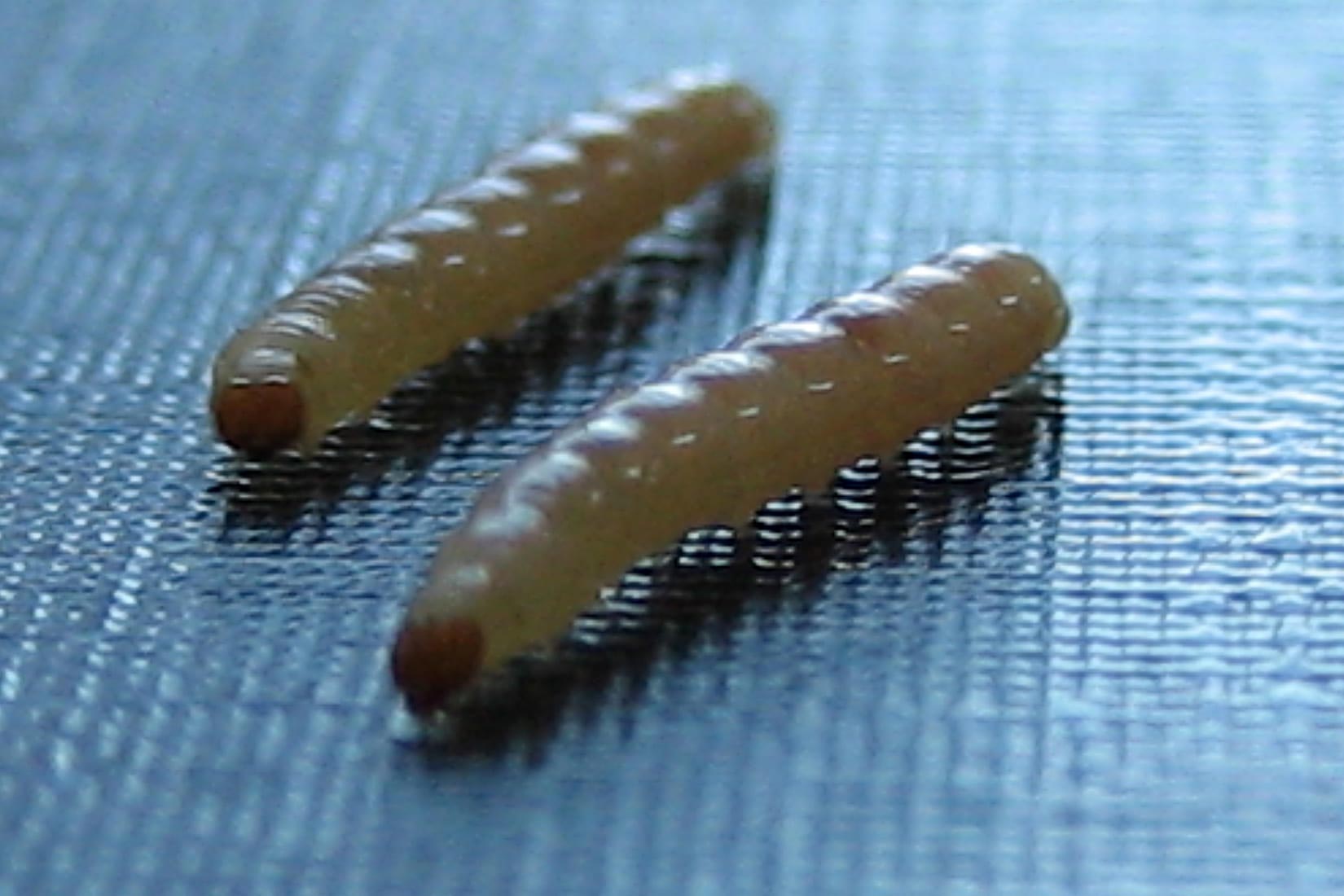
Also known as weevil moths and pantry moths, Indian meal moths are common pantry pests that lay eggs in cereals, flour, and other packaged foods. As larvae, they’re vegetarian caterpillars with one exception: They sometimes eat one another, including their own broodmates.
In laboratory tests, researchers showed they could predictably increase or decrease rates of cannibalism in Indian meal moths by decreasing how far individuals could roam from one another, and thus increasing the likelihood of “local” interactions between sibling larvae. In habitats where caterpillars were forced to interact more often with siblings, less selfish behavior evolved within 10 generations.
Rudolf, a professor of biosciences at Rice, said increased local interactions stack the deck against the evolution of selfish behaviors like cannibalism.
The Spectrum of Selfishness: From Altruism to Cannibalism
To understand why, he suggests imagining behaviors can be sorted from least to most selfish.
“At one end of the continuum are altruistic behaviors, where an individual may be giving up its chance to survive or reproduce to increase reproduction of others,” he said. “Cannibalism is at the other extreme. An individual increases its own survival and reproduction by literally consuming its own kind.”
Rudolf said the study provided a rare experimental test of a key concept in evolutionary theory: As local interactions increase, so does selective pressure against selfish behaviors. That’s the essence of a 2010 theoretical prediction by Rudolf and Boots, the corresponding author of the meal moth study, and Rudolf said the study’s findings upheld the prediction.
“Families that were highly cannibalistic just didn’t do as well in that system,” he said. “Families that were less cannibalistic had much less mortality and produced more offspring.”
In the meal moth experiments, Rudolf said it was fairly easy to ensure that meal moth behavior was influenced by local interactions.
“They live in their food,” he said. “So we varied how sticky it was.”
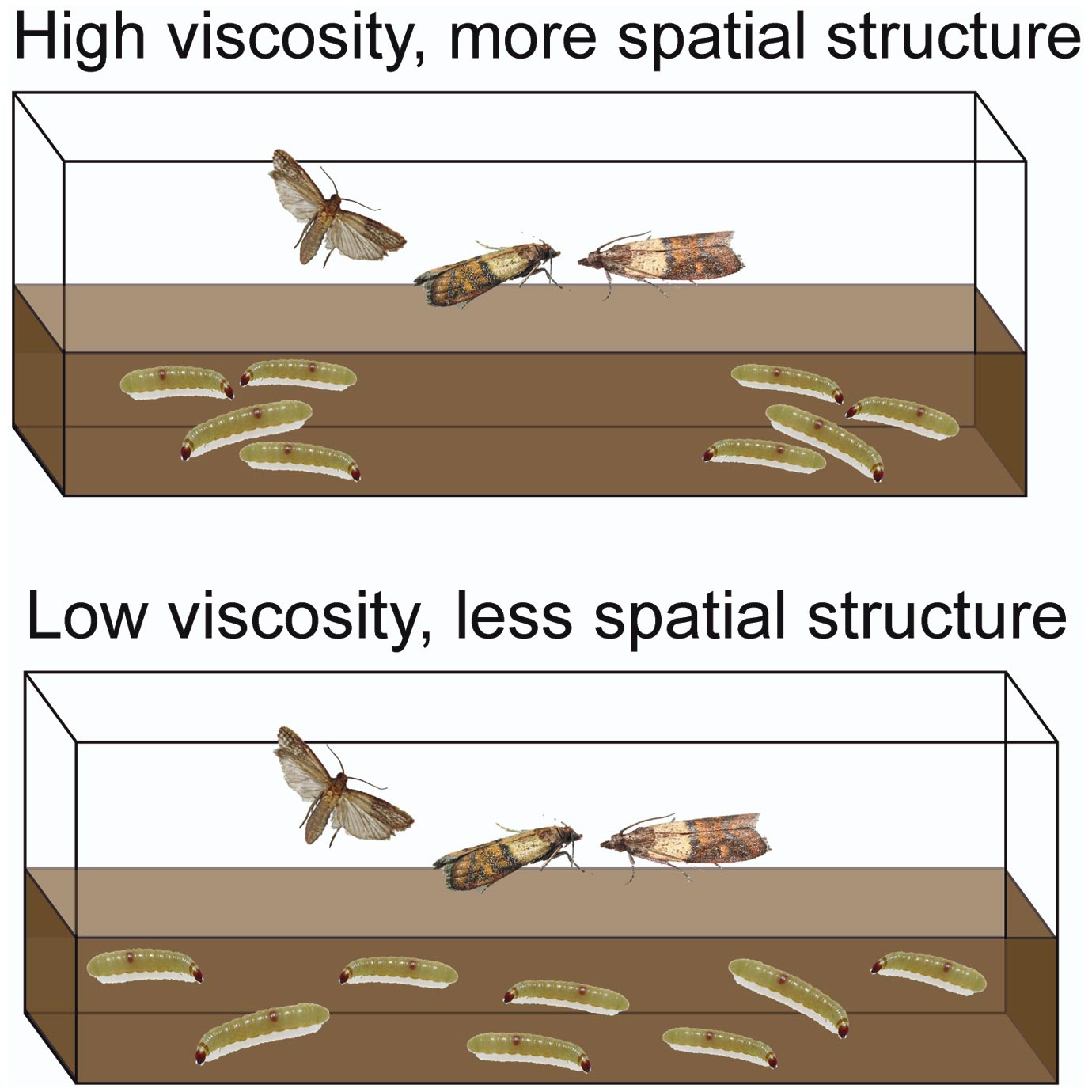
Fifteen adult females were placed in several enclosures to lay eggs. The moths lay eggs in food, and larval caterpillars eat and live inside the food until they pupate. Food was plentiful in all enclosures, but it varied in stickiness.
“Because they’re laying eggs in clusters, they’re more likely to stay in these little family groups in the stickier foods that limit how fast they can move,” Rudolf said. “It forced more local interactions, which, in our system, meant more interactions with siblings. That’s really what we think was driving this change in cannibalism.”
Rudolf said the same evolutionary principle might also be applied to the study of human behavior.
“In societies or cultures that live in big family groups among close relatives, for example, you might expect to see less selfish behavior, on average, than in societies or cultures where people are more isolated from their families and more likely to be surrounded by strangers because they have to move often for jobs or other reasons,” he said.
Cannibalism: Natural, Common, and Misunderstood
Rudolf has studied the ecological and evolutionary impacts of cannibalism for nearly 20 years. He finds it fascinating, partly because it was misunderstood and understudied for decades. Generations of biologists had such a strong aversion to human cannibalism that they wrote off the behavior in all species as a “freak of nature,” he said.
That finally began to change slowly a few decades ago, and cannibalism has now been documented in well over 1,000 species and is believed to occur in many more.
“It’s everywhere. Most animals that eat other animals are cannibalistic to some extent, and even those that don’t normally eat other animals — like the Indian meal moth — are often cannibalistic,” Rudolf said. “There’s no morality attached to it. That’s just a human perspective. In nature, cannibalism is just getting another meal.”
But cannibalism “has important ecological consequences,” Rudolf said. “It determines dynamics of populations and communities, species coexistence, and even entire ecosystems. It’s definitely understudied for its importance.”
He said the experimental follow-up to his and Boots’ 2010 theory paper came about almost by chance. Rudolf saw an epidemiological study Boots published a few years later and realized the same experimental setup could be used to test their prediction.
Pushing and Pulling Evolution: When Selfishness Makes Sense
While the moth study showed that “limiting dispersal,” and thus increasing local interactions, can push against the evolution of cannibalism by increasing the cost of extreme selfishness, Rudolf said the evolutionary push can probably go the other way as well. “If food conditions are poor, cannibalism provides additional benefits, which could push for more selfish behavior.”
He said it’s also possible that a third factor, kin recognition, could also provide an evolutionary push.
“If you’re really good at recognizing kin, that limits the cost of cannibalism,” he said. “If you recognize kin and avoid eating them, you can afford to be a lot more cannibalistic in a mixed population, which can have evolutionary benefits.”
Rudolf said he plans to explore the three-way interaction between cannibalism, dispersal, and kin recognition in future studies.
“It would be nice to get a better understanding of the driving forces and be able to explain more of the variation that we see,” he said. “Like, why are some species extremely cannibalistic? And even within the same species, why are some populations far more cannibalistic than others. I don’t think it’s going to be one single answer. But are there some basic principles that we can work out and test? Is it super-specific to every system, or are there more general rules?”
Reference: “Experimental evidence that local interactions select against selfish behaviour” by Mike Boots, Dylan Childs, Jessica Crossmore, Hannah Tidbury and Volker Rudolf, 23 March 2021, Ecology Letters.
DOI: 10.1111/ele.13734
Additional co-authors include Dylan Childs and Jessica Crossmore of the University of Sheffield, and Hannah Tidbury of both the University of Sheffield and the Centre for Environment, Fisheries and Aquaculture Science in Weymouth, England.
The research was funded by the National Science Foundation (1256860, 0841686, 2011109) the National Institutes of Health (R01GM122061) and the Natural Environment Research Council (NEJ0097841).
Never miss a breakthrough: Join the SciTechDaily newsletter.
Follow us on Google and Google News.
18 Comments
An important question is “Does life have a purpose or ‘Prime Directive?” If the answer is “Yes,” then it might well be “survival of the species.” Given different circumstances, a different balance between selfishness and selflessness will provide higher survival rates for the species. His work makes sense in that context.
Interesting facts about selfish behavior vs altruistic behavior. I would say that Covid19 gave us important clues about how humans can turn selfish after anxiety and uncertainty in their environment. Another factor is tribalism which is interesting because you must be altruistic within tribe but cannibalistic towards other tribes depending on the relationship of the tribes..
Watch the movie “The Day”…it already showed your predicted outcomes in humans regarding this subject..
I imagine the primer directive of live is to create and grow. The all is an infinite growing thermometer with an energy component and a vibration component. The energy gives the vibration consumes.
Energy
1. Less defined
2. Less limited
3. Less needy
So top of thermometer is “he who is most high” and bottom is he who is parasitic most low.
Vibration
1. More limited
2. More defined
3. More needy
Frequency
And of course the frequency is where a conscious entities sits on the every expanding infinite thermometer of “the all”
Everything is a trinity consisting of a head a tails and the point where they connect.
Everything has an energy frequency and a vibration.
This is what tesla meant when he says that those who truly understand that everything is energy frequency vibration has key to universe.
We are all frequencies of the all God each with its own perspective yet all ONE much like the 30 trillion living and conscious organisms that are what you call your single body are YOU .. this spreads out into ur world and one day you realize that we are ALL one.
The premise is absurd! If cannabalism references survival methods, ok, the premise may be relative at an nominal level but I would not bet the farm on it. If any scientists got a government grants for this bird-brsin concept, I’d say there’s a sucker born every minute. There is no way that you can compare human behavior and meal worm behavior and make over-reaching conclusions. Since when do apple and oranges add up? Seriously, please find a cure for cancer or something. What a joke!
“…the evolution of cannibalism by increasing the cost of extreme selfishness, Rudolf said” Meal worms being “selfish”. Since when are mealworm conscious of their egiic “self”? Please…
Jane, your comments to me are naive and ludicrous. What struck me most in this study was that the results support the hypothesis that selfishness has a significant genetic component…which means jerks cannot be rehabilitated, etc. It might also help explain Republicans.
*egoic
Well, people are what they eat, as they say. I think the study is great work! However, being that we cannot communicate directly with the meal worms, it is difficult to see if they actually have other reasons.
I would imagine that if it came down to humans doing it, and they have, that is would be something seemingly more sinister to the “moral” human mind…like why do people steal things? Because they like it or could use it somehow…can’t that actually be the same for why a person would eat another person? Yes, if there was no food, then it would be a battle everyday to survive, like animals; but with the over abundance of food and people right now. I can’t see anyone would willingly work to buy food, and eating food they don’t like. Sure, there can be benefits but if it doesn’t taste good, well, people usually don’t touch it.
In my opinion, if world pease ever happened, it would be because everyone is eating each other instead of just making more population.
It’s an ass-backwards concept, but so goes the snake eating it’s self…it likes itself. It feels nourished in knowing everything about itself, including all 5 senses.
I have a theory that may cause the end of the world as we know it…the theory of everything, based on art, science and spirituality…this connects to what I have written. ^. .^
So, each idea that we follow through, from thought, to feeling love, then acting out or building, it goes into a trust. In this bank, holds basically, the Akashic records. This bank is here…where we live in the universe. This is why we haven’t found other life on planets…because we are here to find what we like, what sparks us…and then let it destroy us. And the human ego only likes one part of itself…if it knew all of itself, then it would in turn, eat itself. And just keep reincarnating back to this land, the land of eden.
There are those who want to leave and create many many different cultures on other planets. Further dividing people.
Our body is actually made to consume itself already…if we do not eat anything else.
The ego, for many, has lead them to starvation to be skinny…only to go too far a die of literally their bodies eating itself. It may start as ego, but if taken to extreme like this, then it is no longer for beauty. The ego drops away, because it’s not about how looking gets you by. It’s about feeling. Choosing not to kill anything else for a meal, and instead, let everything live on its own terms.
The seasons take time for plants and animals. All different rates.
But when we die, the bottom feeders eat out body and then get eaten by birds…it’s never ending. But if we are ourselves…
Well, what are we?! We are elements. Everything is made of elements to different degree. But the most self-nourishing thing you could choose to eat is yourself. You were made for you.
The rituals of the past, when death comes and people are sent off into the elements of where they came, is actually this exact symbology.
Anyways, if you got this far, cool.
This worm hold of 30 years has gotten me here. Hope you enjoy knowing the secrets of the world/universe.
-600963223-12-21
Posted: May 2nd, 2021 ~1:15PM
Near Peoria, AZ, USA
Titled
“Random Ramblings Of A Craz-E”
Define “selfishness”, and distinguish between speciation and adaptation when you use tje word “evolution”.
If survival of all DNA organisms is looked at (instead of just species), then it seems many causes of death are a byproduct of selfishness in early life. Some of these organisms found ways to out compete in selfish ways since many things that aren’t life will kill as well.
The way the article was titled, I was sure that the man in the picture was a cannibal. Interesting article though.
Selfishness doesn’t require a loss for you to gain.
It seems to me that it is better to see any action that trades potential for immediate consumption as necessary.
But it isn’t selfishness that drives the same actions in humans.
If I spent my life accepting every opportunity presented to me, I would have done so out of selfishness.
It’s reasonable to assume that if I want the best for myself, I will need the best effort from more than myself.
“The rising tide raises all ships”
I can even see a life spent by myself being selfish looking more like sacrifice and service.
I don’t believe that a selfish person can settle for less.
It makes no sense to a selfish person unless it requires work to benefit.
I only care about myself.
So I need to make choices beyond my ability to convince without work and community.
I thought ol’ dude in the photo was a cannibal lol
I can swear I thought that was zuckerberg
Jane you nailed it on the head! This whole article/research needs to be thrown out!! Total waste of money spent on research to try and compare moths to human beings, especially during a PANDEMIC!!!! Selfishness continues to evolve by Overlooking the needs of real people/HUMANS to spend money on b******* such as this!!
“Selfishness” really needs a clear definition. Is wanting to protect what you’ve worked for selfish? Is demanding that one human give the fruits of their labor to another, less efficient, human altruistic? These are questions that need answers now as this is fast becoming the accepted norm and can only be detrimental to the evolutionary success of most species….unless you’re an ant or grub.
Moth mom: Have you seen your brother?
Young larva moth: Nope. *burp*