
Close Menu
    Facebook X (Twitter) Instagram
    SciTechDaily
    • Biology
    • Chemistry
    • Earth
    • Health
    • Physics
    • Science
    • Space
    • Technology
    Facebook X (Twitter) Pinterest YouTube RSS
    SciTechDaily
    Home»Space»Don’t Miss: Partial Lunar Eclipse, Venus, Saturn, and Jupiter – November 2021 Skywatching Tips From NASA
    Space

    Don’t Miss: Partial Lunar Eclipse, Venus, Saturn, and Jupiter – November 2021 Skywatching Tips From NASA

    By NASANovember 6, 20213 Comments4 Mins Read
    Facebook Twitter Pinterest Telegram LinkedIn WhatsApp Email Reddit
    Share
    Facebook Twitter LinkedIn Pinterest Telegram Email Reddit

    What’s Up for November? Sunset planets, a partial lunar eclipse, and the return of the winter stars.

    From November 6th through the 11th, watch the Moon glide past Venus, Saturn, and Jupiter after sunset in the south/southwest. In particular, if you step outside for a look on November 7th, you’ll find the four-day-old crescent Moon just about 2 degrees away from Venus. Should be really pretty, so don’t miss it.
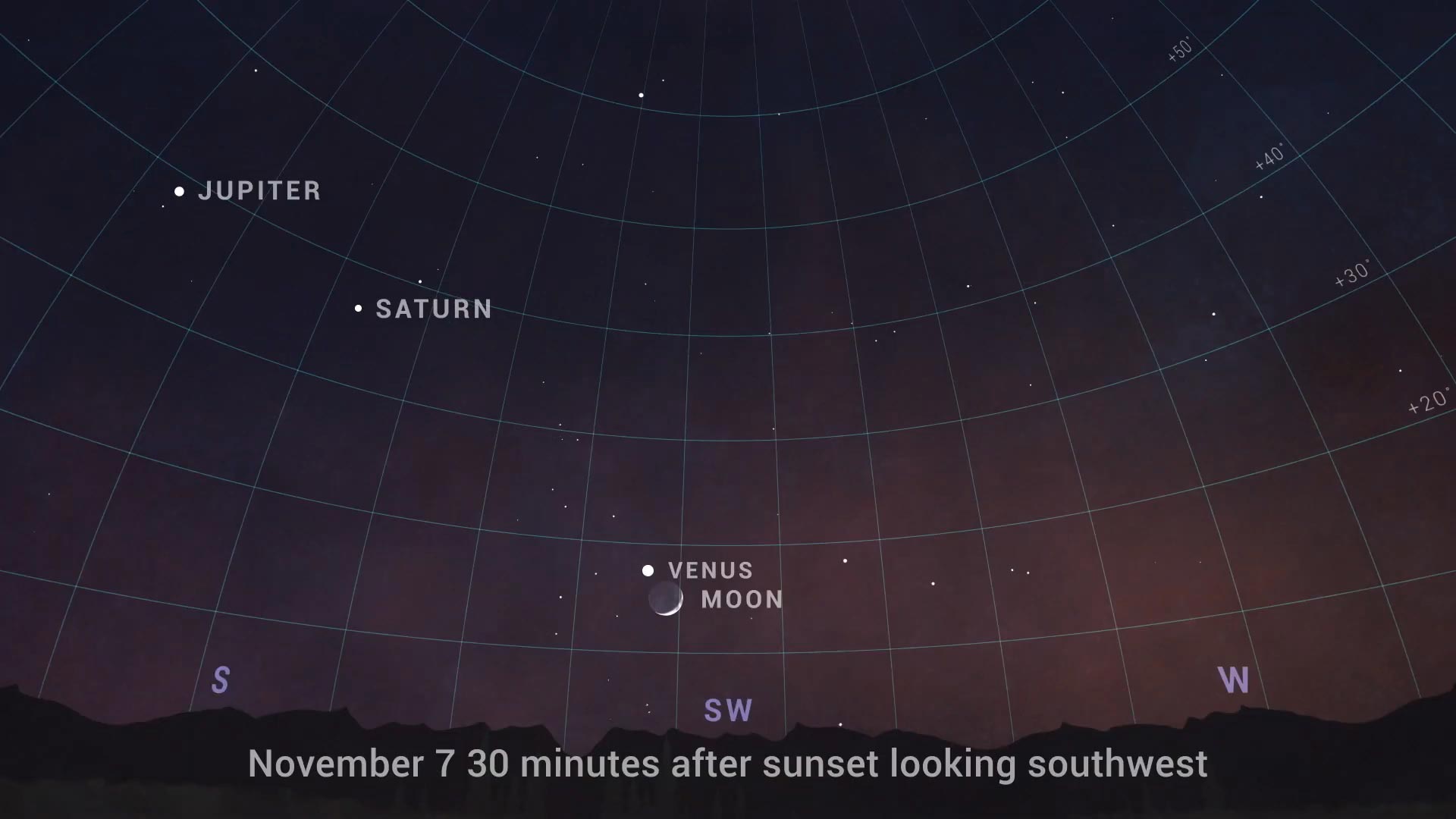
    November 7 Sky Chart
    Sky chart for November 7 following sunset, showing Venus only 2 degrees apart from the crescent Moon in the southwest. Credit: NASA/JPL-Caltech

    And from now through early December, you’ll find Jupiter and Saturn drawing a little closer to Venus each night.

    A partial lunar eclipse is on the way, taking place overnight on November 18th and 19th, when the Moon slips into Earth’s shadow for a couple of hours. Weather permitting, the eclipse will be visible from any location where the Moon appears above the horizon during the eclipse. Depending on your time zone, it’ll occur earlier or later in the evening for you.

    November 2021 Partial Lunar Eclipse Visibility
    Map showing the visibility of the November 18-19 partial lunar eclipse. Darker areas indicate greater visibility. Check local details for visibility near you. Credit: NASA/JPL-Caltech

    Now that’s a huge swath of the planet that’ll be able to see at least part of the eclipse, including North and South America, Eastern Asia, Australia, and the Pacific Region. So check the timing of its visibility for your area.

    For U.S. East Coast observers, the partial eclipse begins a little after 2 a.m., reaching its maximum at 4 in the morning. For observers on the West Coast, that translates to beginning just after 11 p.m., with a maximum at 1 a.m.

    Partial lunar eclipses might not be quite as spectacular as total lunar eclipses – where the Moon is completely covered in Earth’s shadow – but they occur more frequently.

    And that just means more opportunities to witness little changes in our solar system that sometimes occur right before our eyes.

    All month long, if you’re up late and cast your gaze toward the east, you’ll notice some familiar companions have begun rising late in the night. The familiar stars of Northern winter skies are returning, rising late at night and sitting high in the south by dawn.
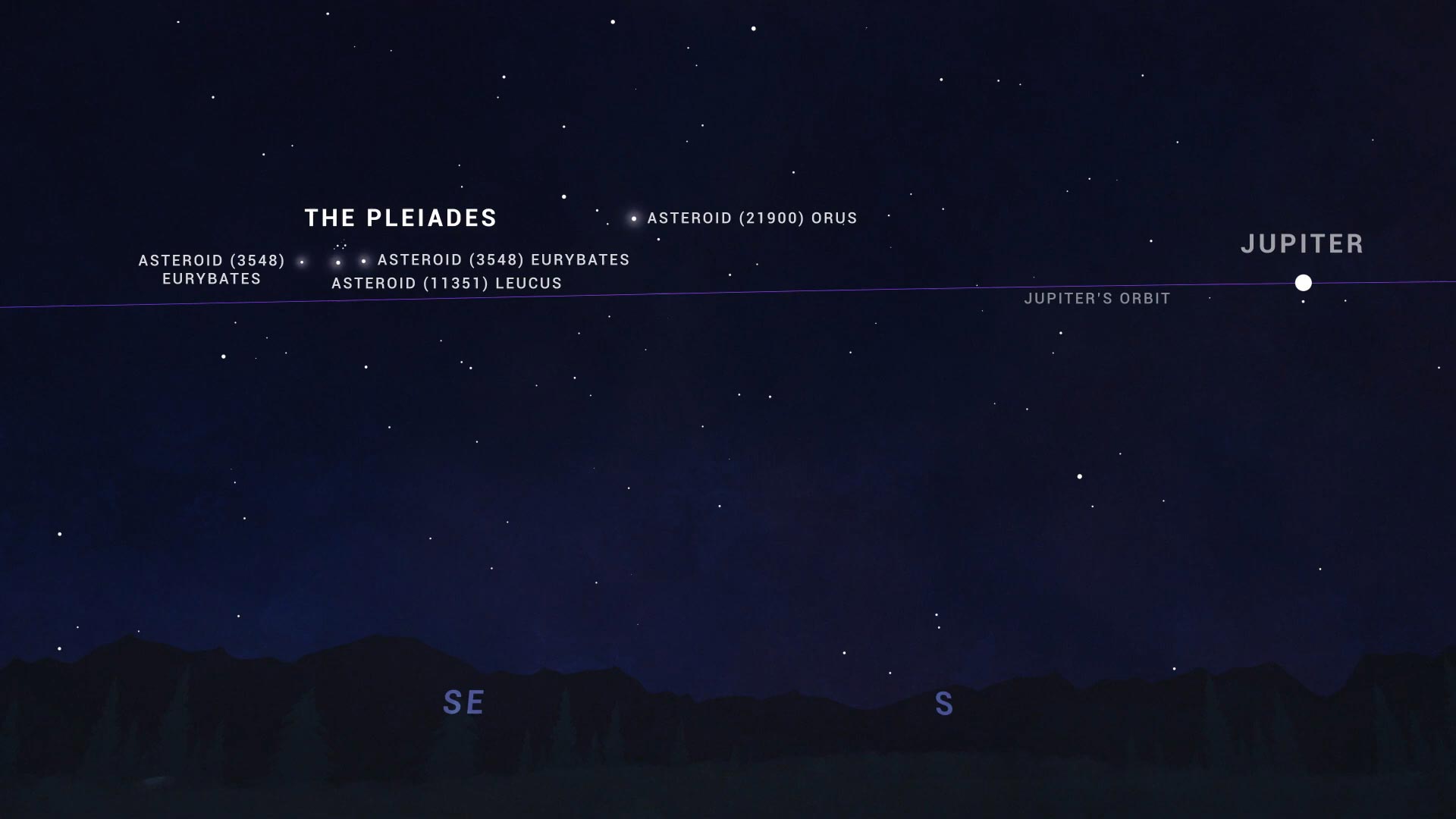
    Trojan Asteroids Sky Chart
    Sky chart showing the locations of several of the Trojan asteroids to be visited by NASA’s recently launched Lucy spacecraft They are too faint to see without a large telescope, but their positions in the sky are near the Pleiades star cluster. Credit: NASA/JPL-Caltech

    You’ll find the Pleiades star cluster leading the constellations Taurus the bull and the hunter Orion, followed by the brightest star in the sky, Sirius – all of them back to keep us company on the long winter nights here in the Northern Hemisphere. (And for those in the Southern Hemisphere, they’re keeping you company on shorter nights as spring gives way to summer there.)

    A fun note about the Pleiades this month is that several of the 8 asteroids to be visited by NASA’s Lucy mission are located in that part of the sky.

    Lucy Spacecraft Launch
    The Lucy spacecraft launches from Space Launch Complex 41, Saturday, October 16, 2021, at Cape Canaveral Space Force Station in Florida. Credit: NASA/Bill Ingalls

    The Lucy spacecraft launched on October 16th on its 12-year mission to visit a bunch of special asteroids called the Trojans. They share the orbit of Jupiter, with a group of them leading the planet, and another group following behind it.

    Lucy will be the first space mission to explore this unique group of asteroids, providing new insights about the formation and early history of our solar system.

    Never miss a breakthrough: Join the SciTechDaily newsletter.
    Follow us on Google and Google News.

    Astronomy JPL NASA Popular
    Share. Facebook Twitter Pinterest LinkedIn Email Reddit

    Related Articles

    Don’t Miss: Total Solar Eclipse, Mars and Saturn Rising, Slim Lunar Crescent, Comet 12P

    Webb’s Ethanol Discovery Fuels Search for Alien Life

    Don’t Miss: Jupiter Plows Through the Pleiades

    NASA’s Next-Gen Exoplanet-Imaging Technology Advances Search for Extraterrestrial Life

    NASA Telescopes Are Unlocking the Secrets Behind Mysterious Deep Space Signals

    Catch the Quadrantid Fireballs: A January Sky Spectacle With Moon and Planet Pairings

    From IRAS to Webb: The Incredible Evolution of NASA’s Infrared Telescopes

    End of an Era: NASA’s NEOWISE 10-Year Mission Ending Due to Solar Activity

    Don’t Miss: Geminid Meteor Shower and Asteroid Vesta

    3 Comments

    1. ROBERT C HABBERSETT on November 8, 2021 10:07 am

      I really enjoyed the animated astronomical depictions – very informative and helpful to my understanding. I would love to see a similar animation that explains why the Pleiades and Orion appear in the winter sky when they do.

      Reply
    2. Lindy P on November 8, 2021 8:32 pm

      I’ve been hearing many rumors of late that the earth is “flat”. What say you and what has NASA been hiding from us all these years. Another rumor I’ve heard is that Neil Armstrong never walked on the moon…I believe Mr. Armstrong himself admitted that. Oh the many tangled webs and possible lies we’ve been led to believe all these years. Hmmmmm
      We shall see won’t we.

      Reply
    3. Rachupalli.saaenaatha reddy on November 9, 2021 8:21 am

      Though so much advances but so far nathing progress of finding track of journey from death to rebirth&how leaving&entering

      Reply
    Leave A Reply Cancel Reply

    • Facebook
    • Twitter
    • Pinterest
    • YouTube

    Don't Miss a Discovery

    Subscribe for the Latest in Science & Tech!

    Trending News

    Mezcal “Worm” in a Bottle Mystery: DNA Testing Reveals a Surprise

    New Research Reveals That Your Morning Coffee Activates an Ancient Longevity Switch

    This Is What Makes You Irresistible to Mosquitoes

    Shockingly Powerful Giant Octopuses Ruled the Seas 100 Million Years Ago

    Scientists Stunned by New Organic Molecules Found on Mars

    Rewriting Dinosaur Evolution: Scientists Unearth Remarkable 150-Million-Year-Old Stegosaur Skull

    Omega-3 Supplements Linked to Cognitive Decline in Surprising New Study

    First-of-Its-Kind Discovery: Homer’s Iliad Found Embedded in a 1,600-Year-Old Egyptian Mummy

    Follow SciTechDaily
    • Facebook
    • Twitter
    • YouTube
    • Pinterest
    • Newsletter
    • RSS
    SciTech News
    • Biology News
    • Chemistry News
    • Earth News
    • Health News
    • Physics News
    • Science News
    • Space News
    • Technology News
    Recent Posts
    • Scientists Map Thousands of Brain Connections With RNA Barcodes
    • This Gene Tweak Turns Strawberries Into Healthier, Tastier Superfruit
    • This New Chip Could Make GPUs Far More Efficient
    • This Tiny World in the Outer Solar System Should Be Airless, but It Has an Atmosphere
    • NASA’s Webb Space Telescope Reveals a Dark Airless Super-Earth That Looks Like Mercury
    Copyright © 1998 - 2026 SciTechDaily. All Rights Reserved.
    • Science News
    • About
    • Contact
    • Editorial Board
    • Privacy Policy
    • Terms of Use

    Type above and press Enter to search. Press Esc to cancel.