
Researchers are divided on the Thwaites Glacier’s stability, with new studies highlighting both its increased vulnerability due to warm tidal currents and its potential resilience against collapse.
As uncertainty looms, radical geoengineering solutions, such as submarine curtains, are being proposed to slow the melt, even as debates intensify about prioritizing emission reductions over technological fixes.
Unveiling New Insights on Thwaites Glacier’s Melting
New research on the Thwaites Glacier, often referred to as the “Doomsday Glacier,” has ignited discussions about using geoengineering to combat climate change. A study[1] published in May by scientists from the University of California Irvine and the University of Waterloo revealed that warming tidal currents are speeding up Thwaites’ melting and causing it to retreat faster than previous models anticipated. In contrast, an August study[2] led by researchers from Dartmouth College and the University of Edinburgh suggests that the glacier might be less prone to collapse and instability than previously believed. Despite these mixed findings, the uncertainty surrounding Thwaites’ future is driving some scientists and engineers to explore controversial methods of environmental intervention to slow its melting.
Assessing Glacier Stability and Predicting Future Changes
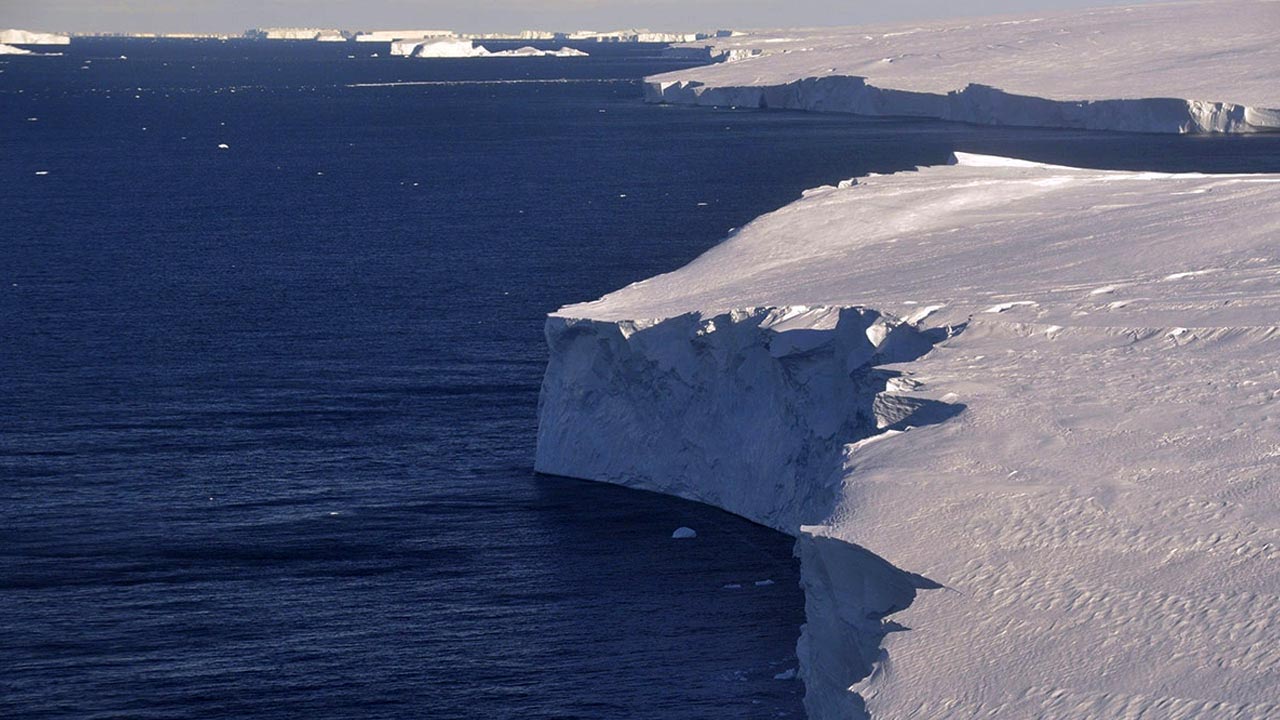
The Thwaites Glacier is one of a line of glaciers sitting along the marine-facing rim of the West Antarctic Ice Sheet (WAIS)—a massive bowl of ice nearly three times the size of Texas sitting in a basin below sea level in Western Antarctica. The only bulwarks that prevent the ocean from filling the basin and melting or dislodging the ice are the glaciers. This situation has led scientists and the media to term the Thwaites—a glacier larger than the entire state of Florida—the “Doomsday Glacier” because its breach would allow warmer ocean waters to melt the WAIS and raise sea levels by nearly 11 feet. This would put many large coastal cities and small island nations at extreme risk.
The Thwaites is retreating rapidly due to climate change, and already accounts for 4% of sea level rise on Earth, losing 50 billion tons of ice each year. Due to the catastrophic sea level rise that would occur, the breaching of the Thwaites and subsequent dislodgement of the WAIS are what’s known as a tipping point in climate science. A tipping point is when crossing a critical threshold—in this case, atmospheric and oceanic warming—leads to large, accelerating, and irreversible changes in the climate system. The melting of the Thwaites Glacier would lead to the collapse of the WAIS which would in turn cause irreversible sea level rise that could endanger millions of people and accelerate warming of other ice.
The study led by UC Irvine and University of Waterloo researchers used high-resolution satellite images and hydrological data to identify areas where warm tidal currents were flowing under the ice and causing faster melt. Understanding the melt rate is critical for predicting sea level rise according to Christine Dow. Dow, an associate professor of glaciology at the University of Waterloo and a co-author of the study, said in an interview with Scientific American, “We were hoping it would take a 100, 500 years to lose that ice. A big concern right now is if it happens much faster than that.”
However, there is some hope for the WAIS. The study by Dartmouth College and University of Edinburgh researchers found that the Thwaites is not as susceptible to a process called marine ice cliff instability (MICI) as previously thought. The MICI hypothesis suggests that tall ice cliffs formed by retreating glaciers are unstable and collapse more easily, but this study showed that thinning of the Thwaites could actually reduce the calving rate and stabilize ice cliffs, highlighting the need for better models when making predictions about the WAIS.
Exploring Geoengineering Solutions for Thwaites Glacier
Faced with uncertainty and the potential of rapid and extreme sea level rise if the Thwaites melts faster than expected, some scientists are turning to glacial geoengineering—the process of using technology and infrastructure to slow or stop glacier retreat even as global temperatures increase—as a potential solution.
A group of glaciologists affiliated with the Climate Systems Engineering Initiative at the University of Chicago released a report in July of this year calling for more research into glacier geoengineering in response to the threats posed by rapidly retreating glaciers. John Moore, a professor with the Arctic Center at the University of Lapland and co-author of the report, explained the necessity of starting this work now to UChicago News, saying, “it will take 15 to 30 years for us to understand enough to recommend or rule out any [glacier geoengineering] interventions,” meaning they must start immediately to be prepared.
Balancing Geoengineering with Emission Reductions
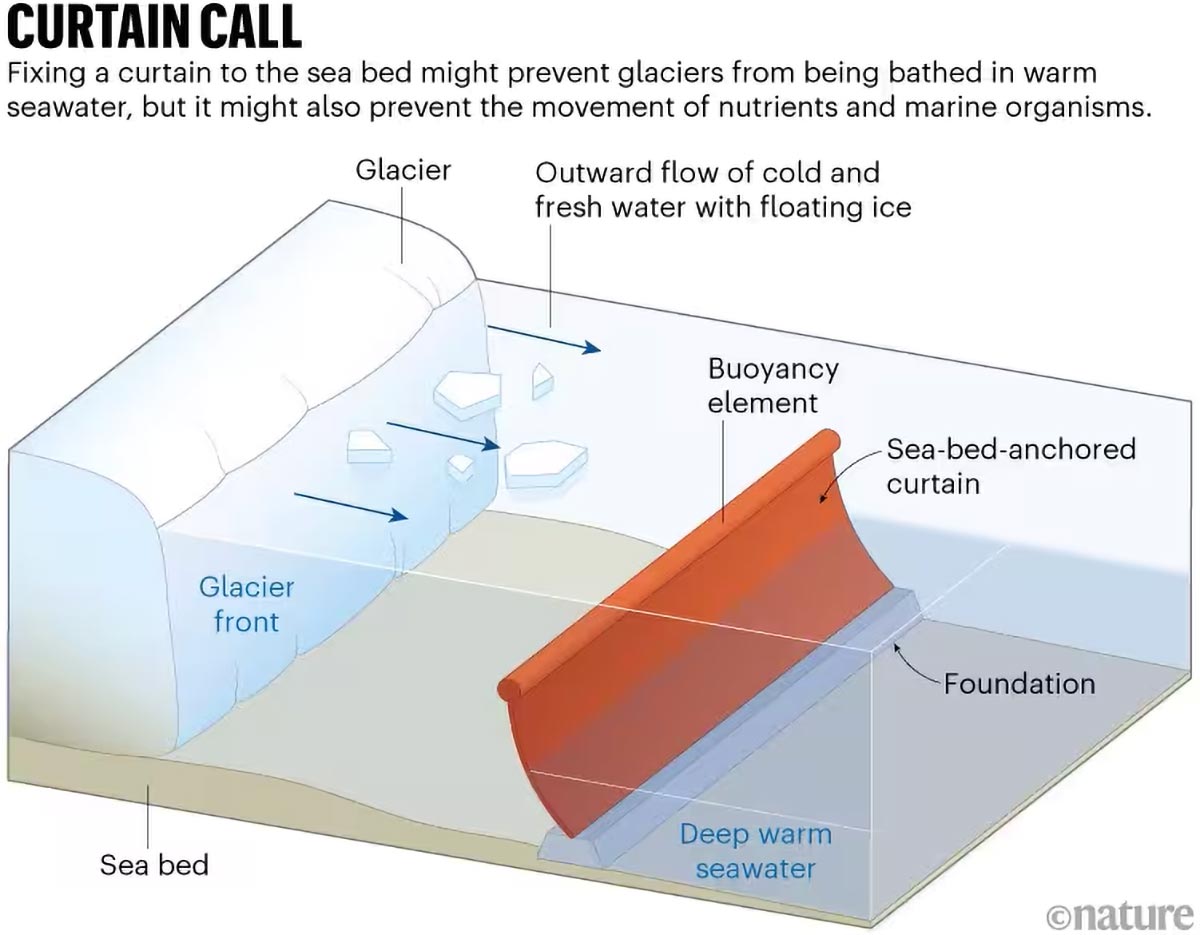
Some of the ideas for protecting the Thwaites and other marine-terminating glaciers like it are considered radical, including creating giant submarine curtains that would at least partially prevent warm tidal currents from reaching the glacier ice. The curtains could be made of fabric or even bubbles if a pipe with holes drilled into it and air pumped through it could be placed between the Thwaites and the warm water.
Glacial geoengineering interventions like these could be extremely useful if implemented correctly, according to Gernot Wagner, a climate economist in the Columbia Climate School. In an interview with GlacierHub, Wagner said, “for some polar tipping points like Arctic sea ice and the WAIS, glacial geoengineering seems to be the only way for us to more or less guarantee that we can address these tipping points.”
However, many of these ideas have faced opposition from glaciologists and climate scientists who claim that they would be difficult or impossible to achieve and draw focus away from the more necessary conversation of reducing carbon emissions. By relying too much on strategies like geoengineering, these scientists argue we may fail to act to curb emissions.
Wagner takes a nuanced approach. His initial reaction to the idea of installing curtains was “that it seems crazy. Geoengineering options like these curtains could detract from the need to cut emissions.” On the flipside, he said, “you can use it as a push to say, ‘wait, if serious people are talking about [using curtains] as a solution, maybe we should be taking it more seriously and cutting emissions much more.’”
As we creep closer to climate tipping points like the melting of the Thwaites Glacier, many believe geoengineering has the potential to be a powerful tool so long as it is not treated as a silver bullet. As Wagner stated, “When we talk about glacial geoengineering, we need to tell the truth, which is that it’s not a solution to climate change—at best, it’s a painkiller. It allows us to get out of bed and do what is necessary to address the underlying illness while taking the edge off the worst of the pain. [But] geoengineering doesn’t solve anything, so we need to use the time it gives us to address emissions.”
References:
- “Widespread seawater intrusions beneath the grounded ice of Thwaites Glacier, West Antarctica” by Eric Rignot, Enrico Ciracì, Bernd Scheuchl, Valentyn Tolpekin, Michael Wollersheim and Christine Dow, 20 May 2024, Proceedings of the National Academy of Sciences.
DOI: 10.1073/pnas.2404766121 - “The West Antarctic Ice Sheet may not be vulnerable to marine ice cliff instability during the 21st century” by Mathieu Morlighem, Daniel Goldberg, Jowan M. Barnes, Jeremy N. Bassis, Douglas I. Benn, Anna J. Crawford, G. Hilmar Gudmundsson and Hélène Seroussi, 21 August 2024, Science Advances.
DOI: 10.1126/sciadv.ado7794
Interviews have been lightly edited for clarity and concision.
Never miss a breakthrough: Join the SciTechDaily newsletter.
Follow us on Google and Google News.
6 Comments
More climate sky is falling – Well, I guess as long as political hack organizations will pay, yo-all will keep writing it.
What a blank existence it must be, just doing robotine activity to pay rent. And remember, anything you do will have consequences you aren’t intellectually capable (apparently) of foreseeing. You know, like putting DDT in all the watersheds thinking you don’t like mosquitos only to find the birds dying and bee colonies dying. Dahhhh.
“…, the breaching of the Thwaites and subsequent dislodgement of the WAIS are what’s known as a tipping point in climate science.”
The use of “tipping point” is disingenuous, at best! Other than the Great Oxygenation Event, there have been no events in the history of Earth that have resulted in permanent, significant changes in the bio-geo environment. Even the past ‘Ice House’ and “Hot House” events have come and gone (several times). The use of “tipping point” can only be understood as an attempt to scare people that once some line is crossed, the Earth will be irrevocably changed and therefore no cost is too high to prevent it from happening. The problem is, it isn’t true.
If the creatures swimming in the Cretaceous Sea that filled the interior of North America were sentient, they may well have been alarmed at the prospect of their home disappearing. However, no more so than today’s inhabitants who would be displaced were the Cretaceous Sea to return to its former glory. Nothing lives forever. Even Mount Everest will eventually be eroded to a small, inconsequential knob. Alarmists seem to be more concerned about losing their jobs than they are about understanding the big picture. It is one thing to objectively describe our geological environment, and quite another to use pejorative words to attempt to emotionally manipulate others into supporting changes in society that might delay what are probably inevitable geomorphic modifications of the surface. Antarctica has only been ice-covered for about 34 million years, with partial-meltings during that time.
“The curtains could be made of … bubbles if a pipe with holes drilled into it and air pumped through it could be placed between the Thwaites and the warm water.”
This could exacerbate the situation if the introduced air were warmer than the water, which it almost certainly will be if compressed to get it down to the sea bed. Furthermore, the rising bubbles might create unintended currents that would also introduce warmer water to the glacier snout. Then there is the issue of how fish and other marine animals would react to the bubbles. Most likely, they would be reluctant to cross the barrier. This could result in a massive breeding disaster.
“Fools rush in where angels fear to tread.”
After having written this, I realized that I missed a great opportunity to put the biological risk in its appropriate context: “Curtain Call”
But think of the opportunity to build tidal generators into said cutains and supply clean blue-reen energy to the assorted Antarctic bases, thus enabling them not to burn diesel oil to keep warm! (Irony alert).
I think that the tidal range in Antarctica is typically around 6-10′ (don’t hold me to that unless I’m way off). The proposals I have seen are for places like the Bay of Fundy where the tidal range is about an order of magnitude larger than the low-end of the Antarctic range. Additionally, there is no large demand for electricity of the scale obtainable from the Bay of Fundy, and Thwaites is no where close enough to any urban areas that could use it where the delivery losses would make economic sense.