
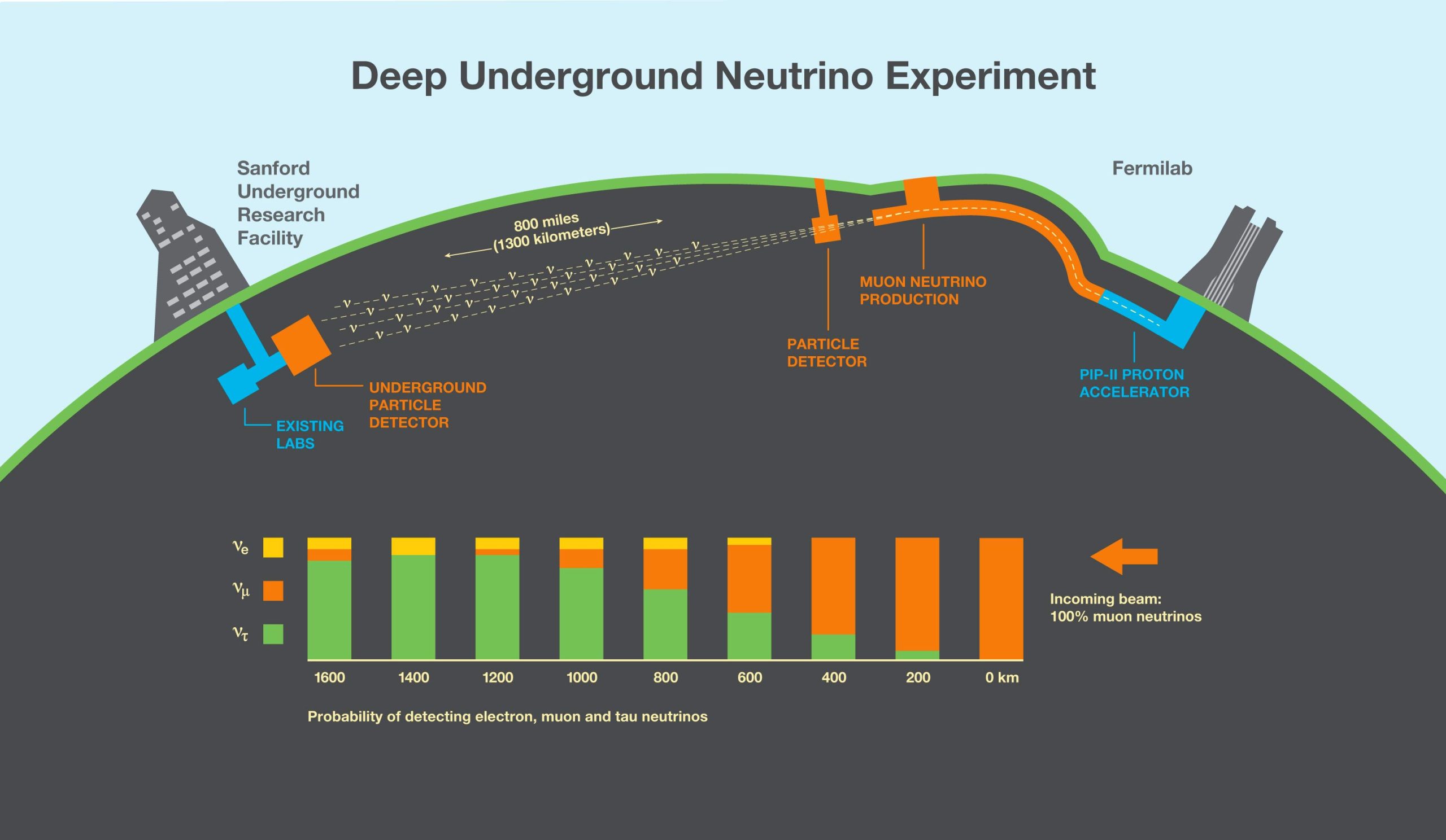
The Sanford Underground Research Facility celebrated the completion of excavation for the LBNF/DUNE project, a major international endeavor led by Fermilab to explore the universe’s deepest questions using neutrino interactions.
With substantial international collaboration and significant technological challenges overcome, this project stands to make groundbreaking scientific advances.
Celebrating the Completion of SURF Excavation
A ribbon-cutting event was held today at the Sanford Underground Research Facility (SURF) in Lead, S.D. to mark the completion of excavation work for the Long-Baseline Neutrino Facility/Deep Underground Neutrino Experiment (LBNF/DUNE), an international project led by the U.S. Department of Energy’s Fermi National Accelerator Laboratory. The “Into the Depths of Discovery” event, hosted by Fermilab and the South Dakota Science and Technology Authority (SDSTA), was attended by supporters of the three-year excavation of the caverns, including state and federal leaders as well as Department of Energy officials.
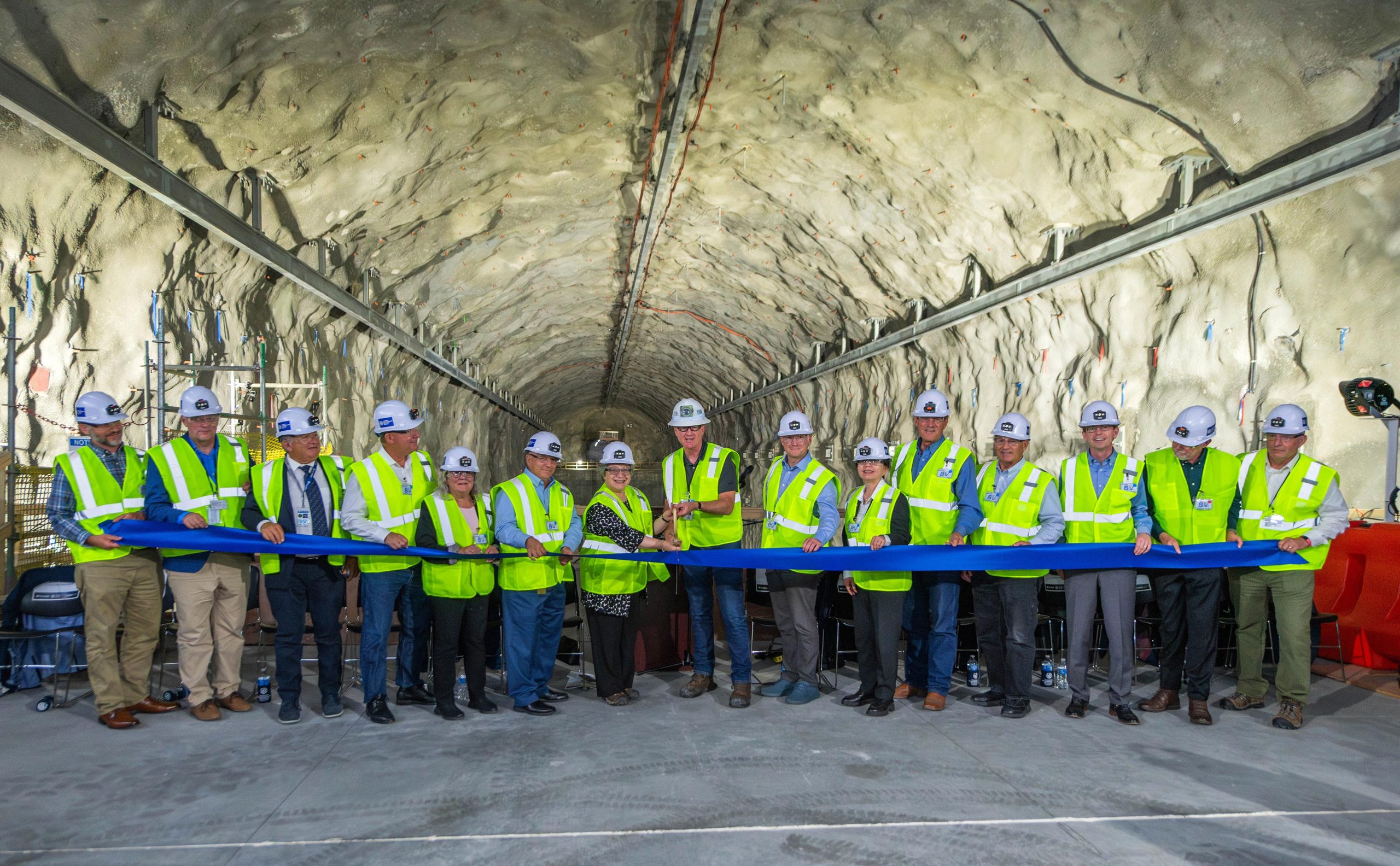
“Today we celebrate this remarkable engineering feat and are grateful to the many people who worked to achieve this milestone,” said Derek Passarelli, DOE Principal Deputy Under Secretary for Science & Innovation. “This is an extraordinary achievement given the nature of the underground excavation. The LBNF/DUNE endeavor, involving partners from the nation as well as from around the world, will bring together our collective minds and talents focused on tackling the most challenging questions about how our universe works.”
The Deep Underground Neutrino Experiment is an international experiment to unlock the mysteries of neutrinos. DUNE will be installed in the Long-Baseline Neutrino Facility, under construction in the United States. The U.S. Department of Energy’s Fermilab is the host laboratory for DUNE, in partnership with funding agencies and more than 1,300 scientists and engineers from over 35 countries.
Exploring Neutrino Interactions and the Universe’s Mysteries
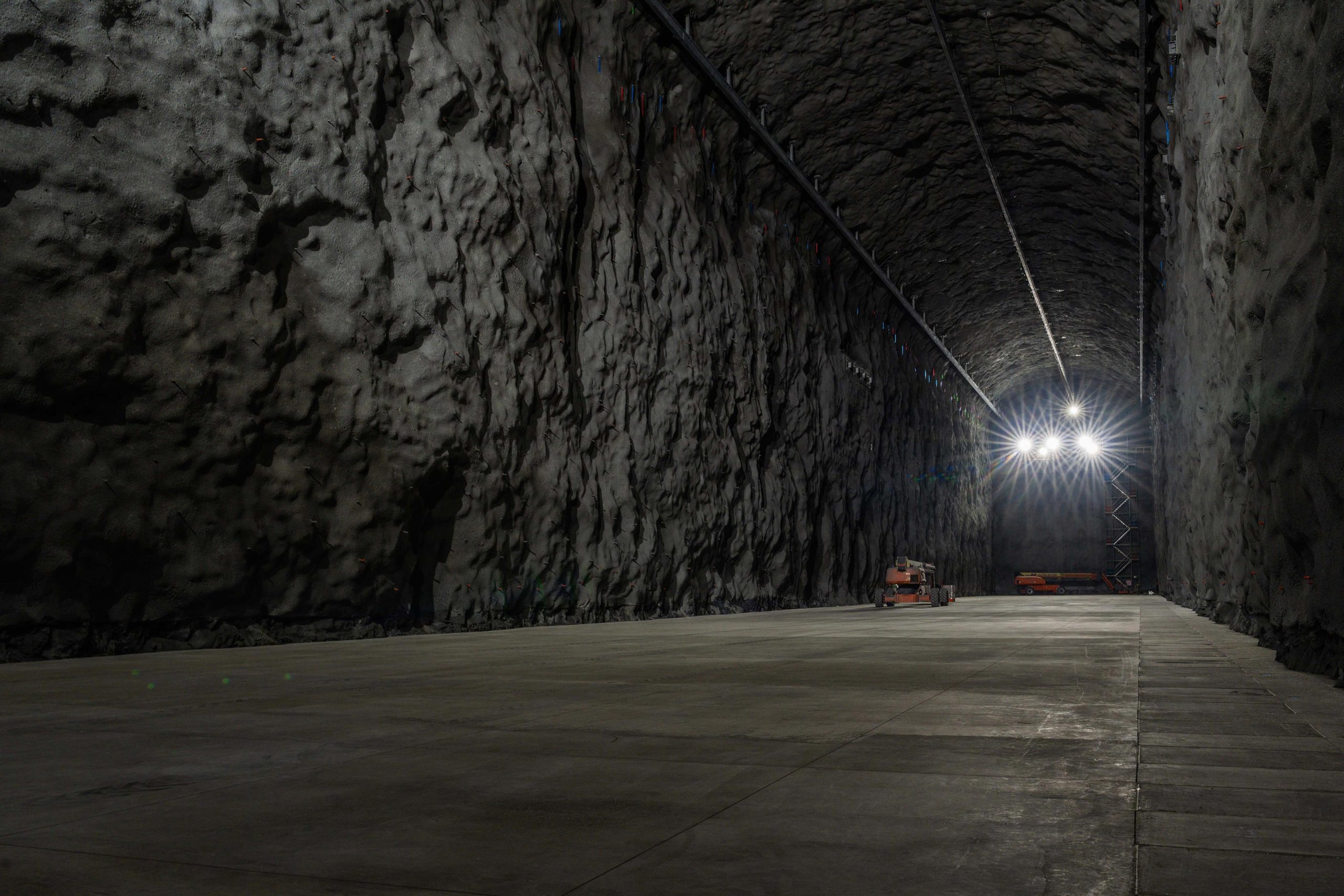
The event occurred one mile beneath the surface at the northern detector cavern and marked the completion of excavation work on two seven-story caverns for housing particle detectors (see 2-minute animation above), as well as a smaller central utility cavern. The two detectors will each be filled with 17,000 tons of liquid argon cooled to minus 184 degrees Celsius to record and study the rare interactions of neutrinos.
The international collaboration of DUNE scientists will study the behavior of mysterious particles known as neutrinos to address some of the biggest questions in science, such as why our universe contains matter, how an exploding star can create a black hole, and if neutrinos are connected to dark matter or other undiscovered particles.
The Role of International Collaboration in Scientific Progress
“It is exciting to have so many people here today who have supported the excavation and construction of the project,” said Lia Merminga, director of Fermilab. “This is an important step in making LBNF/DUNE a world-class international underground science facility.”
The research conducted at Fermilab and SURF is the foundation for future technological innovation. The history of scientific research shows that discoveries made today have the potential to positively impact humanity for generations to come.
Future Prospects at America’s Underground Lab
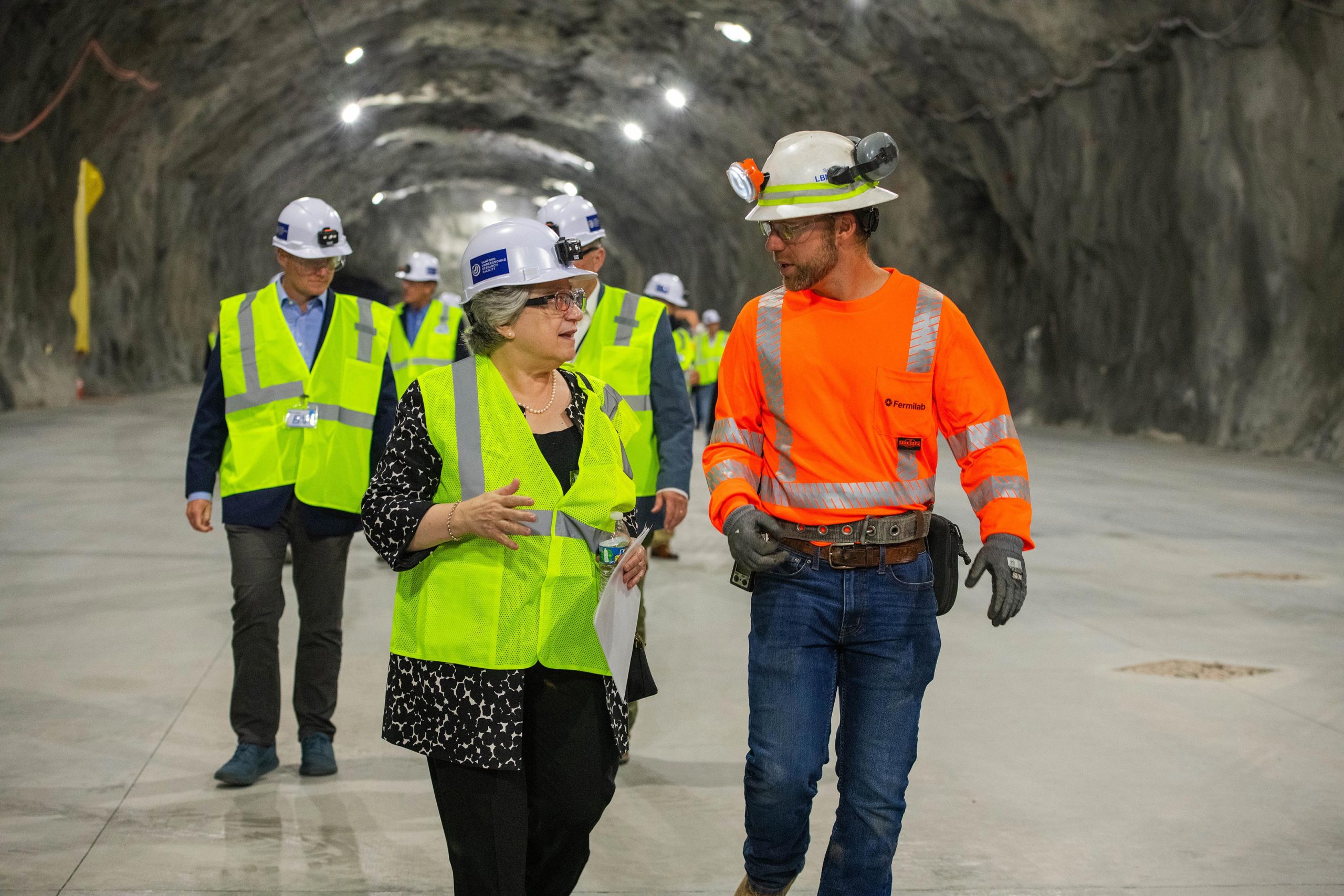
“This important milestone is a great way to celebrate the world-class research, innovation, education, and economic opportunities happening here at America’s Underground Lab,” said Mike Headley, laboratory director at SURF and the executive director of the South Dakota Science and Technology Authority. “The research underway at SURF will extend well into this century; the impact of scientific advancements made here could last much longer. Our future is incredibly bright, and we are excited to help it unfold.”
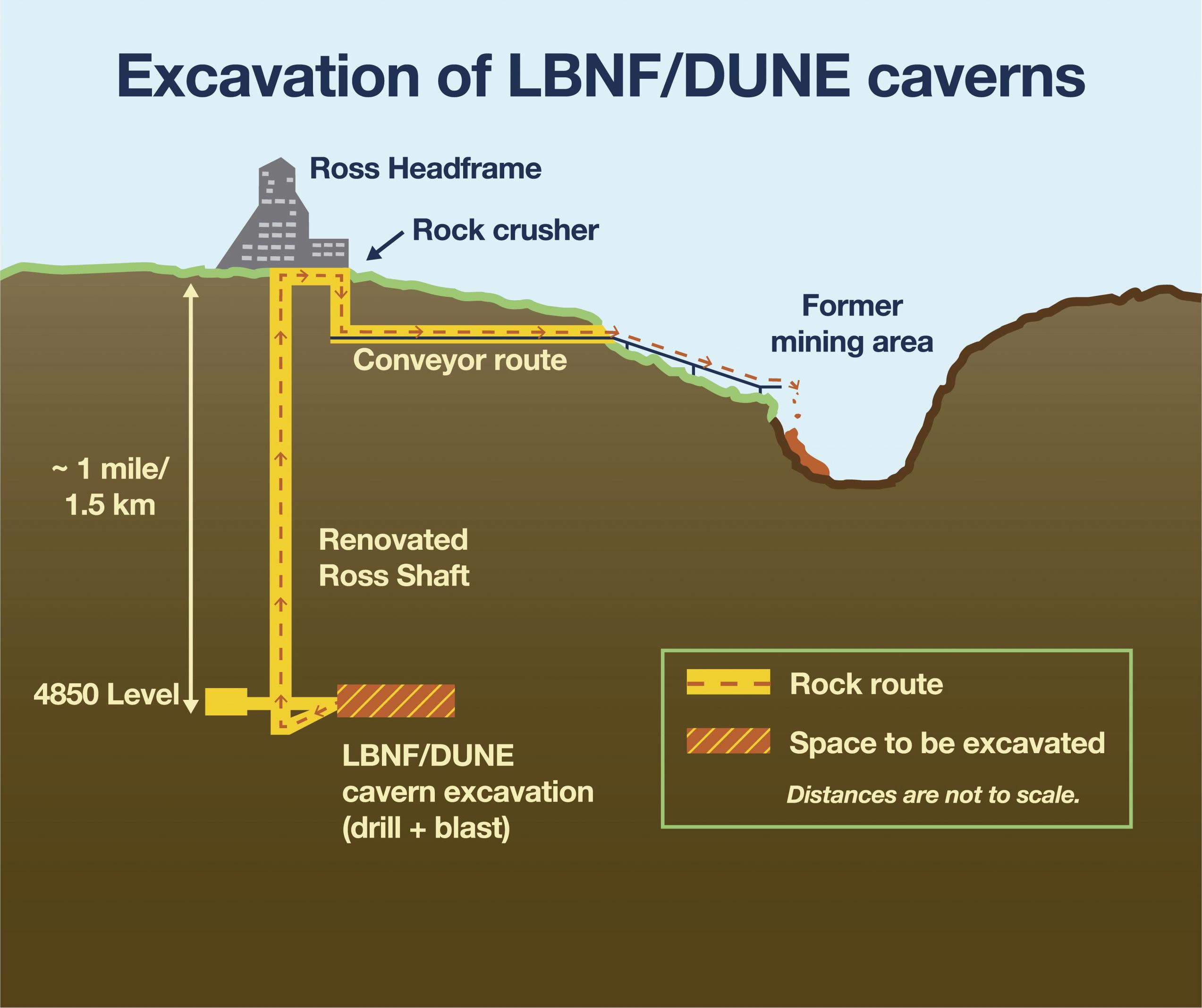
Engineering, construction, and excavation teams have worked 4,850 feet below the surface since 2021 at SURF to prepare the space needed for the experiment. Over 800,000 tons of rock were excavated and moved from underground to an expansive former surface mining area known as the Open Cut. In order to accomplish this feat, construction crews dismantled heavy mining equipment and, piece by piece, transported it underground. Workers then reassembled the machinery and have been blasting and relocating rock ever since.
Fermi National Accelerator Laboratory and the Sanford Underground Research Facility celebrate this massive construction milestone and kick off the next phase of this project. Credit: Sanford Lab
A Global Scientific Endeavor
The U.S. Department of Energy’s Fermi National Accelerator Laboratory and Sanford Underground Research Facility are working together for this international science project as part of a large collaboration comprised of more than 1,400 scientists and engineers from over 200 institutions in over 35 countries and the European Organization for Nuclear Research, known as CERN.
Never miss a breakthrough: Join the SciTechDaily newsletter.
Follow us on Google and Google News.
2 Comments
When physics no longer believes in mathematics, such as no longer believes the scientific validity of low dimensional spacetime topological shapes. It can only dig caverns everywhere or search for their ‘God’ in collisions.
Scientific research guided by correct theories can help humanity avoid detours, failures, and pomposity. Please witness the exemplary collaboration between theoretical physicists and experimentalists (https://scitechdaily.com/microscope-spacecrafts-most-precise-test-of-key-component-of-the-theory-of-general-relativity/#comment-854286). Some people in contemporary physics has always lived in a self righteous children’s story world. Whose values have been overturned by such a comical and ridiculous reality? CP violation opened the dirtiest and ugliest era in the history of physics.
Space has physical properties of zero viscosity and absolute incompressibility. Zero viscosity and absolute incompressibility are physical characteristics of ideal fluids. The space with ideal fluid physical characteristics forms vortices via topological phase transitions, which is not difficult to understand mathematically. Once the topological vortex is formed, it occupies space and maintains its presence in time. This is the transition from chaos to order via two bidirectional coupled continuous chaotic systems.
Each topological vortex is a natural gravitational field. According to the topological vortex gravitational field theory, the disco party between topological vortices and their twin antivortices has no tiniest disco, only smaller ones. Topological vortices either exist or do not exist. If topological vortices exist, their fractal structure is influenced by environmental factors, theoretically there is no minimum, only smaller, and similarly there is no maximum, only larger.
Symmetry of topological vortex can be used to explore particle behavior under spatial, temporal, and quantum number reversals, involving quantum gravity, discrete and continuous changes. It underpins the consistency of natural laws and experiment reproducibility. The perpetually swirling topological vortices defy traditional physics’ expectations, heavily influencing traditional physics theories and potentially unveiling new particles and forces.
Topological vortex fractal structures are ubiquitous. Topological spin creates all things. Topological spin creates the world. Topological vortices exhibit parity conservation, charge conjugation, and time reversal symmetry.
Physics should understand what is feasible and what is not, or should have a relatively clear estimation of oneself at least. CP violation opened the dirtiest and ugliest era in the history of physics. Digging caverns should be stopped in moderation.