
Close Menu
    Facebook X (Twitter) Instagram
    SciTechDaily
    • Biology
    • Chemistry
    • Earth
    • Health
    • Physics
    • Science
    • Space
    • Technology
    Facebook X (Twitter) Pinterest YouTube RSS
    SciTechDaily
    Home»Space»During Planet Formation “Safety Zone” Saves Giant Moons From Fatal Plunge
    Space

    During Planet Formation “Safety Zone” Saves Giant Moons From Fatal Plunge

    By National Institutes of Natural SciencesMarch 10, 2020No Comments3 Mins Read
    Facebook Twitter Pinterest Telegram LinkedIn WhatsApp Email Reddit
    Share
    Facebook Twitter LinkedIn Pinterest Telegram Email Reddit
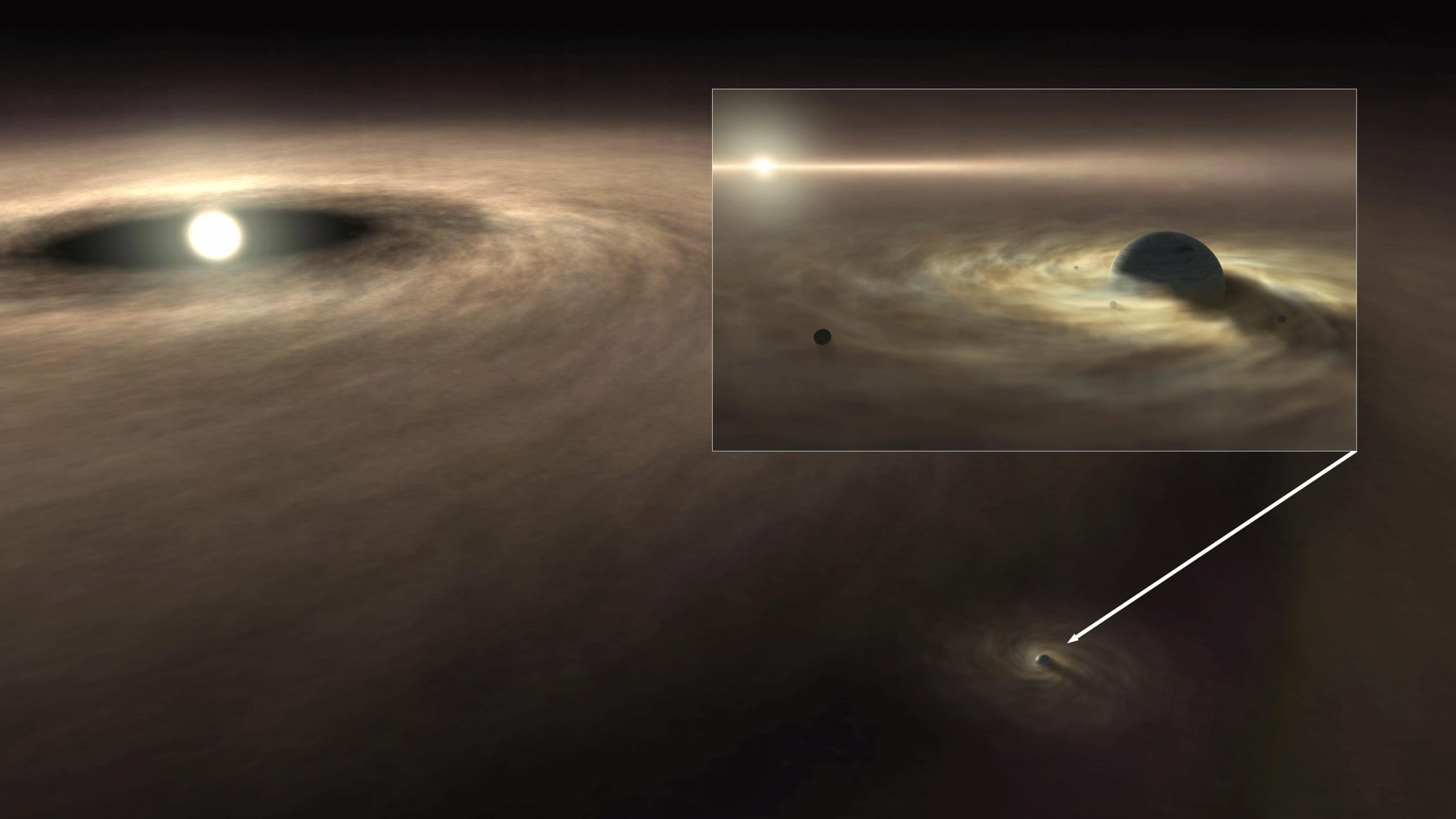
    Satellite Forming Around Gas Giant Planet
    An artist’s impression of a satellite forming around a giant gas planet which is itself still forming around a star. Credit: Nagoya University

    Numerical simulations showed that the temperature gradient in the disk of gas around a young gas giant planet could play a critical role in the development of a satellite system dominated by a single large moon, similar to Titan around Saturn. Researchers found that dust in the circumplanetary disk can create a “safety zone,” which keeps the moon from falling into the planet as the system evolves.

    Astronomers believe that many of the moons we see in the Solar System, especially large moons, formed along with the parent planet. In this scenario, moons form from the gas and dust spinning around the still forming planet. But previous simulations have resulted in either all large moons falling into the planet and being swallowed up or in multiple large moons remaining. The situation we observe around Saturn, with many small moons but only one large moon, does not fit in either of these models.
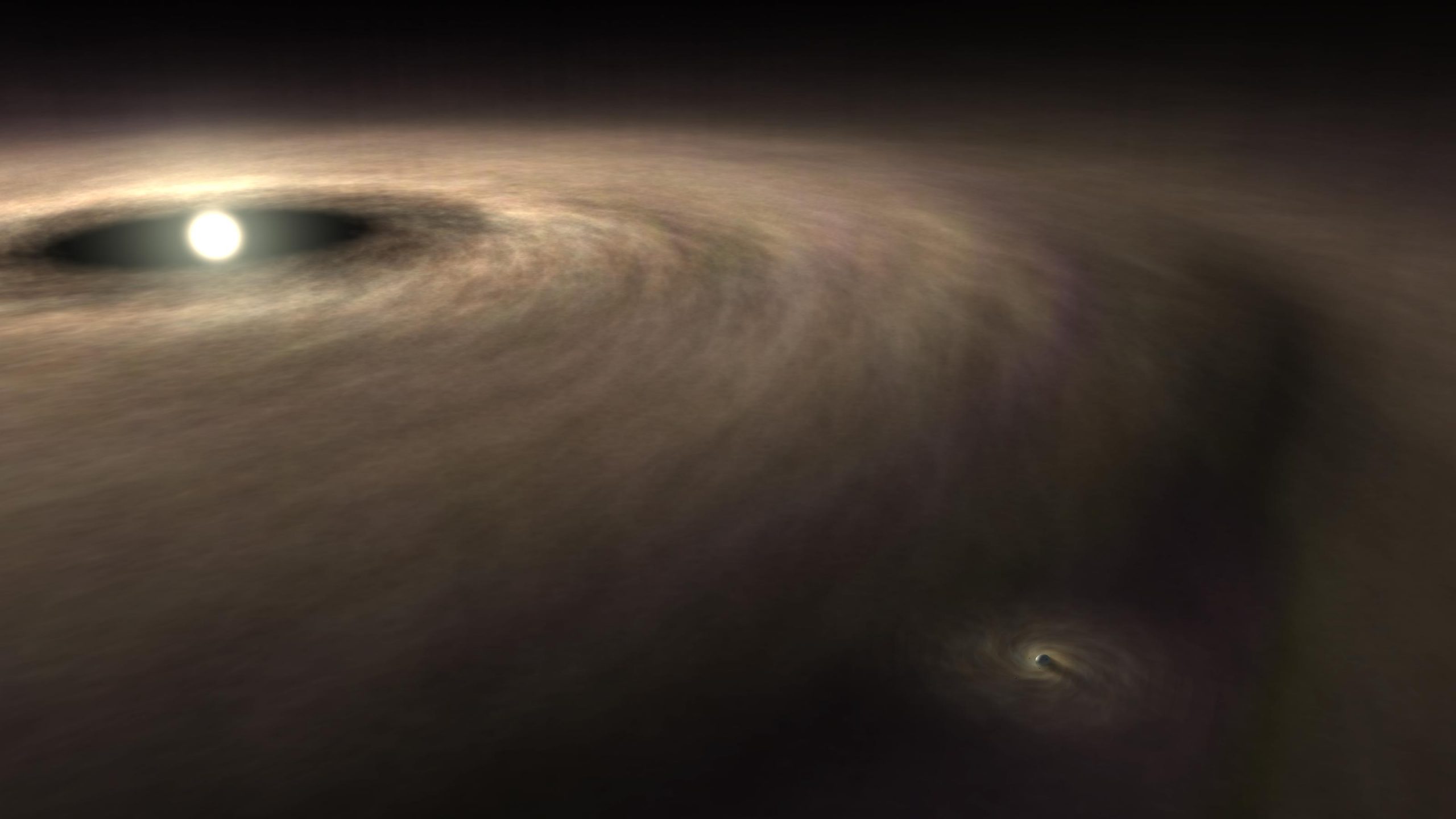
    Gas Giant Planet Forming Around Star
    An artist’s impression of a giant gas planet forming around a star. Credit: Nagoya University

    Yuri Fujii, a Designated Assistant Professor at Nagoya University, and Masahiro Ogihara, a Project Assistant Professor at the National Astronomical Observatory of Japan (NAOJ), created a new model of circumplanetary disks with a more realistic temperature distribution by considering multiple sources of opacities including dust and ice. Then, they simulated the orbital migration of moons considering pressure from disk gas and the gravity of other satellites.

    Their simulations show that there is a “safety zone” where a moon is pushed away from the planet. In this area, warmer gas inside the orbit pushes the satellite outward and prevents it from falling into the planet.
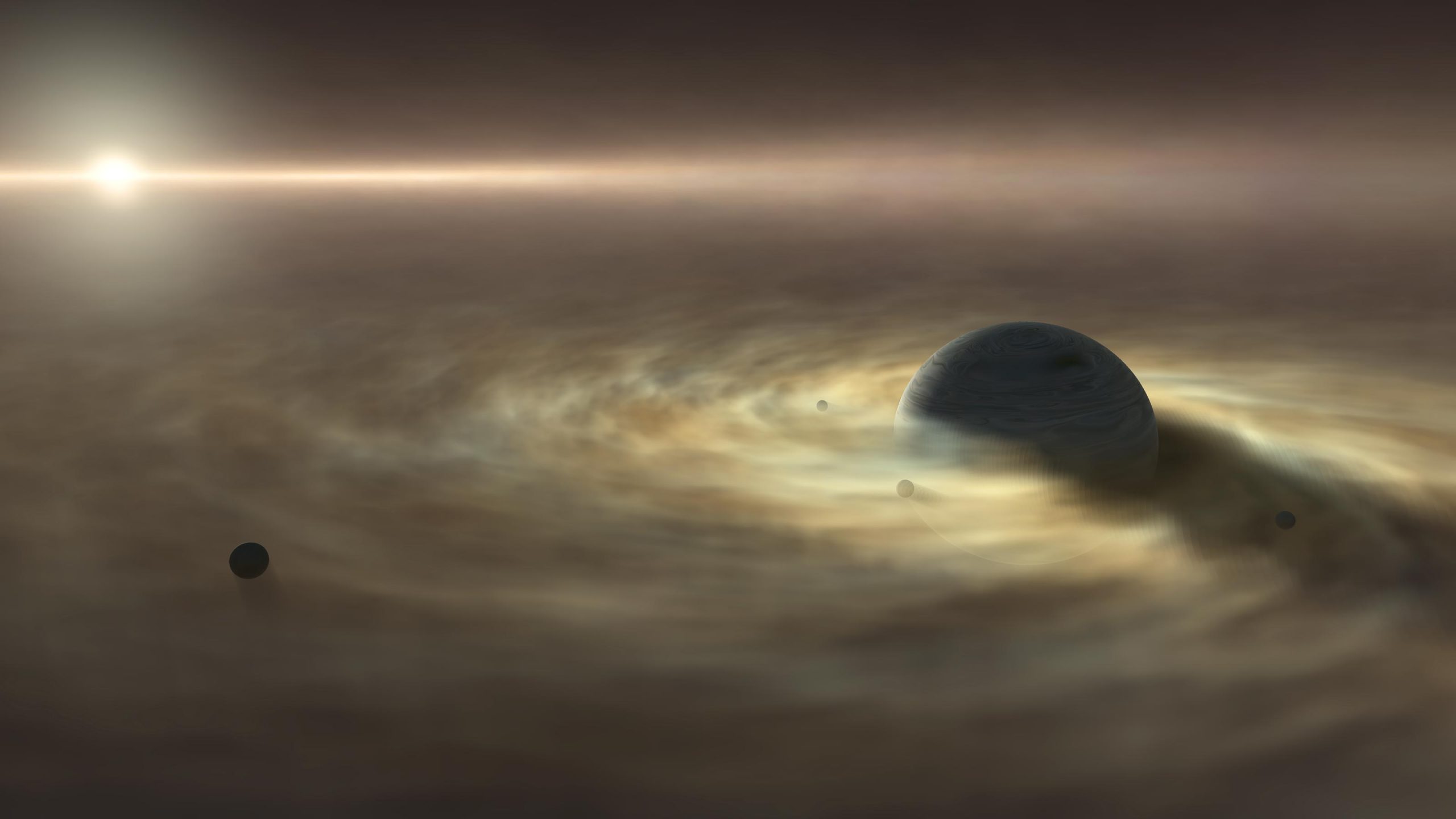
    Satellite Forming Around Giant Gas Planet
    An artist’s impression of a satellite forming around a giant gas planet which is itself still forming around a star. Credit: Nagoya University

    “We demonstrated for the first time that a system with only one large moon around a giant planet can form,” says Fujii. “This is an important milestone to understand the origin of Titan.”

    But Ogihara cautions, “It would be difficult to examine whether Titan actually experienced this process. Our scenario could be verified through research of satellites around extrasolar planets. If many single-exomoon systems are found, the formation mechanisms of such systems will become a red-hot issue.”

    These results were published by Fujii and Ogihara “Formation of single-moon systems around gas giants” in Astronomy and Astrophysics Letters in March 2020. The simulations in this research used the PC Cluster operated by NAOJ.

    Reference: “Formation of single-moon systems around gas giants” by Yuri I. Fujii and Masahiro Ogihara, 9 March 2020, Astronomy & Astrophysics.
    DOI: 10.1051/0004-6361/201937192

    Never miss a breakthrough: Join the SciTechDaily newsletter.
    Follow us on Google and Google News.

    Astronomy Astrophysics Nagoya University National Institutes of Natural Sciences Popular
    Share. Facebook Twitter Pinterest LinkedIn Email Reddit

    Related Articles

    Unveiling a 100-Year-Old Astrophysics Mystery: Where the Milky Way’s Cosmic Rays Come From

    Astronomers Use Artificial Intelligence to Reveal the Actual Shape of the Universe

    ALMA Peers Back 12.4 Billion Years and Discovers the Most Ancient Galaxy of Its Kind Ever Observed

    Enormous Plasma Jets Reveal Monstrous Magnetic Fields Far, Far Away

    Unknown Physics on the Cosmic Scale? 1000 Supernova Explosions Chart the Expansion History of the Universe

    A New Window to See Unexplored Hidden Side of Magnetized Universe

    Natural Cosmic Telescope Helps ALMA Discover Rotating Infant Galaxy

    Supercomputer Turns Back Cosmic Clock for Insights Into One of the Most Important Mysteries in Modern Astronomy

    Second Alignment Plane of Solar System Discovered After Accounting for Galactic Gravity

    Leave A Reply Cancel Reply

    • Facebook
    • Twitter
    • Pinterest
    • YouTube

    Don't Miss a Discovery

    Subscribe for the Latest in Science & Tech!

    Trending News

    5 Simple Ways To Remember More and Forget Less

    The Atomic Gap That Could Cost the Semiconductor Industry Billions

    Researchers Finally Solve 50-Year-Old Blood Group Mystery

    Scientists Discover “Molecular Switch” That Fuels Alzheimer’s Brain Inflammation

    Trees Emit Tiny Lightning Flashes During Storms and Scientists Finally Prove It

    Pomegranate Compound Could Help Protect Against Heart Disease

    Your Blood Test Might Already Show Alzheimer’s Risk

    Scientists Were Wrong About This Strange “Rule-Breaking” Particle

    Follow SciTechDaily
    • Facebook
    • Twitter
    • YouTube
    • Pinterest
    • Newsletter
    • RSS
    SciTech News
    • Biology News
    • Chemistry News
    • Earth News
    • Health News
    • Physics News
    • Science News
    • Space News
    • Technology News
    Recent Posts
    • Scientists Complete Largest 3D Map of the Universe to Probe Dark Energy
    • Hidden Parasite Found in Popular Portuguese Lake Raises Health Concerns
    • This Simple Trick Can Boost Your Workout Endurance by 20%
    • This Popular Supplement May Interfere With Cancer Treatment, Scientists Warn
    • Scientists Propose Radical New Way To Detect Alien Life – Without Traditional Biosignatures
    Copyright © 1998 - 2026 SciTechDaily. All Rights Reserved.
    • Science News
    • About
    • Contact
    • Editorial Board
    • Privacy Policy
    • Terms of Use

    Type above and press Enter to search. Press Esc to cancel.