

A subduction zone near Cascadia is unraveling piece by piece. The process offers a rare glimpse into how tectonic plates die and form new geological boundaries.
With unprecedented clarity, researchers have captured a rare geological event: a subduction zone—the point where one tectonic plate sinks beneath another, actively fracturing. The finding, published in Science Advances, offers new insight into the dynamic processes shaping Earth’s crust and raises important questions about long-term earthquake risks in the Pacific Northwest.
Subduction zones are among Earth’s most powerful and influential geological systems. They propel continents across the globe, generate catastrophic earthquakes and volcanic eruptions, and recycle the planet’s crust back into the mantle.
However, these colossal systems don’t last forever. If subduction zones never ended, continents would continually collide and merge, eliminating oceans and erasing the planet’s geologic history. For decades, scientists have asked one key question: what exactly causes these immense systems to come to an end?
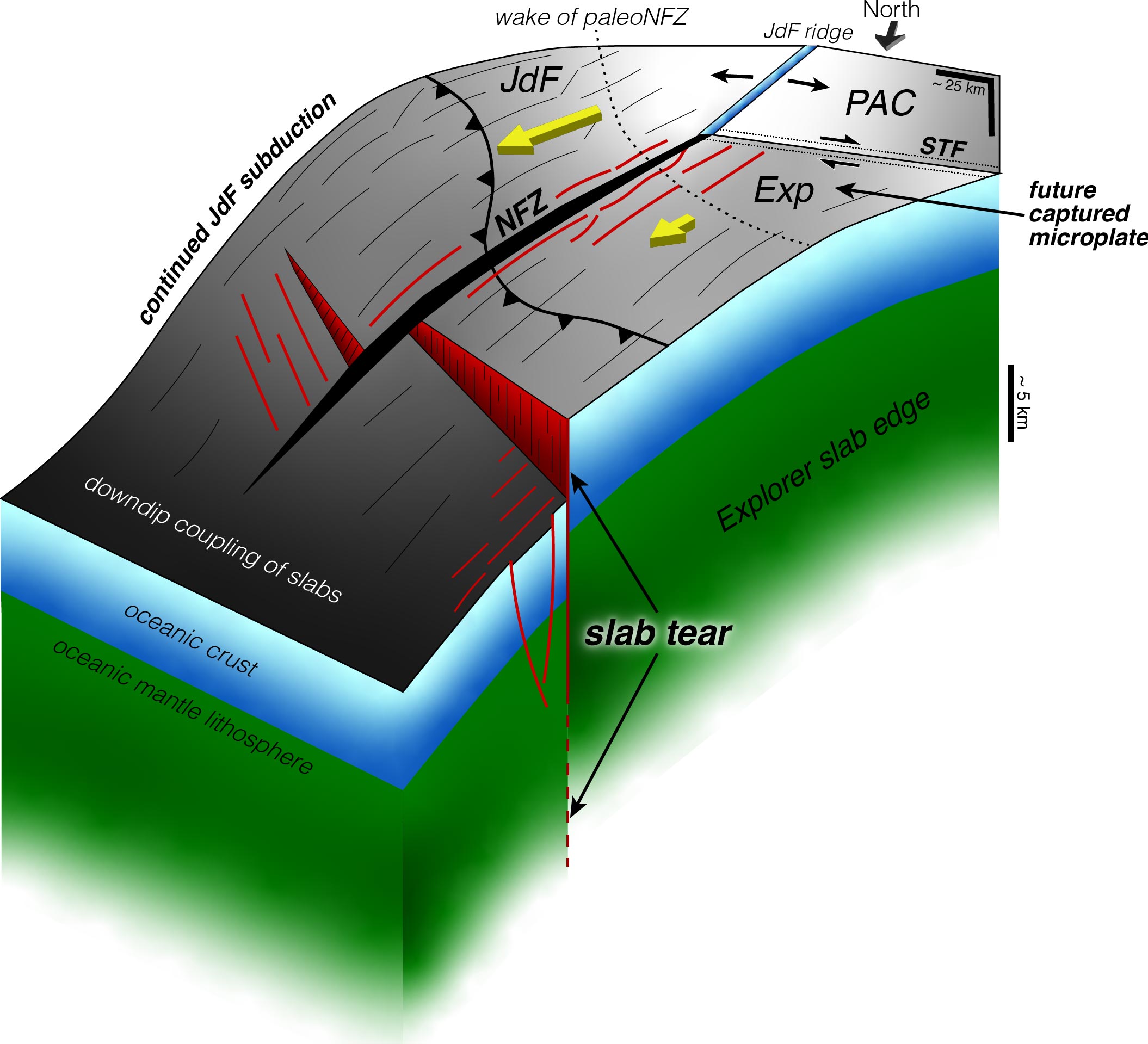
“Getting a subduction zone started is like trying to push a train uphill—it takes a huge effort,” said Brandon Shuck, a geologist at Louisiana State University and lead author of the study. “But once it’s moving, it’s like the train is racing downhill, impossible to stop. Ending it requires something dramatic—basically, a train wreck.”
A natural laboratory off Vancouver Island
Just off Vancouver Island, in the Cascadia region where the Juan de Fuca and Explorer plates slowly descend beneath the North American plate, scientists believe they have found the answer. By combining seismic reflection imaging—essentially an ultrasound of Earth’s interior—with extensive earthquake data, the team observed a subduction zone in the process of breaking apart.
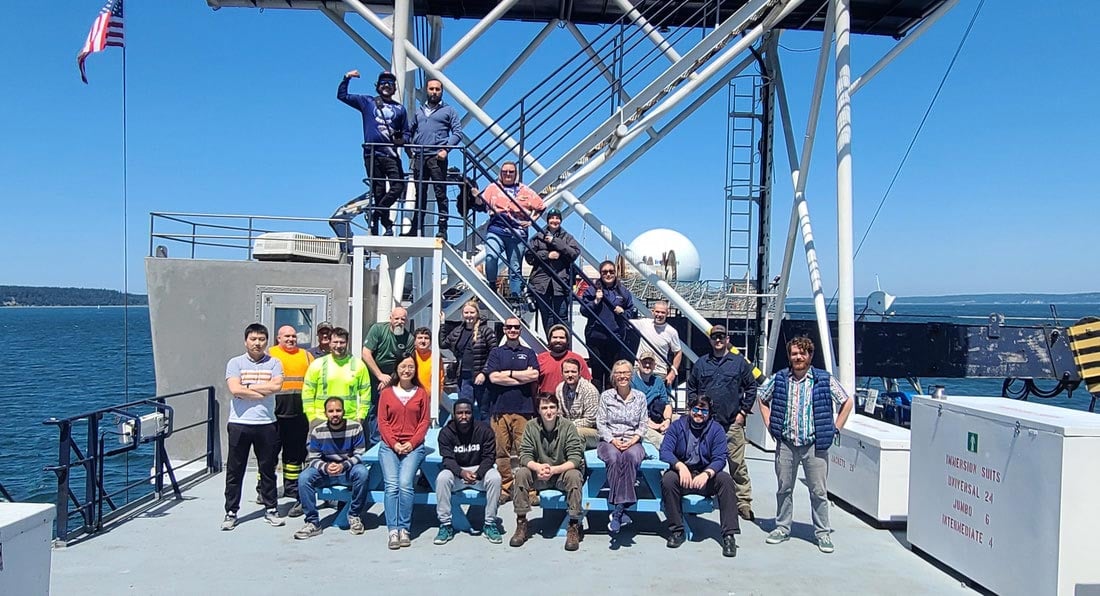
The seismic readings were obtained during the NSF-supported 2021 Cascadia Seismic Imaging Experiment (CASIE21). During this expedition, researchers aboard a ship sent sound waves into the seafloor and tracked their reflections using a 15-kilometer streamer of underwater sensors. The data produced detailed images of the region’s subsurface, exposing deep fractures and fault lines where the tectonic plate is beginning to split.
Watching a tectonic plate die in real time
“This is the first time we have a clear picture of a subduction zone caught in the act of dying,” said Shuck. “Rather than shutting down all at once, the plate is ripping apart piece by piece, creating smaller microplates and new boundaries. So instead of a big train wreck, it’s like watching a train slowly derail, one car at a time.”
The team observed tears slicing through the oceanic plate, including a massive offset where the slab has dropped by about five kilometers. “There’s a very large fault that’s actively breaking the plate,” Shuck explained. “It’s not 100% torn off yet, but it’s close.” Earthquake records confirm the pattern: along the 75-kilometer-long tear, some sections are still seismically active, while others are eerily quiet. “Once a piece has completely broken off, it no longer produces earthquakes because the rocks aren’t stuck together anymore,” he said. That missing gap of seismicity is a telltale sign that part of the plate has already detached and the gap is growing slowly over time.
The step-by-step collapse of tectonic plates
The study found that this breakup happens in stages, through what researchers call “episodic” or “piecewise” termination. Rather than a sudden break across the entire tectonic plate, the plate gradually tears apart one section at a time. Transform boundaries—faults where plates slide past each other—play a key role in this process. Acting like natural scissors, these faults cut across the plate, perpendicularly to the tear, allowing one piece to detach and form a microplate while subduction continues in neighboring sections.
By tearing off in smaller chunks, the larger plate loses momentum—like cutting the cars off a runaway train—and eventually stops being pulled downward. Each piece that breaks away is a process that takes several million years, but together these episodes gradually shut down an entire subduction system.
This episodic breakup helps explain puzzling features in Earth’s history preserved elsewhere, such as abandoned fragments of tectonic plates and unusual bursts of volcanic activity. A striking example lies off Baja California, where scientists have long observed fossil microplates—the shattered remains of the once-massive Farallon plate. For decades, researchers knew these fragments must be evidence of dying subduction zones, but the mechanism that created them was unclear. Cascadia is now providing that missing piece: subduction zones don’t collapse in a single catastrophic event but unravel step by step, leaving behind microplates as geological evidence.
A planet in motion and future implications
And the process isn’t over. As each fragment detaches, it reshapes Earth’s surface. The torn edges may create “slab windows” where hot mantle rises, fueling bursts of volcanic activity. Over time, the plate boundaries migrate, new microplates form, and the cycle repeats. “It’s a progressive breakdown, one episode at a time,” said Shuck. “And it matches really well with what we see in the geologic record, where volcanic rocks get younger or older in a sequence that reflects this step-by-step tearing.”
Looking ahead, researchers are exploring whether a major earthquake could rupture across one of these newly discovered tears or whether the breaks might influence how ruptures propagate. While these findings help refine models of how structural complexities affect earthquake behavior, they do not significantly change the hazard outlook for Cascadia on a human timescale. The region remains capable of producing very large earthquakes and tsunamis, and understanding how these new breaks influence rupture patterns will improve models used to study seismic hazards in the Pacific Northwest.
Reference: “Slab tearing and segmented subduction termination driven by transform tectonics” by Brandon Shuck, Brian Boston, Suzanne M. Carbotte, Shuoshuo Han, Anne Bécel, Nathaniel C. Miller, J. Pablo Canales, Jesse Hutchinson, Reid Merrill, Jeffrey Beeson, Pinar Gurun, Geena Littel, Mladen R. Nedimović, Genevieve Savard and Harold Tobin, 24 September 2025, Science Advances.
DOI: 10.1126/sciadv.ady8347
CASIE21 is supported by the National Science Foundation under awards OCE 1827452 and OCE 2217465.
Never miss a breakthrough: Join the SciTechDaily newsletter.
Follow us on Google and Google News.
28 Comments
That’s gonna ruin someone’s day.
Fascinating discovery. What strikes me most is how the Earth rarely breaks all at once; it unravels slowly, in layers and silences. The fact that parts of the subducting slab are already “quiet” because they have detached feels almost poetic, like memory fading before the body dies. It is a reminder that change in nature, like in civilizations, begins long before we notice it on the surface.
The idea of “slab windows” opening beneath the crust, allowing raw mantle to rise, also says something profound: creation often requires destruction first. What appears to be collapse may be the beginning of renewal, even if it takes millions of years for us to understand the pattern.
Beautiful science, terrifying too, but it reminds us that the planet is never still, never truly whole, and that we stand upon a story still being rewritten beneath our feet.
Nicely put…
Beautifully said lumpy .
I agree
Beautifully said lumpy .
YOUR wonderful thoughts of describing Earths Formations and Time’s Ticking&Tocking Hours of Re+Creations are entirely beautiful and poetic!! Ur words are calmly still and so very inspiring…even amidst ‘the unconfined and unconforming dangers of terrifying events and the ‘..could be…’ unforgiving catastrophes that ‘…maybe…’ alla round US every single one of OUR every single days…. ‘ Thank You Lumpy for giving me a BITTA fresh air to breathe this evening. With both of my lungs full, as well as my sight, YOU LUMPY ARE LITERALLY A WONDERFUL DELIGHT!!! I’m so grateful to know that others are still admirable and real!!!!!!! P.S. I ❤️ fresh air, THANKS SO MUCH AGAIN FOR YOUR AMAZING MIND, THOUGHTS, AND COMMENT!!!!!!! God Bless and Take Care!! Sincerely, giggles!!
Is this tiktok or a actual reliable source?
What is wrong with this world? Do you not know that God says The whole groans awaiting the day. The earth reacts to sin. Any movement is Judgment! Stop acting like you are God’s.
oh shut up
I believe Earth was once smaller, like a balloon being blown up.. (by internal heat and probably billions of years of added space material).. earth has grown.. gravity has increased.. (less in the time of the dinosaurs), water (from asteroids etc) added… the crust has cracked, moved and floated apart (like a rice pudding skin), creating the continents
Lumpy, you have beautifully written of the possible , even probable chaos and even terror in what our Earth can and does do, in a way that brings calm acceptance. It is written to even be admired. A masterpiece of expression!
Are we gonna die? I live in California.
We will… eventually.
Yes
Please evacuate California….Goiaten to The Masters Voice prophecy on uTube concerning the word of The Lord and the Judgment coming to California and America. Please leave California
Thanks for the reminder to be prepared.
Earthquakes are Judgment The earth reacts to sin. America is Mystery Babylon and Judgement is coming.
Thank you to the author and ALL the scientist doing a very cpmplex study/research of our mother EARTH.
It takes millions of years so you arent going to live that long, but Caifornia has experienced this for millions of years in the earthquakes that are so frequent so the expert geologists say. I can only assume the Slow moving faults you are already living by and would be part of the process now are still the same danger, but California is going to break off into the ocean chunk by slow moving chunk in the next few million years.
This is my own opionion strictly from studying. Im no geologist. Yellowstone is more of a worry i think. I dont kmow any more than I
I studied, but im not worried either
Colorado has the Rockies which are a result of the same process 60 million years ago.
The largest tallest mountain range in the world still exists as the Rockies foothills rolling plains to their eastern side. Its the large rolling hills we drive to the east which were pushed down as the Rockies rose.
Where i live is 50 or so miles east of Pikes Peak at 11500 feet or so and this town is 8500 feet or so above sea level to its east. Banana belt winters and huge blizzards and Arabian horses are just great here.
The Rockies pushed all that huge mountain range down from the west as it rose to its own high place.
Its normal geology and faults cause its slow movement causes earthquakes and tsunamis in California.
Yes mother Earth is sick 😷 of us ! We ☠️ poison the land the air and the sea , as well as the Hart the mind the body and if you will the very sole ! Seen us at our worst , knows that us at our best is to rair it seeñ to much of kill liying steeling That’s not way we where here ¡!!¡ We have Fàiled people now it time to go! May the GODS help us all ! For the 🌎 eàrth is , was and will be alive with our us she is making up her mind ! Don’t think it is going our way¿??¿ Good luck 🤞
Dark Gaia is awakening.
Will Sonic stop it in time?
Great job Team May God continue to bless us all with safe coexistence.
I am leaving California next time when we are having a dangerous event because I hate myself for no reason lol :].
This thread is full of the kinda folks that make everything worth it. It’s so nice when you catch yourself thinking “I love people”. Those moments are a rarity these days. I thank ya’ll for that & tip my hat …
P.S. Hey Lumpy, you really need to work on your user name. It just doesn’t seem befitting…
Please leave now…you may not have the chance in the future. Please go listen to The Masters voice prophecy on uTube. I am not a nutcase..I just love God and he has shown me a great earthquake is coming. Many have been given dreams but celestial has been shown by God what is coming.
YOUR wonderful thoughts of describing Earths Formations and Time’s Ticking&Tocking Hours of Re+Creations are entirely beautiful and poetic!! Ur words are calmly still and so very inspiring…even amidst ‘the unconfined and unconforming dangers of terrifying events and the ‘..could be…’ unforgiving catastrophes that ‘…maybe…’ alla round US every single one of OUR every single days…. ‘ Thank You Lumpy for giving me a BITTA fresh air to breathe this evening. With both of my lungs full, as well as my sight, YOU LUMPY ARE LITERALLY A WONDERFUL DELIGHT!!! I’m so grateful to know that others are still admirable and real!!!!!!! P.S. I ❤️ fresh air, THANKS SO MUCH AGAIN FOR YOUR AMAZING MIND, THOUGHTS, AND COMMENT!!!!!!! God Bless and Take Care!! Sincerely, giggles!!
And I live directly over the heart of this regional activity. Whidbey – or what I nicknamed years ago “The Void.” I have been trying to explain for years without any professional understanding what this article summarizes. Thank you, this brings me peace.
Lumpy, you should become a poet if you aren’t already. Your words are an inspiration to us all.Thank You.😀😀😀