
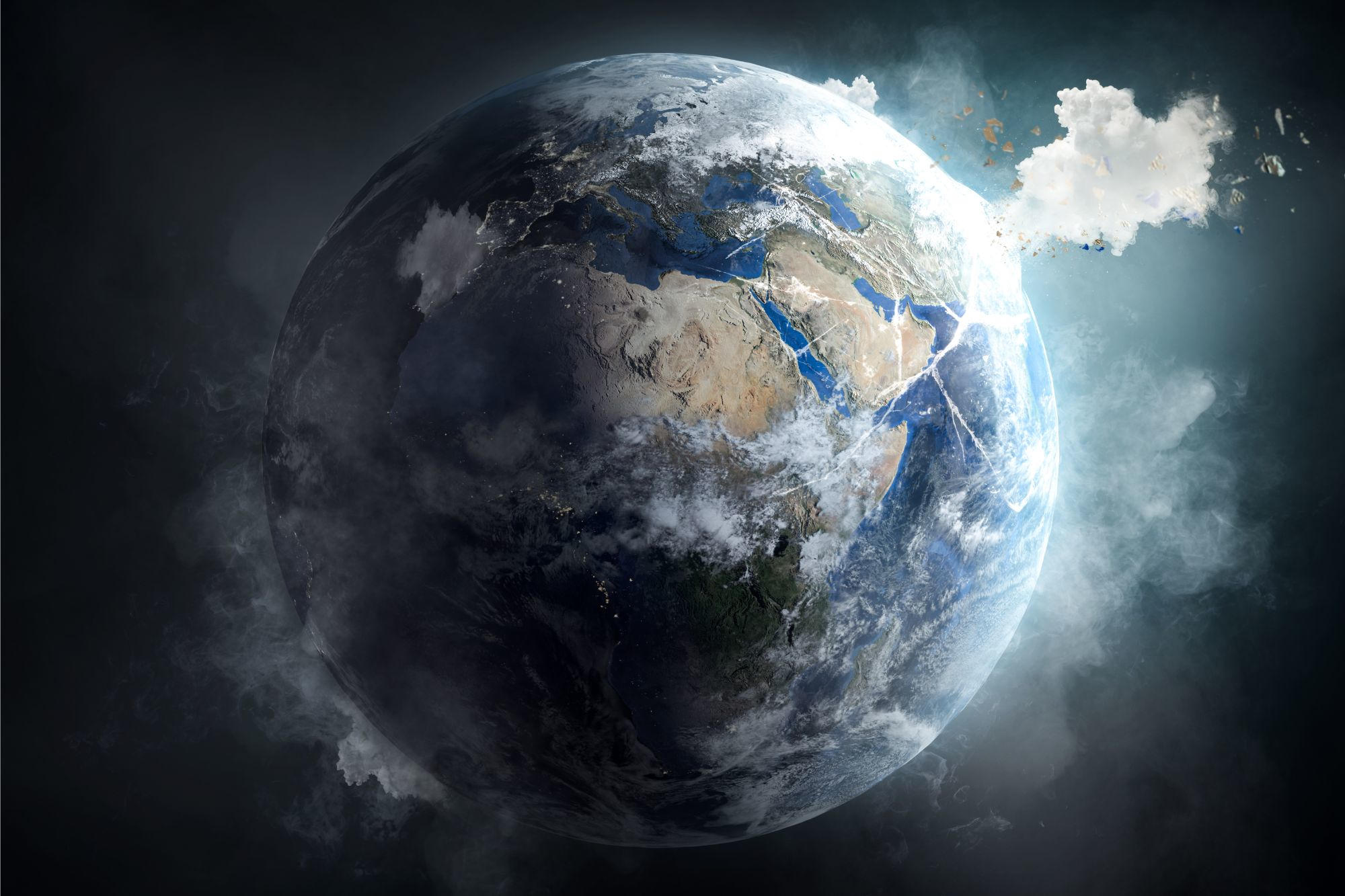
Earth’s current ice-covered state is an anomaly, relying on rare geological conditions, and scientists caution that excessive warming may not naturally revert to cooler climates.
New research reveals that the cool conditions necessary for ice caps to form on Earth are rare in the planet’s history and depend on a complex interplay of factors.
A team of scientists from the University of Leeds investigated why Earth has spent most of its history in a ‘greenhouse’ state—without ice caps—and why the present ice-covered conditions are so uncommon.
Their findings suggest that Earth’s current climate is an anomaly, made possible by a fortunate combination of circumstances.
Many ideas have previously been proposed to explain the known cold intervals in Earth’s history. These include decreased CO2 emissions from volcanoes, or increased carbon storage by forests, or the reaction of CO2 with certain types of rocks.
The researchers undertook the first-ever combined test of all of these cooling processes in a new type of long-term 3D model of the Earth which was first developed at the University of Leeds. This type of ‘Earth Evolution Model’ has only recently been made possible through advances in computing.
They concluded that no single process could drive these cold climates, and that the cooling in fact required the combined effects of several processes at once. The results of their study were recently published in the journal Science Advances.
The findings will help to reconcile a debate in the Earth Science community about which processes were responsible for driving these cold periods.
Why Icehouse Earth Is Rare
Lead author, Dr Andrew Meredith, who carried out the research while working in the School of Earth and Environment at the University of Leeds, said the study helped to explain why icehouse states are so rare.
“We now know that the reason we live on an Earth with ice caps – rather than an ice-free planet – is due to a coincidental combination of very low rates of global volcanism, and highly dispersed continents with big mountains, which allow for lots of global rainfall and therefore amplify reactions that remove carbon from the atmosphere,” he explained.
“The important implication here is that the Earth’s natural climate regulation mechanism appears to favor a warm and high-CO2 world with no ice caps, not the partially glaciated and low-CO2 world we have today.
“We think this general tendency towards a warm climate has helped prevent devastating ‘snowball Earth’ global glaciations, which have only occurred very rarely and have therefore helped life to continue to prosper.”
Benjamin Mills, Professor of Earth System Evolution in Leeds’ School of Earth and Environment, supervised the project. He added that the results of the research had important implications for global warming and the immediate future.
“There is an important message, which is that we should not expect the Earth to always return to a cold state as it was in the pre-industrial age,” he said.
“Earth’s current ice-covered state is not typical for the planet’s history, but our current global society relies on it.
“We should do everything we can to preserve it, and we should be careful with assumptions that cold climates will return if we drive excessive warming before stopping emissions. Over its long history, the Earth likes it hot, but our human society does not.”
Reference: “Phanerozoic icehouse climates as the result of multiple solid-Earth cooling mechanisms” by Andrew S. Merdith, Thomas M. Gernon, Pierre Maffre, Yannick Donnadieu, Yves Goddéris, Jack Longman, R. Dietmar Müller and Benjamin J. W. Mills, 14 February 2025, Science Advances.
DOI: 10.1126/sciadv.adm9798
Never miss a breakthrough: Join the SciTechDaily newsletter.
Follow us on Google and Google News.
11 Comments
Finally someone with common sense. You’d be surprised that a lot of people already knew this and didn’t need a degree to figure it out. Good luck convincing the liberal climate warming mungers that it’s a natural condition. The world is a place inhabited by some really smart dumb people.
“Over its long history, the Earth likes it hot, but our human society does not.”
So that’s why the tropics & subtropics are completely uninhabited!
P. S. Carlos is right; this has long been generally understood.
33 deg C and humid is livable, especially if one has a sea breeze or cool katabatic mountain breeze. 40 deg C and humid, day and night is a little more than horribly uncomfortable. 45 deg C and low humidity leads one to want to sit in the shade of a tree, whilst praying for a cool breeze at night, for the afternoon after starting work at 5am. Any hotter, humid or dry, is getting less than habitable unless one has airconditioning. Yes, people live in the tropics; but generally at daytime temperatures of around 30-35deg C and 24-26deg C maximum at night.
Don’t “scientists” look at climate history at all?
100,000 years ago humans lived through a time when the temperatures rose higher and faster than now. How did humans survive that without private jet-flying globalists taking all their money?
Kardashev fantasized about humans gaining the ability to tweak an energy balance favorable to certain humans living in certain geographic coordinates. I’d say that those smart dumb people, perhaps nefariously seeking economic hegemony, warped the messaging in a fit of anxious hypercompetition.
If no one mentioned global warming, which was the great global freeze when I was in high school in the late ’70s, this whole discussion wouldn’t be happening. We’ve come so far with pollution. The Beatles song, Blue Jay Way, is about the smog over LA. They cannot let it go. It’s now a religion, and carbon is the devil, apparently. There’s nothing you can say, nothing you can do. You’re dealing with fanatics, and it’s funny, just this week, reading about Australians and their fanaticism, obsession with so many L wing issues. I really think there’s an organic brain issue going on with many of these people. If you point out that core samples show warmer times before industry, they blow a gasket. If you point out the Roman Warm Period they blow a gasket. We just need to elect more Trumps, and roll over these fanatics. Period.
Eric Sanders, Trump is a fanatic! A dangerous one at that! It’s one thing to admit that global cooling was very real and reasonable, it’s a totally different thing to say let’s get more Trumps in to power!! A convicted felon and rapist who supports the biggest dictator (Putin) in the world is not the right words to use if you want to sound like you have a 1/4 of a brain cell!
It sounds like the authors have made the judgement that an ‘Ice House’ state is preferable to the state that Earth has experienced most during the last 4.6 billion years and allowed the exceptional evolution of life. Why else would they express a concern about them disappearing and not returning?
However, there have been ‘Ice House’ conditions frequently enough that I don’t think it is actually probable that they will stop for no apparent reason.
The one thing that is constant on Earth is change.
We know that when Co2 levels are elevated, plants grow at an accelerated rate..
The more Co2 in the atmosphere, the faster the forests and jungles will grow, and massive forests create their own weather and…. you get dinosaurs and megafauna… and I’m not sure where I was going with this but I’m sure I need a sandwich ✔️
The human race better due what it’s really good at then, adapt.