
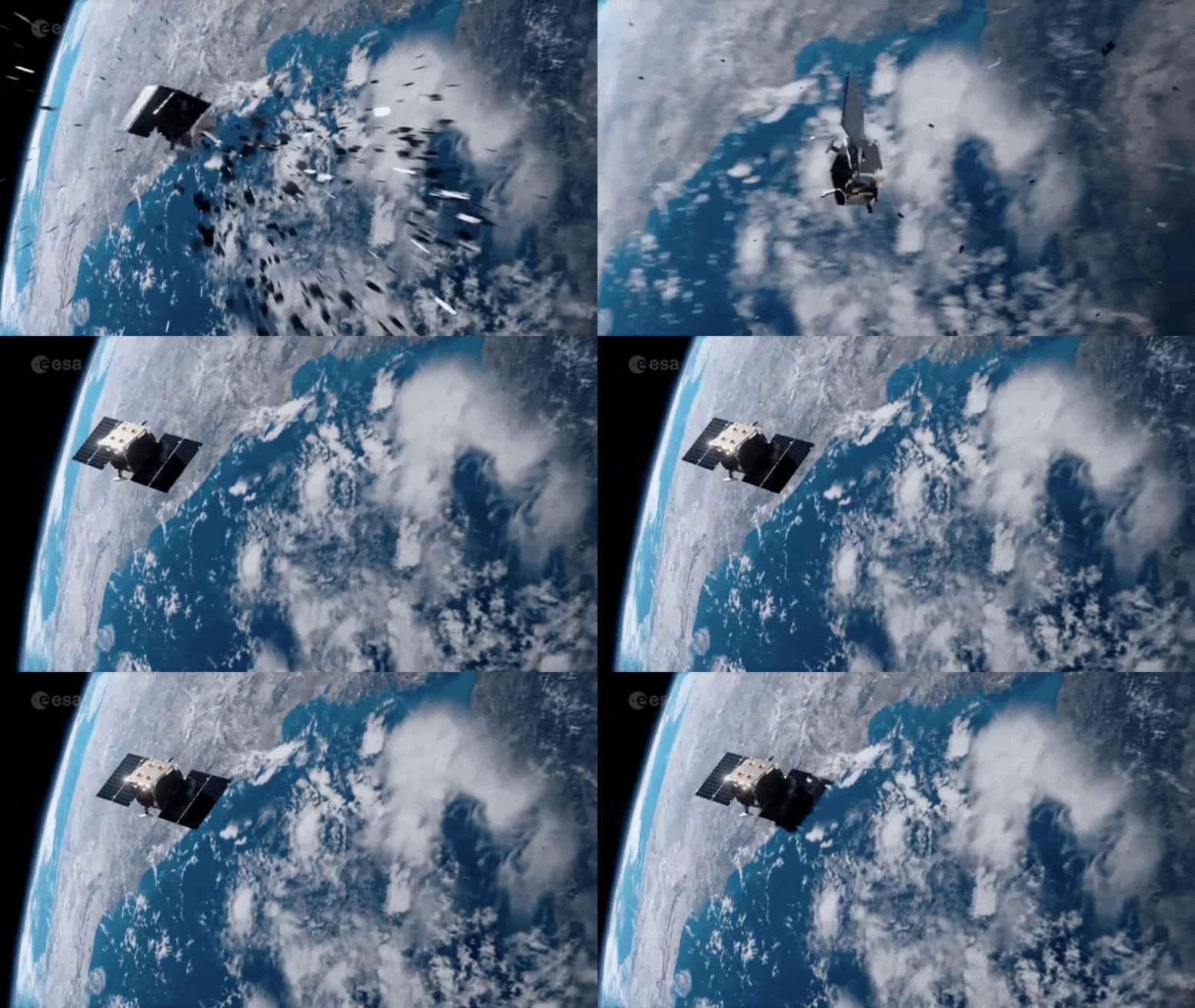
The reduced atmosphere in the upper atmosphere will increase satellites’ risk of collision with space pollution.
According to a recent study from the British Antarctic Survey, rising CO2 levels in the Earth’s atmosphere will cause a long-term drop in air density at high altitudes. This reduced density will lessen the drag on objects orbiting between 90 and 500 km in the upper atmosphere, prolonging the lifespan of space debris and increasing the possibility of debris collisions with satellites.
Collisions might result in serious issues if satellites, which cost billions of dollars, are destroyed since society is becoming more and more reliant on satellites for navigation systems, mobile communications, and monitoring Earth.
The study, which was recently published in the journal Geophysical Research Letters, offers the first realistic estimate of climate change in the upper atmosphere over the next 50 years. Although several studies have examined the changes that would occur in the lower and middle atmosphere, there has been far less research into situations that occur at higher altitudes.
A Scientific Reports study found that there were about 5,000 active and defunct satellites in low Earth orbit — up to 2,000km altitude — as of March 2021, and this number had increased by 50% over the previous two years. There are various companies planning to add thousands more in the next decade. Once decommissioned, satellites continue to orbit but gradually slow due to atmospheric drag, lowering their orbital altitude until they burn up in the lower atmosphere. Current guidelines set by the Inter-Agency Space Debris Coordination Committee advise that satellite operators make sure that decommissioned satellites deorbit within 25 years but the reduced atmospheric density will introduce errors in planning and calculations.
Cooling and Density Decline in the Upper Atmosphere
In contrast to the lower atmosphere, the middle and upper atmosphere has been cooling. This leads to a decline in density with practical implications for the drag on objects such as derelict satellites and space mission-related debris at those altitudes. With reduced drag the lifetime of these objects is extended, objects remain in orbit for longer and there is a greater risk of collision with active satellites as well as with other space debris.
Ingrid Cnossen, a NERC independent research fellow at the British Antarctic Survey, used a global model of the whole atmosphere up to 500 km altitude to simulate changes in the upper atmosphere up to 2070. She compared her projections to the last 50 years of data and found that even under a moderate future emissions scenario the predicted average cooling and decline in upper atmosphere density is about twice as strong as has been seen in the past.
Cnossen says: “The changes we saw between the climate in the upper atmosphere over the last 50 years and our predictions for the next 50 are a result of CO2 emissions. It is increasingly important to understand and predict how climate change will impact these regions, particularly for the satellite industry and the policymakers who are involved with setting standards for that industry.”
She continues, “Space debris is becoming a rapidly growing problem for satellite operators due to the risk of collisions, which the long-term decline in upper atmosphere density is making even worse. I hope this work will help to guide appropriate action to control the space pollution problem and ensure that the upper atmosphere remains a useable resource into the future.”
There are over 30,000 trackable debris pieces in low Earth orbit larger than 10 cm in diameter and 1 million debris objects greater than 1 cm according to the European Space Agency.
The Ionosphere and Climate Monitoring Challenges
The ionosphere – the charged part of the upper atmosphere – is also expected to change, in part as a result of increasing CO2 concentrations but also because of changes in the Earth’s magnetic field. Understanding the distribution of electrons in the ionosphere is important to correct for errors that they introduce into satellite-based sea level measurements used for climate monitoring. The largest changes in electron count are found to be expected over South America, the southern Atlantic Ocean, and western Africa. The study recommends that further studies monitor these changes and build up a picture in order to control for effects on satellite-based data applications.
References:
“A Realistic Projection of Climate Change in the Upper Atmosphere Into the 21st Century” by Ingrid Cnossen, 23 September 2022, Geophysical Research Letters.
DOI: 10.1029/2022GL100693
“Satellite mega-constellations create risks in Low Earth Orbit, the atmosphere and on Earth” by Aaron C. Boley, and Michael Byers, 20 May 2021, Scientific Reports.
DOI: 10.1038/s41598-021-89909-7
Never miss a breakthrough: Join the SciTechDaily newsletter.
Follow us on Google and Google News.
1 Comment
“… the first REALISTIC estimate of climate change in the upper atmosphere over the next 50 years.”
I’m not sure that I buy this. It is a matter of great concern to those building and maintaining satellites.
“This leads to a decline in density with practical implications for the drag on objects.” My understanding of the Universal Gas Law, PV=nRT, is that as a gas cools, the volume or pressure decreases and the density increases! Conversely, an increase in temperature of any of the layers causes the envelope to expand and exert increased drag at higher elevations. Perhaps I’m missing something here. However, a quick read of the actual article did not produce the claim made above.