

From sunflowers to starfish, symmetry appears everywhere in biology. This isn’t just true for body plans – the molecular machines keeping our cells alive are also strikingly symmetric. But why? Does evolution have a built-in preference for symmetry?
An international team of researchers believe so, and have combined ideas from biology, computer science, and mathematics to explain why. As they report in PNAS, symmetric and other simple structures emerge so commonly because evolution has an overwhelming preference for simple “algorithms” – that is, simple instruction sets or recipes for producing a given structure.
“Imagine having to tell a friend how to tile a floor using as few words as possible,” says Iain Johnston, a professor at the University of Bergen and author on the study. “You wouldn’t say: put diamonds here, long rectangles here, wide rectangles here. You’d say something like: put square tiles everywhere. And that simple, easy recipe gives a highly symmetric outcome.”
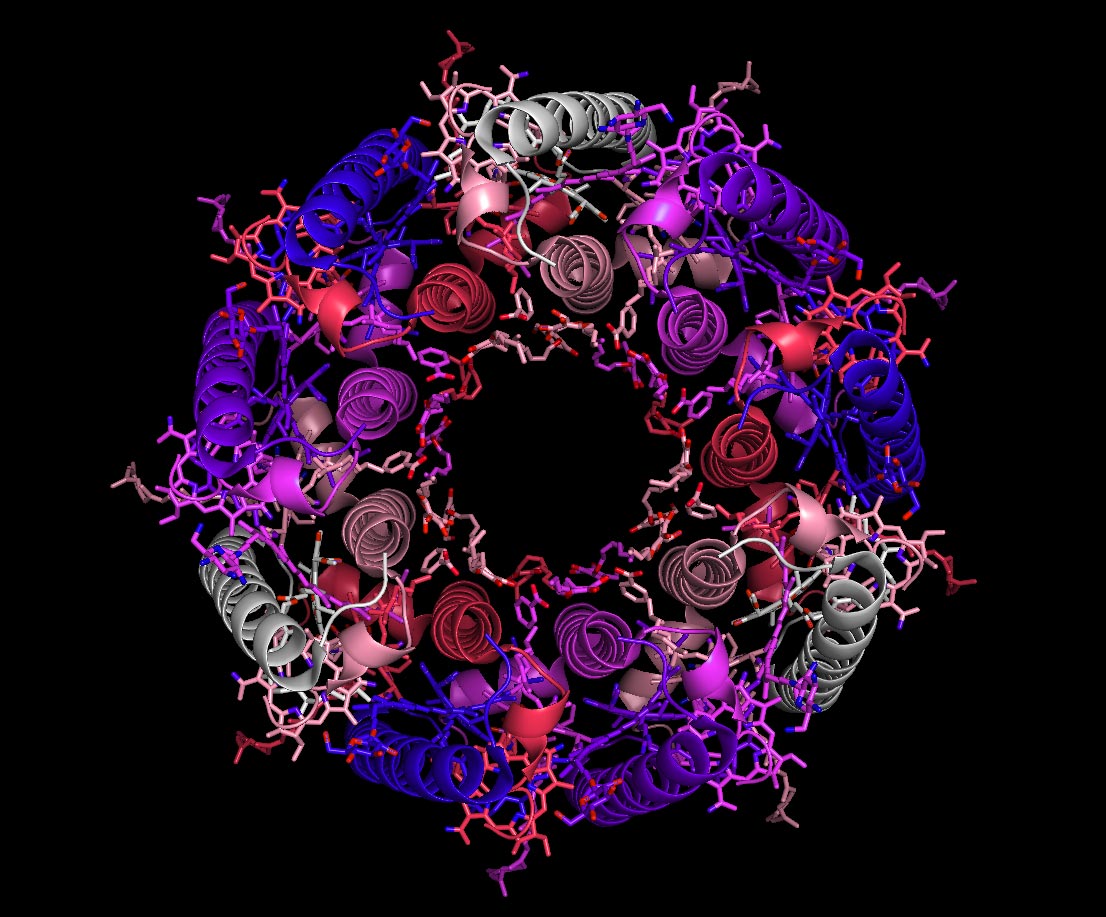
The team used computational modeling to explore how this preference comes about in biology. They showed that many more possible genomes describe simple algorithms than more complex ones. As evolution searches over possible genomes, simple algorithms are more likely to be discovered – as are, in turn, the more symmetric structures that they produce. The scientists then connected this evolutionary picture to a deep result from the theoretical discipline of algorithmic information
theory.
“These intuitions can be formalized in the field of algorithmic information theory, which provides quantitative predictions for the bias towards descriptive simplicity,” says Ard Louis, professor at the University of Oxford and corresponding author on the study.
The study’s key theoretical idea can be illustrated by a twist on a famous thought experiment in evolutionary biology, which pictures a room full of monkeys trying to write a book by typing randomly on a keyboard. Imagine the monkeys are instead trying to write a recipe. Each is far more likely to randomly hit the letters required to spell out a short, simple recipe than a long, complicated one. If we then follow any recipes the monkeys have produced – our metaphor for producing biological structures from genetic information – we will produce simple outcomes much more often than complicated ones.
The scientists show that a wide range of biological structures and systems, from proteins to RNA and signaling networks, adopt algorithmically simple structures with probabilities as predicted by this theory. Going forward, they plan to investigate the predictions that their theory makes for biases in larger-scale developmental processes.
Reference: “Symmetry and simplicity spontaneously emerge from the algorithmic nature of evolution” by Iain G. Johnston, Kamaludin Dingle, Sam F. Greenbury, Chico Q. Camargo, Jonathan P. K. Doye, Sebastian E. Ahnert and Ard A. Louis, 11 March 2022, Proceedings of the National Academy of Sciences.
DOI: 10.1073/pnas.2113883119
Never miss a breakthrough: Join the SciTechDaily newsletter.
Follow us on Google and Google News.
5 Comments
For forward progress, suggesting willpower, swimming, then walking then flying. It all takes equal pressure side to side, as fins turn to wings turn to feet and hands, symmetry is for MOVEMENT, in short.
“The new theory suggests that this symmetry emerges naturally from how information is encoded and used in evolution.”
This “theory” (or this sentence) makes no sense at all. “Emerges”? Really? Where the information in general (its specific goals and coordination), the specific information to “encode” and the specific information to “use” (how to “decode”) come from? It has nothing to do with evolution. The article even tries to “link” “molecular machines” to evolution! As if they were “friends”! No way. Btw, here’s another great machine (topoisomerase – great video): https://youtu.be/wQ5oPL0PqYE
When “evolution did it” is subtly presented without no power in evolution to do it, it seems obvious it’s another “nice try” to make people abandon their critical thinking and don’t see how desperately powerless evolution and its stories are when confronted to the great discoveries from molecular biology in our century.
Shamelessly attempting to make a link between molecular machines and evolution, low effort thinking, not enough proof and low on evidence. Plus symmetry is, as anyone with critical thinking would deduct, the easiest way to cope in life. Since symmetry is the ideal way to be for creatures to move and think (imagine if the 2 parts of the brain werent symmetric!)
The extraterrestrial link proposed then there follows “Where did they come from why and how do they exist do the same algorithms apply – why are they so apparently advanced what was their model from another galaxy”
Symmetry is the primal law of manifestation. From the earliest proto-material interactions—before atoms had even formed—to the intricate architectures of molecules in matter and life, integrity and stability emerge only through symmetry. Where symmetry prevails, structures hold; where it falters, they collapse.
The unfolding universe, and the life it carries, is nothing but the ceaseless play between entropy’s pull toward disorder and symmetry’s striving for stsymmetry.
Singularity, in its purest sense, lies beyond entropy and symmetry.
It is a state prior to differentiation, where the very notions of order and disorder, balance and imbalance, have no relevance. In singularity, there is no opposition, no dual play—only undivided potential.
Creation begins the moment this stillness stirs, when the seamless unity fractures into the twin principles of entropy and symmetry. From then on, existence unfolds as their perpetual interplay: entropy driving dissolution, symmetry striving for coherence. The cosmos and life are but waves rising from this tension, patterns born of their ceaseless dance.
Symetry is holding together to delay entropy before falling back to singularity.