
Close Menu
    Facebook X (Twitter) Instagram
    SciTechDaily
    • Biology
    • Chemistry
    • Earth
    • Health
    • Physics
    • Science
    • Space
    • Technology
    Facebook X (Twitter) Pinterest YouTube RSS
    SciTechDaily
    Home»Technology»Energizing the Future: The Rise of Bendable Storage Materials
    Technology

    Energizing the Future: The Rise of Bendable Storage Materials

    By Pohang University of Science & Technology (POSTECH)March 29, 2024No Comments3 Mins Read
    Facebook Twitter Pinterest Telegram LinkedIn WhatsApp Email Reddit
    Share
    Facebook Twitter LinkedIn Pinterest Telegram Email Reddit
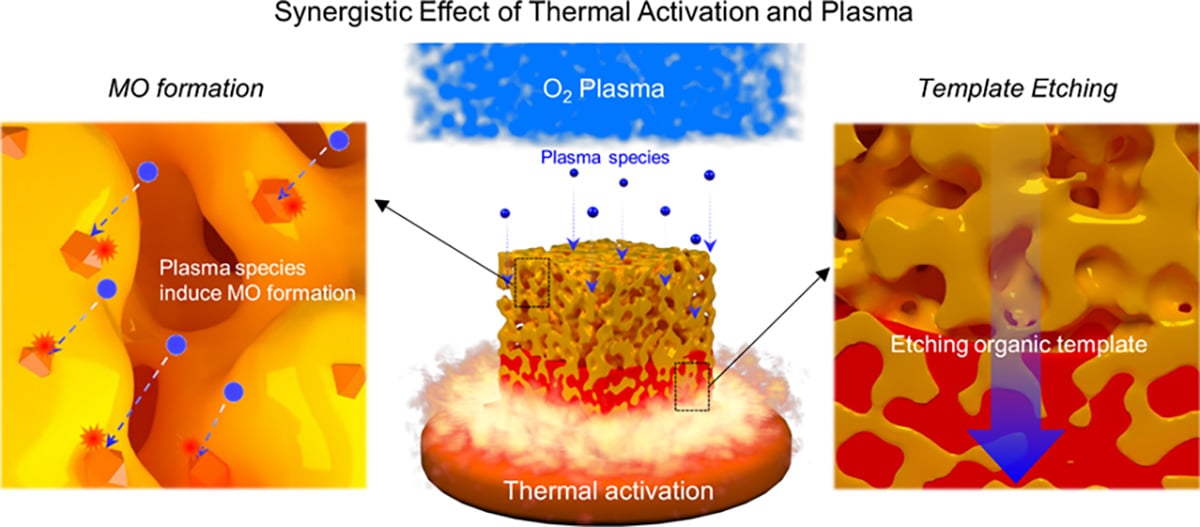
    Synergistic Effect of Thermal Activation and Plasma
    Synergistic effect of thermal activation and plasma. Credit: POSTECH

    Imaging being able to wear your smartphone on your wrist, not as a watch, but literally as a flexible band that surrounds around your arm. How about clothes that charge your gadgets just by wearing them?

    Recently, a collaborative team led by Professor Jin Kon Kim and Dr. Keon-Woo Kim of Pohang University of Science and Technology (POSTECH), Professor Taesung Kim and M.S./Ph.D. student Hyunho Seok of Sungkyunkwan University (SKKU), and Professor Hong Chul Moon of University of Seoul (UOS) has brought a step closer to making this reality. This research work was published in Advanced Materials.

    Challenges in Developing Flexible Devices

    Mesoporous metal oxides (MMOs) are characterized by pores ranging from 2 to 50 nanometers (nm) in size. Due to their extensive surface area, MMOs have various applications, such as high-performance energy storage and efficient catalysis, semiconductors, and sensors.

    However, the integration of MMOs on wearable and flexible devices remains a great challenge, because plastic substrates could not maintain their integrity at elevated temperatures (350°C or above) where MMOs could be synthesized.
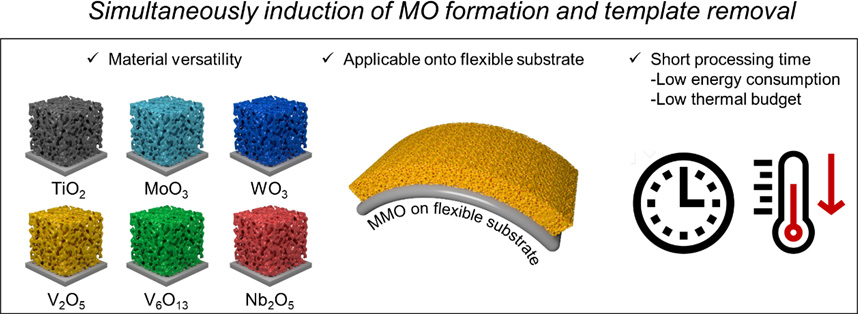
    Simultaneously Induction of Metal Oxides Formation and Template Removal
    Simultaneously induction of metal oxides formation and template removal. Credit: POSTECH

    The research team tackled this problem by using the synergetic effect of heat and plasma to synthesize various MMOs including vanadium oxide (V2O5), renowned high-performance energy storage materials, V6O13, TiO2, Nb2O5, and WO3, on flexible materials at much lower temperatures (150 ~ 200 oC). The high reactive plasma chemical moieties provide enough energy that could be compensated by high temperature. The fabricated devices could be bent thousands of times without losing the energy storage performance.

    Professor Jin Kon Kim, the leading researcher, expressed his opinion, stating: “We’re on the brink of a revolution in wearable tech. Our breakthrough could lead to gadgets that are not only more flexible but also much more adaptable to our daily needs.”

    Reference: “Low-Temperature, Universal Synthetic Route for Mesoporous Metal Oxides by Exploiting Synergistic Effect of Thermal Activation and Plasma” by Keon-Woo Kim, Hyunho Seok, Sihoon Son, Su-Jeong Park, Chanwoo Yang, Dongho Lee, Hyo-Chang Lee, Jihun Mun, Hee-Jung Yeom, Min Young Yoon, Bomi Park, Se Hyun Kim, Changshin Jo, Hong Chul Moon, Taesung Kim and Jin Kon Kim, 19 January 2024, Advanced Materials.
    DOI: 10.1002/adma.202311809

    This research was supported by National Creative Initiative Research Program, the Basic Research in Science & Engineering Program, and the Nano & Material Technology Development Program.

    Never miss a breakthrough: Join the SciTechDaily newsletter.
    Follow us on Google and Google News.

    Energy Engineering Mechanical Engineering Pohang University of Science & Technology
    Share. Facebook Twitter Pinterest LinkedIn Email Reddit

    Related Articles

    Scientists Uncover Game-Changing Fix That Could Extend Battery Life by Over 19 Times

    No More Blackouts? New Framework Guarantees the Stability of Microgrids

    New Aluminum Batteries Increase the Range of UUVs Tenfold

    MIT Engineers Look Toward All-Solid Lithium Batteries

    Engineers Design Calcium-Based Multi-Element for Liquid Batteries

    Sustainable Power Sources Based on High Efficiency Thermopower Wave Devices

    New Material Can Store Solar Energy During the Day and Release it Later as Heat

    Thermal-Imaging Quickly Tracks Energy Leaks in Homes and Buildings

    Power Conserving Chip May Increase Smartphone Battery Life

    Leave A Reply Cancel Reply

    • Facebook
    • Twitter
    • Pinterest
    • YouTube

    Don't Miss a Discovery

    Subscribe for the Latest in Science & Tech!

    Trending News

    Breakthrough Bowel Cancer Trial Leaves Patients Cancer-Free for Nearly 3 Years

    Natural Compound Shows Powerful Potential Against Rheumatoid Arthritis

    100,000-Year-Old Neanderthal Fossils in Poland Reveal Unexpected Genetic Connections

    Simple “Gut Reset” May Prevent Weight Gain After Ozempic or Wegovy

    2.8 Days to Disaster: Scientists Warn Low Earth Orbit Could Suddenly Collapse

    Common Food Compound Shows Surprising Power Against Superbugs

    5 Simple Ways To Remember More and Forget Less

    The Atomic Gap That Could Cost the Semiconductor Industry Billions

    Follow SciTechDaily
    • Facebook
    • Twitter
    • YouTube
    • Pinterest
    • Newsletter
    • RSS
    SciTech News
    • Biology News
    • Chemistry News
    • Earth News
    • Health News
    • Physics News
    • Science News
    • Space News
    • Technology News
    Recent Posts
    • After 37 Years, the World’s Longest-Running Soil Warming Experiment Uncovers a Startling Climate Secret
    • NASA Satellite Captures First-Ever High-Res View of Massive Pacific Tsunami
    • ADHD Isn’t Just a Deficit: Study Reveals Powerful Hidden Strengths
    • Scientists Uncover “Astonishing” Hidden Property of Light
    • Scientists Discover Stem Cells That Could Regrow Teeth and Bone
    Copyright © 1998 - 2026 SciTechDaily. All Rights Reserved.
    • Science News
    • About
    • Contact
    • Editorial Board
    • Privacy Policy
    • Terms of Use

    Type above and press Enter to search. Press Esc to cancel.