
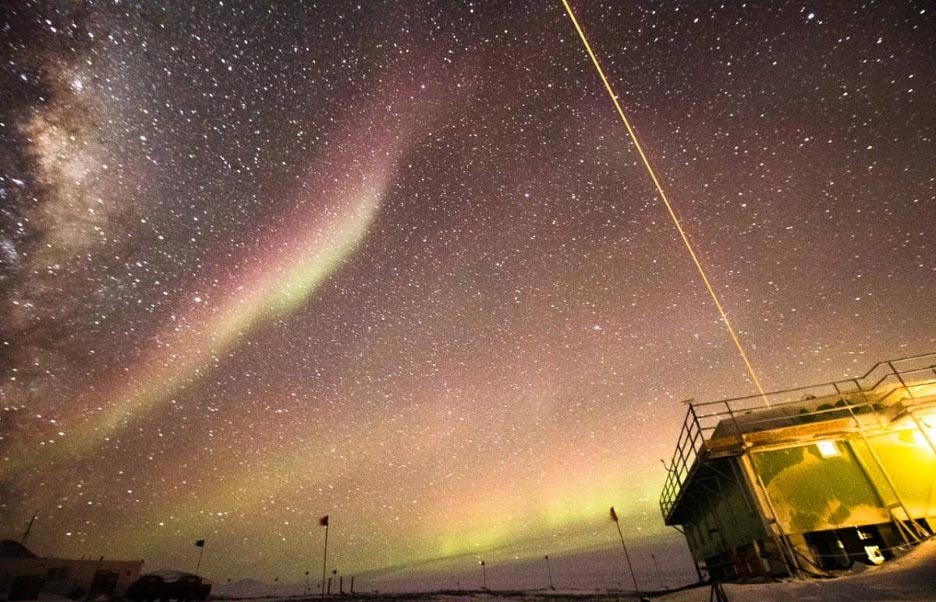
A University of Colorado Boulder-led team is the first to observe new equatorial wind patterns in Antarctica, revealing new connections in global circulation.
A CIRES-led team has uncovered a critical connection between winds at Earth’s equator and atmospheric waves 6,000 miles away at the South Pole. The team has found, for the first time, evidence of a Quasi-Biennial Oscillation (QBO)—an atmospheric circulation pattern that originates at the equator—at McMurdo, Antarctica.
The discovery highlights how winds in the deep tropics affect the remote South Pole, in particular the polar vortex, which can trigger outbreaks of cold weather patterns in mid latitudes. Scientists will be able to use this information to better understand the planet’s weather and climate patterns and fuel more accurate atmospheric models, the authors say.
“We have now seen how this atmospheric pattern propagates from the equator all the way to the high latitudes of Antarctica, showing how these far-away regions can be linked in ways we didn’t know about before,” said Zimu Li, a former CIRES research assistant who did this work at CU Boulder, and lead author of the study out today in the Journal of Geophysical Research: Atmospheres.
“This can better our understanding of how large-scale atmospheric circulation works, and how patterns in one area of the world can ripple across the entire globe,” said Xinzhao Chu, CIRES Fellow, professor in the Ann & H.J. Smead Department of Aerospace Engineering Sciences at the University of Colorado Boulder, and corresponding author on the new work.
Every two years or so, the QBO causes the stratospheric winds at Earth’s equator to switch direction, alternating between easterly and westerly. Lynn Harvey, a researcher at CU’s Laboratory for Atmospheric and Space Physics (LASP) and a coauthor on the study, helped the team study the polar vortices, the massive swirls of cold air that spiral over each of Earth’s poles. The study reports that the Antarctic vortex expands during the QBO easterly phase and contracts during the westerly phase. The team suspects that when the QBO changes the polar vortex behavior, that, in turn, affects the behavior of atmospheric waves called gravity waves, which travel across different layers of the atmosphere. They identified specific kinds of changes in those gravity waves: The waves are stronger during the easterly period of the QBO and weaker when the QBO is westerly.
For the last nine years, members of Chu’s lidar team have spent long seasons at McMurdo Station, Antarctica, braving 24-hour darkness and frigid temperatures to operate custom lasers and measure patterns in Earth’s atmosphere. These long-term measurements, along with 21 years of NASA MERRA-2 atmospheric records, were critical to the new findings. Each QBO cycle takes years to complete, so long-term data streams are the only way to identify interannual connections and patterns.
“Atmospheric scientists can use this information to improve their models—before this nobody really knew how QBO impacts gravity waves in this polar region,” said Xian Lu, researcher at Clemson University and a coauthor on the study. “Researchers can use this information to better model and predict climate, including the variability of atmosphere and space and long-term change.”
Reference: “First Lidar Observations of Quasi‐Biennial Oscillation‐Induced Interannual Variations of Gravity Wave Potential Energy Density at McMurdo via a Modulation of the Antarctic Polar Vortex” by Zimu Li, Xinzhao Chu, V. Lynn Harvey, Jackson Jandreau, Xian Lu, Zhibin Yu, Jian Zhao and Weichun Fong, 26 July 2020, JGR Atmospheres.
DOI: 10.1029/2020JD032866
“First Lidar Observations of Quasi-Biennial Oscillation-Induced Interannual Variations of Gravity Wave Potential Energy Density at McMurdo via a Modulation of the Antarctic Polar Vortex” published in Journal of Geophysical Research: Atmospheres on 26 July, 2020. Authors include: Zimu Li (CIRES), Xinzhao Chu (CIRES, CU Boulder Ann & H.J. Smead Department of Aerospace Engineering Sciences), V. Lynn Harvey (CU Laboratory for Atmospheric and Space Physics), Jackson Jandreau (CIRES, CU Boulder Department of Aerospace Engineering Sciences, Smead Scholar), Xian Lu (Clemson University, Department of Physics and Astronomy), Zhibin Yu (CIRES, Harbin Institute of Technology), Jian Zhao (CIRES), Weichun Fong (CIRES).
We gratefully acknowledge the graduate students and research scientists who made contributions to the McMurdo lidar campaign, including many winter-over lidar scientists. We sincerely appreciate the staff of the United States Antarctic Program, McMurdo Station, Antarctica New Zealand and Scott Base for their superb support over the years.The lidars were housed in the Arrival Heights Observatory run by Antarctica New Zealand, and the lidar observations were enabled by a collaboration between the United States Antarctic Program and Antarctica New Zealand. This project was supported by the National Science Foundation grants OPP-0839091, OPP-1246405, and OPP-1443726.
Never miss a breakthrough: Join the SciTechDaily newsletter.
Follow us on Google and Google News.