
Close Menu
    Facebook X (Twitter) Instagram
    SciTechDaily
    • Biology
    • Chemistry
    • Earth
    • Health
    • Physics
    • Science
    • Space
    • Technology
    Facebook X (Twitter) Pinterest YouTube RSS
    SciTechDaily
    Home»Space»ESO Image of the Week – Dawn of a New Era for Supernova 1987A
    Space

    ESO Image of the Week – Dawn of a New Era for Supernova 1987A

    By SciTechDailyFebruary 27, 2017No Comments2 Mins Read
    Facebook Twitter Pinterest Telegram LinkedIn WhatsApp Email Reddit
    Share
    Facebook Twitter LinkedIn Pinterest Telegram Email Reddit
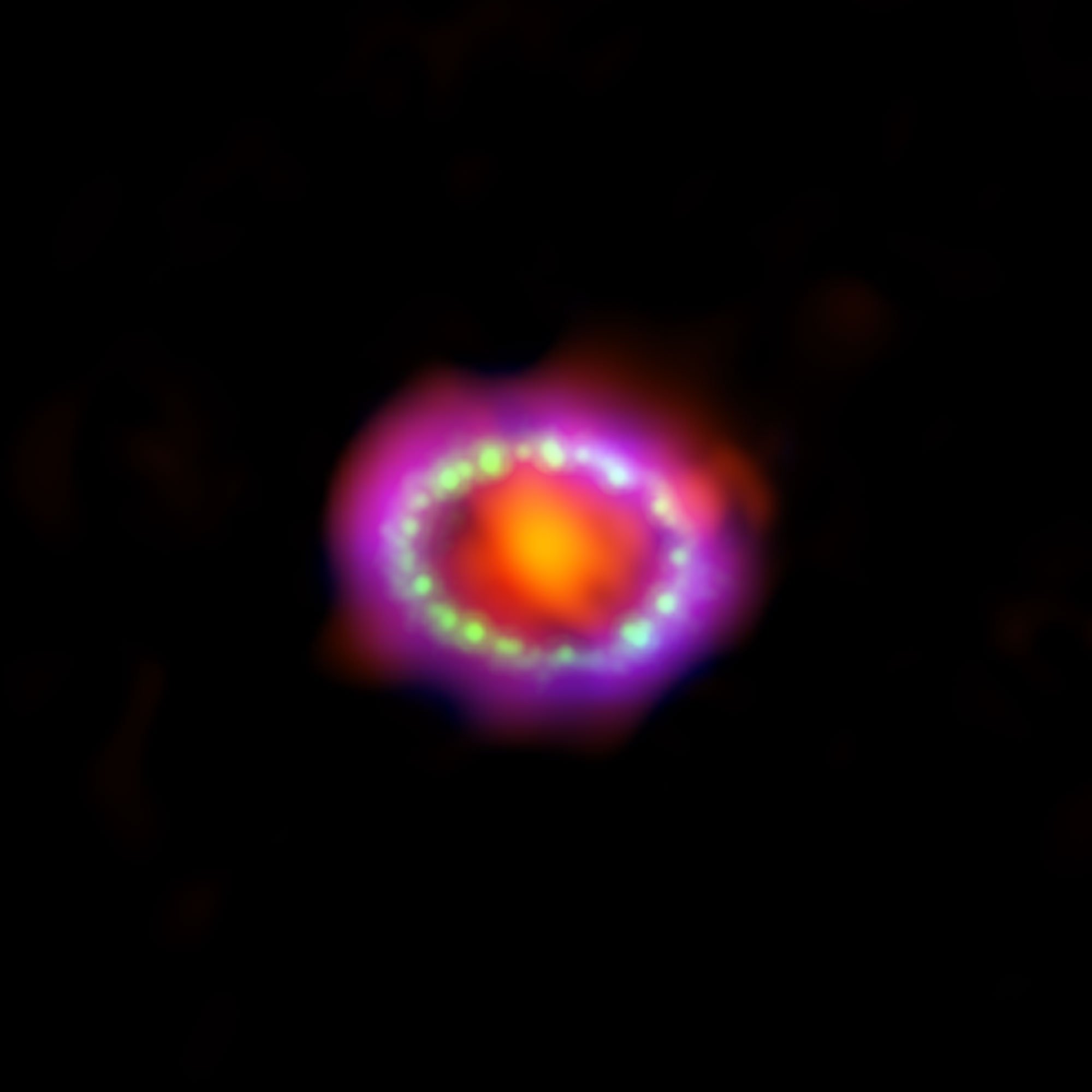
    New Composite Image of Supernova 1987A
    Credit: ALMA: ESO/NAOJ/NRAO/A. Angelich; Hubble: NASA, ESA, R. Kirshner (Harvard-Smithsonian Center for Astrophysics and Gordon and Betty Moore Foundation) and P. Challis (Harvard-Smithsonian Center for Astrophysics); Chandra: NASA/CXC/Penn State/K. Frank et al.

    This composite image shows Supernova 1987A, one of the brightest supernovae detected since the invention of the telescope.

    Three decades ago, astronomers spotted one of the brightest supernovae in more than 400 years. The stellar explosion, SN 1987A, blazed with the power of 100 million suns for several months after its discovery on February 23, 1987.

    Located in the Large Magellanic Cloud, one of the Milky Way’s satellite galaxies, SN 1987A was the nearest supernova explosion observed in centuries and it quickly became the best-studied supernova of all time. Over the last thirty years, detailed follow-up observations with telescopes both in space and on the ground have allowed astronomers to study the death throes of a massive star in unprecedented detail, from star to supernova to supernova remnant, revolutionizing our understanding of these explosive events.

    With its superb sensitivity at millimeter and submillimeter wavelengths, the Atacama Large Millimeter/submillimeter Array (ALMA) has been exploring previously unstudied aspects of SN 1987A since 2013. Astronomers are using ALMA to observe the glowing remains of the supernova in high resolution, studying how the remnant is making vast amounts of dust from the new elements created in the progenitor star. A portion of this dust will make its way into interstellar space and may one day be the material from which future planets around other stars are made. These observations suggest that dust in the early Universe was created by similar supernova explosions.

    The composite image presented here combines observations made with ALMA, the NASA/ESA Hubble Space Telescope, and NASA’s Chandra X-Ray observatory.

    More Information: 3D Model Allows Astronomers to Explore Supernova 1987a Like Never Before

    Never miss a breakthrough: Join the SciTechDaily newsletter.
    Follow us on Google and Google News.

    ALMA Astronomy Chandra X-ray Observatory Hubble Space Telescope Popular Supernova
    Share. Facebook Twitter Pinterest LinkedIn Email Reddit

    Related Articles

    3D Model Lets Astronomers Explore Supernova 1987a Like Never Before

    Astronomers Discover Clues For How Giant Black Holes Formed So Quickly

    Astronomers Identify Likely Trigger for Milky Way’s Youngest Supernova

    Hubble Telescope Views Shrapnel from the Veil Nebula Supernova Remnant

    Chandra and Hubble Find Clues That May Help Identify Dark Matter

    Hubble Discovers a Companion Star to a Rare Type of Supernova

    Chandra Reveals a New Composite Image of NGC 4258

    Swift Reveals Before and After Images of Supernova SN 2014J

    Astronomers Detect X-rays From the Remains of Supernova SN 1957D

    Leave A Reply Cancel Reply

    • Facebook
    • Twitter
    • Pinterest
    • YouTube

    Don't Miss a Discovery

    Subscribe for the Latest in Science & Tech!

    Trending News

    Why Popular Diabetes Drugs Like Ozempic Don’t Work for Everyone: The “Genetic Glitch”

    Scientists Stunned After Finding Plant Thought Extinct for 60 Years

    Scientists Discover Tiny New Spider That Hunts Prey 6x Its Size

    Natural Component From Licorice Shows Promise for Treating Inflammatory Bowel Disease

    Scientists Warn: Popular Sweetener Linked to Dangerous Metabolic Effects

    Monster Storms on Jupiter Unleash Lightning Beyond Anything on Earth

    Scientists Create “Liquid Gears” That Spin Without Touching

    The Simple Habit That Could Help Prevent Cancer

    Follow SciTechDaily
    • Facebook
    • Twitter
    • YouTube
    • Pinterest
    • Newsletter
    • RSS
    SciTech News
    • Biology News
    • Chemistry News
    • Earth News
    • Health News
    • Physics News
    • Science News
    • Space News
    • Technology News
    Recent Posts
    • Hidden Ocean Currents Revealed in Stunning Detail by AI
    • Trees Emit Tiny Lightning Flashes During Storms and Scientists Finally Prove It
    • Forget Chemicals. This Plant Removes Microplastics From Water
    • Breakthrough Crystal Lets Scientists “Write” Nanoscale Patterns With Light
    • Pomegranate Compound Could Help Protect Against Heart Disease
    Copyright © 1998 - 2026 SciTechDaily. All Rights Reserved.
    • Science News
    • About
    • Contact
    • Editorial Board
    • Privacy Policy
    • Terms of Use

    Type above and press Enter to search. Press Esc to cancel.