
Close Menu
    Facebook X (Twitter) Instagram
    SciTechDaily
    • Biology
    • Chemistry
    • Earth
    • Health
    • Physics
    • Science
    • Space
    • Technology
    Facebook X (Twitter) Pinterest YouTube RSS
    SciTechDaily
    Home»Space»ESO Views the Ghost of a Dying Star – Planetary Nebula ESO 378-1
    Space

    ESO Views the Ghost of a Dying Star – Planetary Nebula ESO 378-1

    By European Southern ObservatoryAugust 24, 2015No Comments3 Mins Read
    Facebook Twitter Pinterest Telegram LinkedIn WhatsApp Email Reddit
    Share
    Facebook Twitter LinkedIn Pinterest Telegram Email Reddit
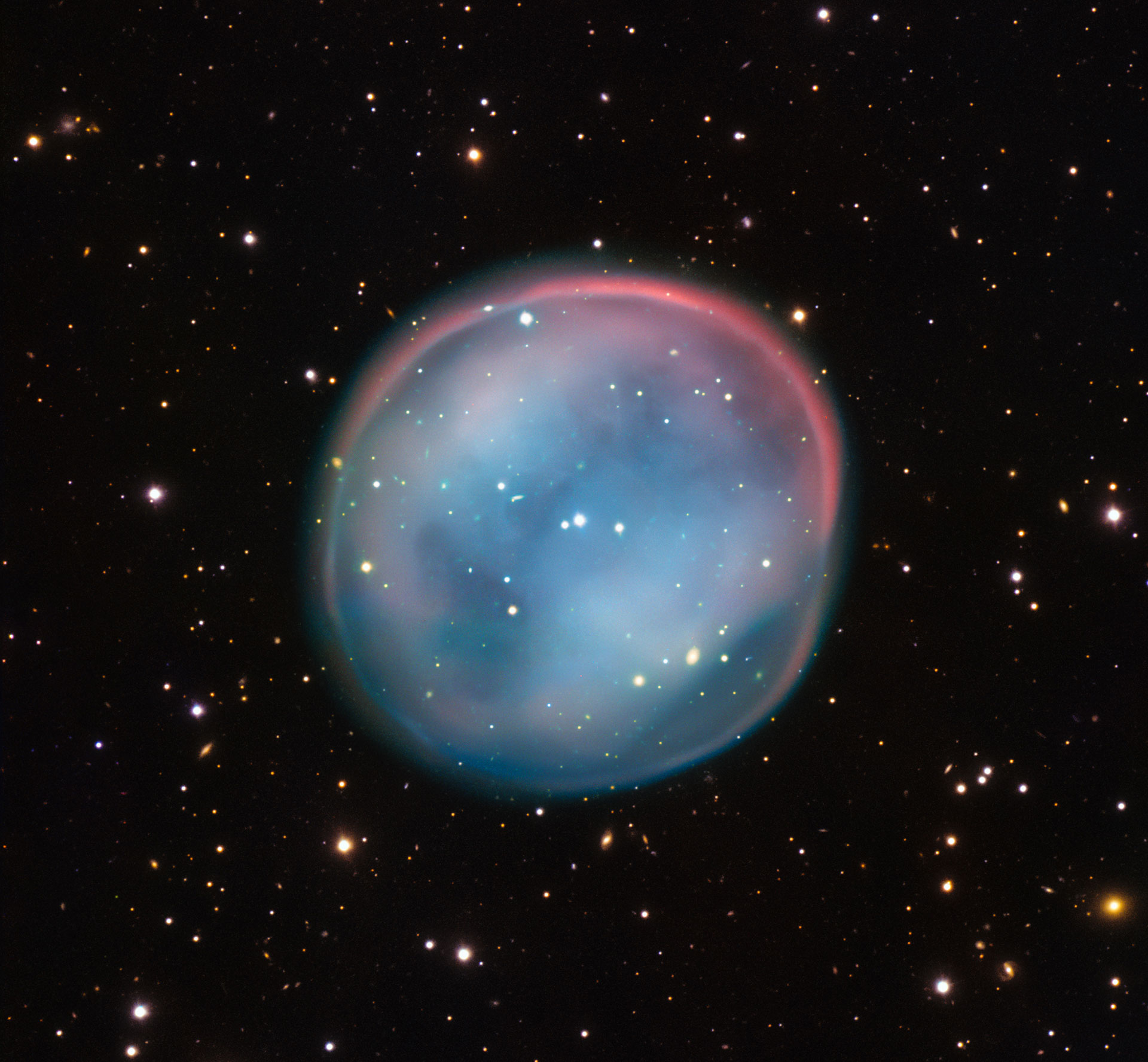
    ESO Views Planetary Nebula ESO 378-1
    ESO 378-1, which is also cataloged as PN K 1-22 and PN G283.6+25.3, is located in the constellation of Hydra (The Female Water Snake).

    A new image from ESO’s Very Large Telescope provides the best view to date of planetary nebula ESO 378-1.

    This extraordinary bubble, glowing like the ghost of a star in the haunting darkness of space, may appear supernatural and mysterious, but it is a familiar astronomical object: a planetary nebula, the remnants of a dying star.

    Nicknamed the Southern Owl Nebula, this shimmering orb is a planetary nebula with a diameter of almost four light-years. Its informal name relates to its visual cousin in the northern hemisphere, the Owl Nebula. ESO 378-1, which is also cataloged as PN K 1-22 and PN G283.6+25.3, is located in the constellation of Hydra (The Female Water Snake).

    Like all planetary nebulae, ESO 378-1 is a relatively short-lived phenomenon, lasting only a few tens of thousands of years, compared to a typical stellar lifetime of several billion years.

    Planetary nebulae are created by the ejected and expanding gas of dying stars. Although they are brilliant and intriguing objects in the initial stages of formation, these bubbles fade away as their constituent gas moves away and the central stars grow dimmer.

    For a planetary nebula to form, the aging star must have a mass less than about eight times that of the Sun. Stars that are heavier than this limit will end their lives in dramatic fashion as supernova explosions.


    Panning across the planetary nebula ESO 378-1

    As these less massive stars grow old they start to lose their outer layers of gas to stellar winds. After most of these outer layers have dissipated, the remaining hot stellar core starts to emit ultraviolet radiation which then ionizes the surrounding gas. This ionization causes the expanding shell of ghostly gas to begin to glow in bright colors.

    After the planetary nebula has faded away, the leftover stellar remnant will burn for another billion years before consuming all its remaining fuel. It will then become a tiny — but hot and very dense — white dwarf that will slowly cool over billions of years. The Sun will produce a planetary nebula several billion years in the future and will afterward also spend its twilight years as a white dwarf.

    Planetary nebulae play a crucial role in the chemical enrichment and evolution of the Universe. Elements such as carbon and nitrogen, as well as some other heavier elements, are created in these stars and returned to the interstellar medium. Out of this material new stars, planets, and eventually life can form. Hence astronomer Carl Sagan’s famous phrase: “We are made of star stuff.”

    This picture comes from the ESO Cosmic Gems program, an outreach initiative to produce images of interesting, intriguing or visually attractive objects using ESO telescopes for the purposes of education and public outreach. The program makes use of telescope time that cannot be used for science observations. All data collected may also be suitable for scientific purposes, and are made available to astronomers through ESO’s science archive.

    Never miss a breakthrough: Join the SciTechDaily newsletter.
    Follow us on Google and Google News.

    Astronomy European Southern Observatory Nebula Very Large Telescope
    Share. Facebook Twitter Pinterest LinkedIn Email Reddit

    Related Articles

    “We Found Something Never Seen Before” – Mysterious Shock Wave Around Dead Star Surprises Astronomers

    ESO’s Very Large Telescope Views Planetary Nebula Abell 33

    Planetary Nebula Fleming 1 Likely Has Two White Dwarfs Circling Each Other at Its Center

    Detailed Image of Barnard 59, The Mouthpiece of the Pipe Nebula

    ESO’s New Image of Spiral Galaxy NGC 1187

    VLT Reveals That O Stars, Which Drive the Evolution of Galaxies, Don’t Live Alone

    Popular VISTA Image of the Orion Nebula

    Scientists Detect Dark Galaxies for the First Time

    Astronomers Combine Hundreds of Images of Carina Nebula to Reveal Thousands of Stars in Stellar Nursery

    Leave A Reply Cancel Reply

    • Facebook
    • Twitter
    • Pinterest
    • YouTube

    Don't Miss a Discovery

    Subscribe for the Latest in Science & Tech!

    Trending News

    Quantum Fluctuations Break a Crystal’s Symmetry Rules

    Why Does an Irregular Heartbeat Strike 40 Years Early in Some People?

    Scientists Reveal How ADHD Could Fuel Creative Thinking

    Scientists Find Just 3 Minutes of Sprinting Can Transform Blood Chemistry

    Have We Found Alien Life? Here’s What Scientists Really Think

    Neuroscientist Challenges the Idea That Your Brain “Makes” Decisions

    Quitting Alcohol Can Change the Brain in Surprising Ways, Mouse Study Finds

    FDA-Approved Drug Shows Promise for Reversing Osteoarthritis Damage

    Follow SciTechDaily
    • Facebook
    • Twitter
    • YouTube
    • Pinterest
    • Newsletter
    • RSS
    SciTech News
    • Biology News
    • Chemistry News
    • Earth News
    • Health News
    • Physics News
    • Science News
    • Space News
    • Technology News
    Recent Posts
    • Ancient DNA Reveals How Europe Changed After the Fall of Rome
    • Historians Called Them “Housekeepers” – but Roman Women Were Running Profitable Farms
    • Construction Crew Uncovers Giant 20-Meter Dinosaur in Brazil
    • New Soil Test Could Improve Our Understanding of a Vital but Limited Nutrient
    • A Manhattan-Sized Ice Island Just Broke Off Greenland
    Copyright © 1998 - 2026 SciTechDaily. All Rights Reserved.
    • Science News
    • About
    • Contact
    • Editorial Board
    • Privacy Policy
    • Terms of Use

    Type above and press Enter to search. Press Esc to cancel.