
Close Menu
    Facebook X (Twitter) Instagram
    SciTechDaily
    • Biology
    • Chemistry
    • Earth
    • Health
    • Physics
    • Science
    • Space
    • Technology
    Facebook X (Twitter) Pinterest YouTube RSS
    SciTechDaily
    Home»Space»ESO Views the Star Formation Region NGC 6559
    Space

    ESO Views the Star Formation Region NGC 6559

    By European Southern ObservatoryMay 2, 2013No Comments4 Mins Read
    Facebook Twitter Pinterest Telegram LinkedIn WhatsApp Email Reddit
    Share
    Facebook Twitter LinkedIn Pinterest Telegram Email Reddit
    ESO Zooms in on the Star Formation Region NGC 6559
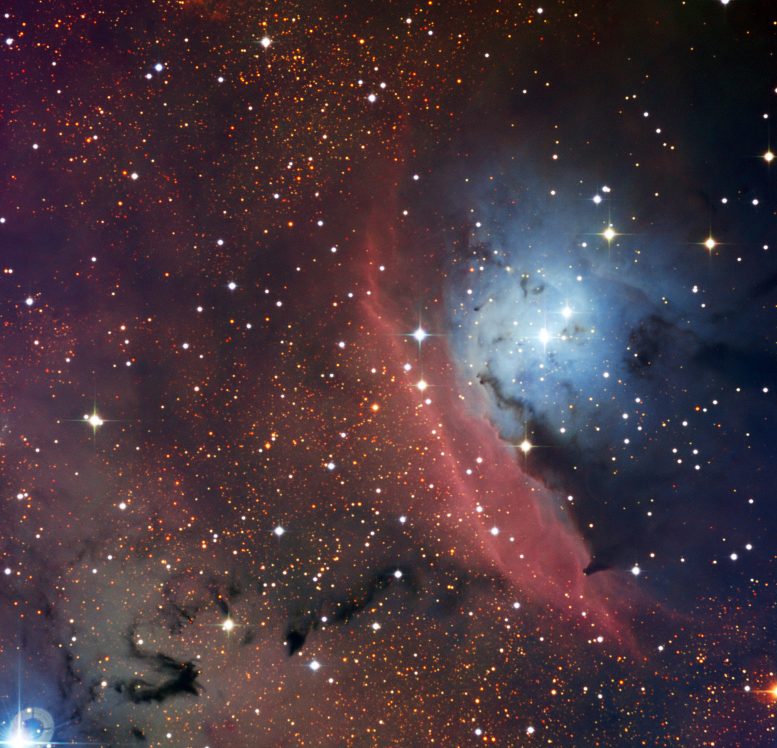
    The Danish 1.54-meter telescope located at ESO’s La Silla Observatory in Chile has captured a striking image of NGC 6559, an object that showcases the anarchy that reigns when stars form inside an interstellar cloud. This region of sky includes glowing red clouds of mostly hydrogen gas, blue regions where starlight is being reflected from tiny particles of dust and also dark regions where the dust is thick and opaque. Credit: ESO

    A new image from ESO’s La Silla Observatory in Chile shows NGC 6559, a star formation region located roughly 5,000 light-years from Earth in the constellation of Sagittarius.

    The Danish 1.54-meter (5-foot) telescope located at ESO’s La Silla Observatory in Chile has captured a striking image of NGC 6559, an object that showcases the anarchy that reigns when stars form inside an interstellar cloud.

    NGC 6559 is a cloud of gas and dust located at a distance of about 5000 light-years from Earth, in the constellation of Sagittarius (The Archer). The glowing region is a relatively small object, just a few light-years across, in contrast to the one hundred light-years and more spanned by its famous neighbor, the Lagoon Nebula (Messier 8, eso0936). Although it is usually overlooked in favor of its distinguished companion, NGC 6559 has the leading role in this new picture.

    The gas in the clouds of NGC 6559, mainly hydrogen, is the raw material for star formation. When a region inside this nebula gathers enough matter, it starts to collapse under its own gravity. The center of the cloud grows ever denser and hotter, until thermonuclear fusion begins and a star is born. The hydrogen atoms combine to form helium atoms, releasing energy that makes the star shine.

    These brilliant hot young stars born out of the cloud energize the hydrogen gas still present around them in the nebula.[1] The gas then re-emits this energy, producing the glowing threadlike red cloud seen near the center of the image. This object is known as an emission nebula.

    But NGC 6559 is not just made out of hydrogen gas. It also contains solid particles of dust, made of heavier elements, such as carbon, iron or silicon. The bluish patch next to the red emission nebula shows the light from the recently formed stars being scattered — reflected in many different directions — by the microscopic particles in the nebula. Known to astronomers as a reflection nebula, this type of object usually appears blue because the scattering is more efficient for these shorter wavelengths of light.[2]

    In regions where it is very dense, the dust completely blocks the light behind it, as is the case for the dark isolated patches and sinuous lanes to the bottom left-hand side and right-hand side of the image. To look through the clouds at what lies behind, astronomers would need to observe the nebula using longer wavelengths that would not be absorbed.

    The Milky Way fills the background of the image with countless yellowish older stars. Some of them appear fainter and redder because of the dust in NGC 6559.

    This eye-catching image of star formation was captured by the Danish Faint Object Spectrograph and Camera (DFOSC) on the 1.54-meter Danish Telescope at La Silla in Chile. This national telescope has been in use at La Silla since 1979 and was recently refurbished to turn it into a remote-controlled state-of-the-art telescope.

    Notes

    1. These young stars are usually of spectral type O and B, with temperatures between 10,000 and 60,000 K (17,500 and 107,500 F), which radiate huge amounts of high-energy ultraviolet light that ionizes the hydrogen atoms.
    2. Rayleigh scattering, named after the British physicist Lord Rayleigh, happens when light is scattered off particles of material that are much smaller than the wavelength of the light. It is much more effective for short wavelengths of light, that is, wavelengths corresponding to the blue end of the visible spectrum, so the result is a bluish diffuse light. This is the same mechanism that explains the blue color of the daytime cloud-free sky.

    Never miss a breakthrough: Join the SciTechDaily newsletter.
    Follow us on Google and Google News.

    Astronomy European Southern Observatory
    Share. Facebook Twitter Pinterest LinkedIn Email Reddit

    Related Articles

    Supermassive Black Holes on a Collision Course: Closest Pair of Supermassive Black Holes to Earth Ever Discovered

    Black Hole Discovered Lurking in Star Cluster Outside Our Galaxy

    Discovery in a Galaxy Over 12 Billion Light-Years Away – Reveals How Element Found in Our Bones Is Forged in the Universe

    Strange 160 Mile-Long “Dog-Bone” Asteroid Kleopatra Captured in Detailed Images

    Astronomers Find Small Rocky Planet – Just Half the Mass of Venus

    First Clear Detection of a Moon-Forming Disc Around a Planet Outside Our Solar System

    Mystery Solved: Astronomers Unravel the Puzzle of Betelgeuse’s “Great Dimming”

    Stunning Galactic Fireworks: New ESO Images Reveal Spectacular Features of Nearby Galaxies

    Astronomers Were Puzzled by “Great Dimming” of Betelgeuse – Now the Mystery Is Solved

    Leave A Reply Cancel Reply

    • Facebook
    • Twitter
    • Pinterest
    • YouTube

    Don't Miss a Discovery

    Subscribe for the Latest in Science & Tech!

    Trending News

    Scientists Discover Stem Cells That Could Regrow Teeth and Bone

    Early Cannabis Use May Stall Key Brain Skills in Teens

    Popular Vitamin D Supplement Has “Previously Unknown” Negative Effect, Study Finds

    Study Reveals Malaria’s Hidden Role in Human Evolution

    The Hidden Risk of Taking Breaks From Weight-Loss Drugs Like Ozempic

    Scientists Warn That This Common Pet Fish Can Wreck Entire Ecosystems

    Scientists Make Breakthrough in Turning Plastic Trash Into Clean Fuel Using Sunlight

    This Popular Supplement May Interfere With Cancer Treatment, Scientists Warn

    Follow SciTechDaily
    • Facebook
    • Twitter
    • YouTube
    • Pinterest
    • Newsletter
    • RSS
    SciTech News
    • Biology News
    • Chemistry News
    • Earth News
    • Health News
    • Physics News
    • Science News
    • Space News
    • Technology News
    Recent Posts
    • Beyond Inflammation: Scientists Uncover New Cause of Persistent Rheumatoid Arthritis
    • Cancer-Like Mutations Found in the Brain May Be Driving Alzheimer’s Disease
    • A Simple Molecule Could Unlock Safer, Easier Weight Loss
    • Stretching Diamonds Unlocks Powerful New Quantum Sensing Abilities
    • This Robot Could Explore Mars 3x Faster Than Today’s Rovers
    Copyright © 1998 - 2026 SciTechDaily. All Rights Reserved.
    • Science News
    • About
    • Contact
    • Editorial Board
    • Privacy Policy
    • Terms of Use

    Type above and press Enter to search. Press Esc to cancel.