
Close Menu
    Facebook X (Twitter) Instagram
    SciTechDaily
    • Biology
    • Chemistry
    • Earth
    • Health
    • Physics
    • Science
    • Space
    • Technology
    Facebook X (Twitter) Pinterest YouTube RSS
    SciTechDaily
    Home»Space»ETH Astronomers Identify Six ‘Dark Galaxy’ Candidates
    Space

    ETH Astronomers Identify Six ‘Dark Galaxy’ Candidates

    By Andreas Trabesinger, ETH ZurichMay 23, 2018No Comments4 Mins Read
    Facebook Twitter Pinterest Telegram LinkedIn WhatsApp Email Reddit
    Share
    Facebook Twitter LinkedIn Pinterest Telegram Email Reddit
    Astronomers Identify Six Dark Galaxy Candidates
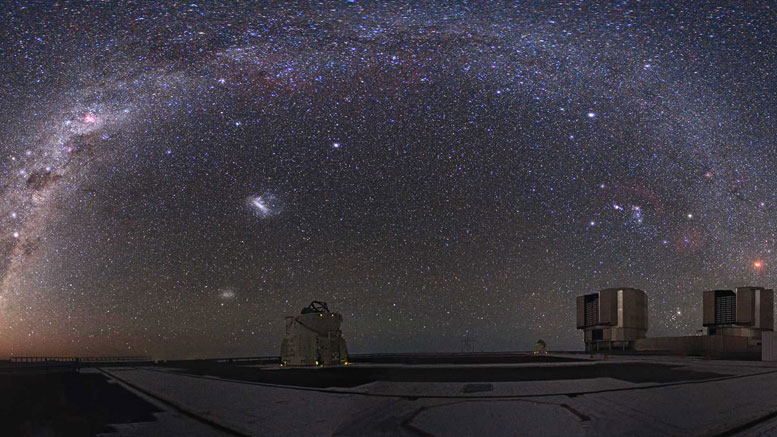
    The Very Large Telescope (VLT) complex in the Atacama Desert of northern Chile. (Photo: ESO / Y. Beletsky)

    Based on new observational data, an international team led by ETH astronomers identified at least six candidates for ‘dark galaxies’ — galaxies that have a few (if any) stars in them and are, for that reason, notoriously difficult to detect with current instruments.

    Despite substantial progress over the past half a century in understanding of how galaxies form, important open questions remain regarding how precisely the diffuse gas known as the ‘intergalactic medium’ is converted into stars. One possibility, suggested in recent theoretical models, is that the early phase of galaxy formation involves an epoch when galaxies contain a great amount of gas but are still inefficient at forming stars. Direct proof of such a ‘Dark Phase’ has been so far elusive, however — after all, dark galaxies do not emit much visible light. The observational discovery of such galaxies would therefore fill an important gap in our understanding of galaxy evolution.

    Identifying Dark galaxy Candidates
    One of the new dark-galaxy candidates, identified through a combination of spectral information (left) and images reflecting the emission of gas (middle) and stars (right). The position of the dark-galaxy candidate is marked by the red circle. R. A. Marino / MUSE

    There are ways to bring dark galaxies to lighten up though. An international team led by Dr. Raffaella Anna Marino and Prof. Sebastiano Cantalupo from the Department of Physics at ETH Zurich has now done just that and thus was able to search the sky for potential dark galaxies with unprecedented efficiency. And successfully so, as they report in a paper published today in The Astrophysical Journal: they have identified at least six strong candidates for dark galaxies.

    To overcome the obstacle that their target objects are dark, the team used a flashlight of sorts, which came in the form of quasars. These emit intense ultraviolet light, which in turn induces fluorescent emission in hydrogen atoms known as the Lyman-alpha line. As a result, the signal from any dark galaxies in the vicinity of the quasar gets a boost, making them visible. Such ‘fluorescent illumination’ has been used before in searches for dark galaxies, but Marino et al. now looked at the neighborhood of quasars at greater distances than has been possible in earlier observations.

    Also, they acquired the full spectral information for each of the dark-galaxy candidates. Deep observations — 10 hours for each of the six quasar fields they studied — enabled Marino and her colleagues to efficiently tell dark-galaxy candidates apart from other sources. From initially 200 Lyman-alpha emitters, half a dozen regions remained that are unlikely to be normal star-forming stellar populations, making them robust candidates for dark galaxies.

    The advances in observational capability have become possible thanks to the Multi Unit Spectroscopic Explorer (MUSE) instrument at the Very Large Telescope (VLT) of the European Southern Observatory (ESO) in Chile. In essence, previous studies were limited to imaging a relative narrow band of frequencies, for which specific filters had to be designed. The MUSE instrument instead allowed hunting ‘blindly’ — without filters — for dark galaxies around quasars at larger distances from Earth than had been possible so far.

    Reference: “Dark Galaxy Candidates at Redshift ~3.5 Detected with MUSE” by Raffaella Anna Marino, Sebastiano Cantalupo, Simon J. Lilly, Sofia G. Gallego, Lorrie A. Straka, Elena Borisova, Gabriele Pezzulli, Roland Bacon, Jarle Brinchmann, C. Marcella Carollo, Joseph Caruana, Simon Consei, Thierry Contini, Catrina Diener, Hayley Finley, Hanae Inami, Floriane Leclercq, Sowgat Muzahid, Johan Richard, Joop Schaye, Martin Wendt and Lutz Wisotzki, 23 May 2018, The Astrophysical Journal.
    DOI: 10.3847/1538-4357/aab6aa

    Never miss a breakthrough: Join the SciTechDaily newsletter.
    Follow us on Google and Google News.

    Astronomy Astrophysics Cosmology ETH Zurich
    Share. Facebook Twitter Pinterest LinkedIn Email Reddit

    Related Articles

    On the Trail of a Mysterious Force in Space – Scientists Shed New Light on Dark Energy

    Space Explosions Just Got More Interesting: Challenging Conventional Understanding of Classical Novae

    Chaotic Triple Drama: Black Hole Billiards in the Centers of Galaxies

    Mysterious Cosmic Flashes Pinpointed to a Surprising Location in Space – “Closest Ever”

    Breaking Cosmology: Too Many Disk Galaxies – “A Significant Discrepancy Between Prediction and Reality”

    Unprecedented Number of Globular Clusters Discovered in Nearby Galaxy

    Part of the Universe’s Missing Matter Found Thanks to Very Large Telescope

    Twin Supernovae Open Up New Possibilities for Precision Cosmology

    On the Quest for Other Earths in the Search for Extraterrestrial Life

    Leave A Reply Cancel Reply

    • Facebook
    • Twitter
    • Pinterest
    • YouTube

    Don't Miss a Discovery

    Subscribe for the Latest in Science & Tech!

    Trending News

    Scientists Discover How Coffee Impacts Memory, Mood, and Gut Health

    Why Did the Neanderthals Disappear? Scientists Reveal Humans Had a Hidden Advantage

    Physicists Propose Strange Experiment Where Time Goes Quantum

    Magnesium Magic: New Drug Melts Fat Even on a High-Fat, High-Sugar Diet

    Weight-Loss Drugs Like Ozempic May Come With an Unexpected Cost

    Mezcal “Worm” in a Bottle Mystery: DNA Testing Reveals a Surprise

    New Research Reveals That Your Morning Coffee Activates an Ancient Longevity Switch

    This Is What Makes You Irresistible to Mosquitoes

    Follow SciTechDaily
    • Facebook
    • Twitter
    • YouTube
    • Pinterest
    • Newsletter
    • RSS
    SciTech News
    • Biology News
    • Chemistry News
    • Earth News
    • Health News
    • Physics News
    • Science News
    • Space News
    • Technology News
    Recent Posts
    • Harvard Scientists Reveal Secret Structure Behind How You Smell
    • Scientists Just Discovered the Hidden Trick That Keeps Your Cells Alive
    • This Simple Movement Could Be Secretly Cleaning Your Brain
    • Male Birth Control Breakthrough: Scientists Find Way To Turn Sperm Production Off and Back On
    • A Common Vitamin Could Hold the Key to Treating Fatty Liver Disease
    Copyright © 1998 - 2026 SciTechDaily. All Rights Reserved.
    • Science News
    • About
    • Contact
    • Editorial Board
    • Privacy Policy
    • Terms of Use

    Type above and press Enter to search. Press Esc to cancel.