

Euclid’s first data release offers a breathtaking glimpse into our universe, revealing over 26 million galaxies and showcasing the telescope’s unprecedented precision in the visible and infrared.
Powered by advanced optics and massive data processing infrastructure, the mission is already revolutionizing how we understand galaxy evolution, dark energy, and the cosmic web. Germany plays a crucial role in the optics, data calibration, and scientific interpretation, as machine learning and citizen scientists help unravel an overwhelming wealth of information.
A New Era of Cosmic Discovery
Euclid’s first data release spans a wide area of the sky, captured in three large mosaics. It features detailed observations of galaxy clusters, active galactic nuclei, and transient events – offering scientists a rich dataset to investigate some of the biggest questions in modern cosmology. With this initial survey, Euclid begins to reveal our cosmic history and the hidden forces – like dark matter and dark energy – that shape the universe.
One of Euclid’s most powerful features is its exceptionally large field of view. It can image an area 240 times larger in a single exposure than the Hubble Space Telescope, while maintaining high-resolution imaging in both visible and infrared wavelengths.

German Institutes Fuel Infrared Precision
Euclid’s infrared capabilities are particularly advanced, thanks in large part to key optical components developed by two German institutes: the Max Planck Institute for Extraterrestrial Physics (MPE) in Garching and the Max Planck Institute for Astronomy (MPIA) in Heidelberg. Light entering the telescope passes through four lenses, a filter, and a beam splitter, resulting in exceptionally high image contrast.
“The requirements for suppressing ghost images are exceeded by a factor of one hundred. The optical design and the precise execution of the optics at MPE and MPIA set new standards for image sharpness and contrast,” says Frank Grupp, who led the development of the near-infrared optics at MPE.
MPE is also contributing to research on galaxy evolution. “We have compiled a catalog of over 70,000 spectroscopic redshifts from various sky surveys and combined it with the Euclid data,” explains Christoph Saulder, who led this part of the project. “This catalog allows for precise distance measurements and the clear identification of numerous galaxies and quasars in Euclid’s high-resolution images. It serves as a foundation for a deeper understanding of these objects, their distribution, and their internal properties.”
Toward the Precision Measurement of Dark Energy
“The new data are also being used to test the techniques for measuring cosmic shear and calibrating redshifts, which will soon be applied to the much larger Euclid data sets to achieve the primary scientific goal – the precision measurement of dark energy,” says Hendrik Hildebrandt from Ruhr University Bochum. He leads the key project for measuring cosmic shear and the redshift calibration task force.
Furthermore, scientists at Ludwig Maximilian University (LMU) in Munich have tested methods to identify and characterize galaxy overdensities, a crucial step in tracing the universe’s large-scale structure. “The methodologies used to pinpoint galaxy clusters in this task will be key to fully exploiting Euclid’s vast dataset, improving cluster identification and contributing to a deeper understanding of cosmic structure formation. At the same time, they help explore previously uncharted regimes in the near-infrared with a statistically significant sample of objects,” says LMU scientist Barbara Sartoris.
Likewise, MPIA scientists play leading roles in numerous Euclid studies. They use the data to identify growing supermassive black holes, answer fundamental questions about galaxy evolution, and perform precise photometric measurements of young and old transient celestial objects.

Euclid’s Deep Fields: 26 Million Galaxies and Counting
Euclid has scouted out the three areas in the sky where it will eventually provide the deepest observations of its mission. In just one week of observations and one scan of each region so far, Euclid spotted already 26 million galaxies. The most distant of those are up to 10.5 billion light-years away. The fields span a combined area equivalent to more than 300 times the full Moon.
In order to unravel the mysteries it is designed to explore, Euclid precisely measures the various shapes and the distribution of billions of galaxies with its high-resolution imaging visible instrument (VIS). In contrast, its near-infrared instrument (NISP) is essential for determining galaxy distances and masses.
MPE was responsible for designing and constructing the NISP near-infrared optics. In turn, MPIA carries out crucial tasks for NISP’s calibration. “MPIA engineers and scientists are developing and maintaining the mission’s entire calibration plan, calibrating and scientifically monitoring the near-infrared camera NISP, performing simulations, and conducting technical analyses such as instrument monitoring,” says MPIA’s Mischa Schirmer. He is the Euclid mission calibration and NISP calibration scientist.
The new images are a testimony to these efforts and showcase Euclid’s capability of mapping hundreds of thousands of galaxies, and start to hint at the large-scale organization of these galaxies in the cosmic web.

Massive Data, Massive Potential
Euclid is expected to capture images of more than 1.5 billion galaxies over six years, sending back around 100 GB of data daily. Such an impressively large dataset creates incredible discovery opportunities, but also poses enormous challenges.
The Euclid consortium has established a European network of nine data centers, including the German Science Data Center (SDC-DE) at MPE. It is equipped with 7,000 processors and processes 10% of the data recorded by Euclid. A team of at least ten experts ensures smooth and consistent processing of astronomical imaging data. MPE’s Max Fabricius, who leads the SDC-DE, says: “Approximately 100 GB of raw data is processed virtually in real time every day. The demands on photometric precision are enormous and require a completely new approach to the methods used to calibrate the data.”
AI and Citizen Science Power Galaxy Classification
When it comes to searching for, analyzing, and cataloging galaxies, the advancement of machine learning algorithms, in combination with thousands of human citizen science volunteers and experts, is playing a critical role. It is a fundamental and necessary tool to fully exploit Euclid’s vast dataset. A significant landmark in this effort is the first detailed catalog of more than 380,000 galaxies, which have been characterized according to features such as spiral arms, central bars, and tidal tails that infer merging galaxies.
This first catalog represents just 0.4% of the total number of galaxies of similar resolution expected to be imaged over Euclid’s lifetime. The final catalog will present the detailed morphology of at least an order of magnitude more galaxies than ever measured before, helping scientists answer questions like how spiral arms form and how supermassive black holes grow.

Unveiling the Hidden Cosmos with Gravitational Lensing
Light traveling towards us from distant galaxies is bent and distorted by normal and dark matter in the foreground. This effect is called gravitational lensing and is one of Euclid’s tools to reveal how dark matter is distributed throughout the universe. When the distortions are very apparent, it is known as ‘strong lensing’, which can result in features such as Einstein rings, arcs, and multiple imaged lenses.
A first catalog of 500 galaxy-galaxy strong lens candidates is released today, almost all previously unknown. MPIA scientists were involved in gravitational lensing classifications, labeling images with markers according to their probability of being lenses, as input for machine learning. “These AI systems will ultimately be essential for analyzing the 200 times larger sky area at the end of the mission. The number of galaxies distorted by lensing will eventually increase to a staggering 100,000, about 100 times more than currently known. Human classification of individual objects will not be possible for this unprecedented dataset,” emphasizes Knud Jahnke from MPIA. He is the NISP instrument scientist.
Euclid will also be able to measure ‘weak’ lensing, when the distortions of background sources are much smaller. Such subtle distortions can only be detected by statistically analyzing large numbers of galaxies. In the coming years, Euclid will measure the distorted shapes of billions of galaxies over 10 billion years of cosmic history, thus providing a 3D view of the distribution of dark matter in our universe.

Mission Timeline and Upcoming Milestones
As of March 19, 2025, Euclid has observed about 2000 square degrees, approximately 14% of the total survey area. The three deep fields together comprise 63.1 square degrees.
Euclid ‘quick’ releases, such as the one of March 19, are of selected areas. They are intended to demonstrate the data products expected in the major data releases that follow, and to allow scientists to sharpen their data analysis tools in preparation. The mission’s first cosmology data will be released to the community in October 2026. Data accumulated over additional, multiple passes of the deep field locations will be included in the 2026 release.
The data release of March 19, 2025, is described in multiple scientific papers that have not yet been through the peer-review process but will be submitted to the journal Astronomy & Astrophysics.
The University of Bonn hosts the Euclid Publication Office, where the scientific publications of the Euclid Consortium are coordinated and reviewed.
Explore Further:
- Just 0.4% In, Euclid’s Dark Universe Map Already Reveals 26 Million Galaxies
- Euclid Captures 26 Million Galaxies in Its First Glimpse of the Dark Universe
About Euclid
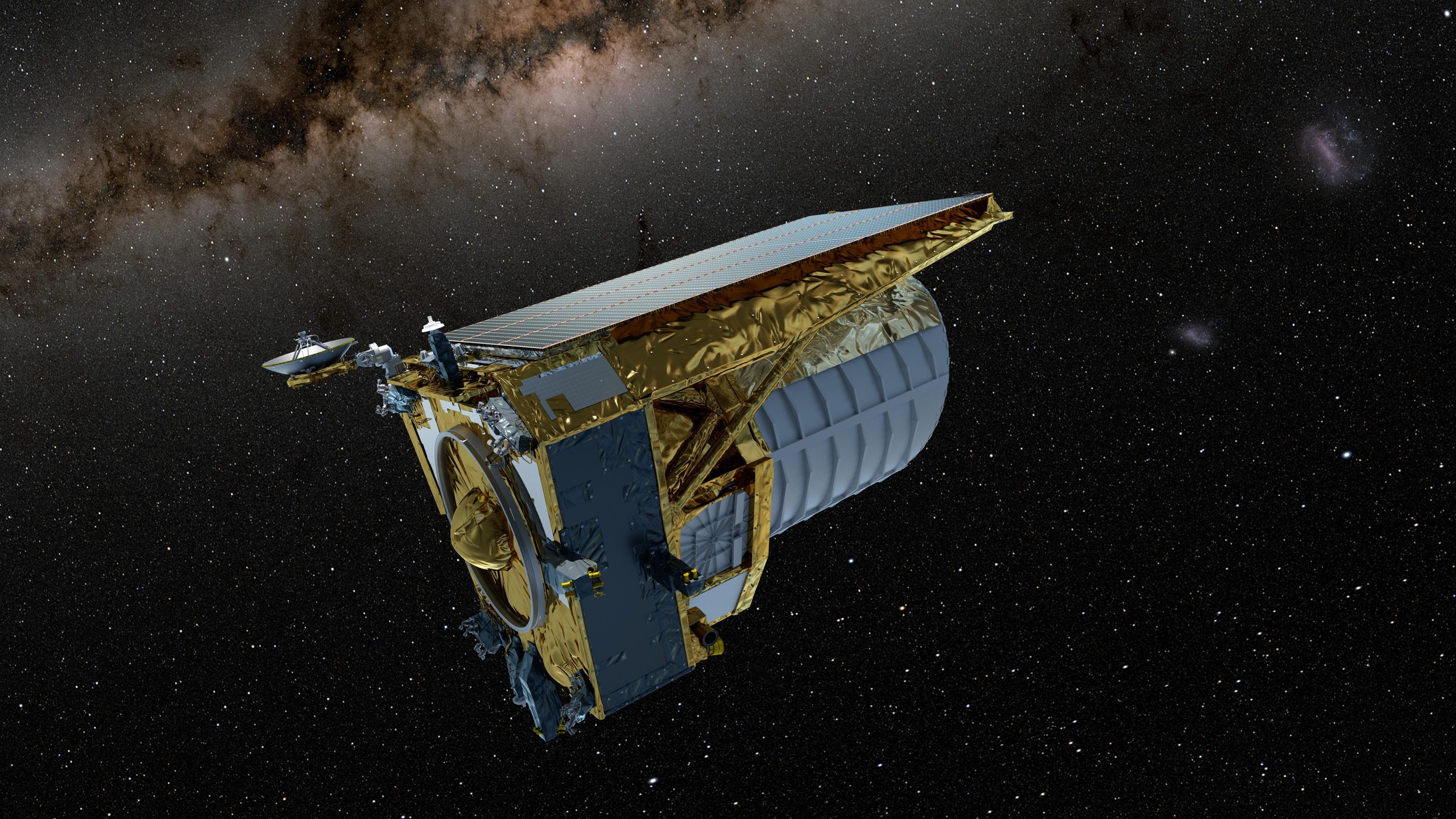
Euclid is a space telescope designed to explore the dark side of the universe—specifically, dark energy and dark matter—and to map the large-scale structure of the cosmos with unprecedented precision. It was launched in July 2023 and began its routine science operations on February 14, 2024.
Led by the European Space Agency (ESA), Euclid is a collaborative international mission with contributions from ESA member states, NASA, and a global scientific community. The mission is part of ESA’s Cosmic Vision Programme and is classified as a medium-class mission.
The scientific backbone of Euclid is the Euclid Consortium, comprising over 2,000 scientists from 300 institutes across 15 European countries, the United States, Canada, and Japan. This team is responsible for the mission’s scientific instruments, data analysis, and ongoing research.
The spacecraft was constructed by Thales Alenia Space, which led the development of the satellite and service module. Airbus Defence and Space built the payload module, including Euclid’s powerful telescope. NASA contributed the infrared detectors for one of Euclid’s key instruments, the Near-Infrared Spectrometer and Photometer (NISP).
Germany plays a major role in the mission. Participating institutions include the Max Planck Institute for Astronomy in Heidelberg, the Max Planck Institute for Extraterrestrial Physics in Garching, Ludwig Maximilian University in Munich, the University of Bonn, Ruhr University Bochum, the University of Bielefeld, and the German Space Agency at the German Aerospace Centre (DLR) in Bonn. DLR coordinates Germany’s involvement and has provided €60 million in funding through the National Space Programme.
Germany is also the largest national contributor to ESA’s science programme, accounting for about 21% of the total funding – underscoring its pivotal role in advancing space science in Europe.
Euclid is expected to revolutionize our understanding of the universe by precisely measuring the distribution and shape of billions of galaxies, helping scientists uncover how dark energy and dark matter have shaped the cosmos over billions of years.
Never miss a breakthrough: Join the SciTechDaily newsletter.
Follow us on Google and Google News.