
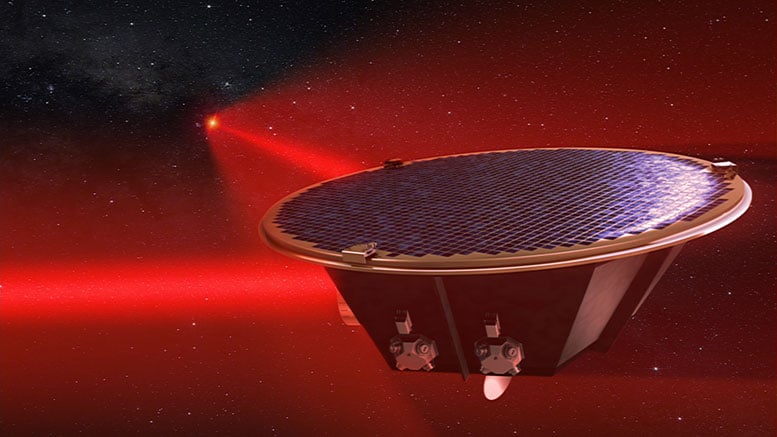
The European Space Agency (ESA) has selected the Laser Interferometer Space Antenna (LISA) for its third large-class mission in the agency’s Cosmic Vision science program. The three-spacecraft constellation is designed to study gravitational waves in space and is a concept long studied by both ESA and NASA.
ESA’s Science Program Committee announced the selection at a meeting on June 20. The mission will now be designed, budgeted and proposed for adoption before construction begins. LISA is expected to launch in 2034. NASA will be a partner with ESA in the design, development, operations and data analysis of the mission.
Gravitational radiation was predicted a century ago by Albert Einstein’s general theory of relativity. Massive accelerating objects such as merging black holes produce waves of energy that ripple through the fabric of space and time. Indirect proof of the existence of these waves came in 1978, when subtle changes observed in the motion of a pair of orbiting neutron stars showed energy was leaving the system in an amount matching predictions of energy carried away by gravitational waves.
In September 2015, these waves were first directly detected by the National Science Foundation’s ground-based Laser Interferometer Gravitational-Wave Observatory (LIGO). The signal arose from the merger of two stellar-mass black holes located some 1.3 billion light-years away. Similar signals from other black hole mergers have since been detected.
Seismic, thermal and other noise sources limit LIGO to higher-frequency gravitational waves around 100 cycles per second (hertz). But finding signals from more powerful events, such as mergers of supermassive black holes in colliding galaxies, requires the ability to detect frequencies much lower than 1 hertz, a sensitivity level only possible from space.
LISA consists of three spacecraft separated by 1.6 million miles (2.5 million kilometers) in a triangular formation that follows Earth in its orbit around the sun. Each spacecraft carries test masses that are shielded in such a way that the only force they respond to is gravity. Lasers measure the distances to test masses in all three spacecraft. Tiny changes in the lengths of each two-spacecraft arm signals the passage of gravitational waves through the formation.
For example, LISA will be sensitive to gravitational waves produced by mergers of supermassive black holes, each with millions or more times the mass of the sun. It will also be able to detect gravitational waves emanating from binary systems containing neutron stars or black holes, causing their orbits to shrink. And LISA may detect a background of gravitational waves produced during the universe’s earliest moments.
For decades, NASA has worked to develop many technologies needed for LISA, including measurement, micropropulsion and control systems, as well as support for the development of data analysis techniques.
For instance, the GRACE Follow-On mission, a U.S. and German collaboration to replace the aging GRACE satellites scheduled for launch late this year, will carry a laser measuring system that inherits some of the technologies originally developed for LISA. The mission’s Laser Ranging Interferometer will track distance changes between the two satellites with unprecedented precision, providing the first demonstration of the technology in space.
In 2016, ESA’s LISA Pathfinder successfully demonstrated key technologies needed to build LISA. Each of LISA’s three spacecraft must gently fly around its test masses without disturbing them, a process called drag-free flight. In its first two months of operations, LISA Pathfinder demonstrated this process with a precision some five times better than its mission requirements and later reached the sensitivity needed for the full multi-spacecraft observatory. U.S. researchers collaborated on aspects of LISA Pathfinder for years, and the mission carries a NASA-supplied experiment called the ST7 Disturbance Reduction System, which is managed by NASA’s Jet Propulsion Laboratory in Pasadena, California.
Never miss a breakthrough: Join the SciTechDaily newsletter.
Follow us on Google and Google News.