

In a landmark clinical trial involving older adults with mild memory loss, those who engaged in low or moderate-to-high intensity physical exercise experienced less cognitive decline compared to individuals who received standard care.
Researchers at the University of California San Diego and Wake Forest University have found that both low and moderate-to-high intensity exercise may be effective in helping to slow the progression of Alzheimer’s disease. Their findings, published in two papers in Alzheimer’s and Dementia: The Journal of the Alzheimer’s Association, present results from the EXERT study (Exercise in Adults with Mild Memory Problems).
This multi-site clinical trial focused on sedentary older adults with amnestic mild cognitive impairment, a key risk factor for Alzheimer’s dementia. The researchers also compared the outcomes of the exercise groups to data from similar individuals who received only standard care, such as routine doctor visits and medication management.

The researchers found:
- Cognitive function remained stable over 12 months for participants in both the low and moderate-to-high intensity exercise groups.
- Both exercise groups experienced significantly less cognitive decline over 12 months compared to individuals who did not participate in the exercise program.
- Participants in the exercise groups also tended to show less loss of brain volume over the same period, particularly in the prefrontal cortex.
Understanding mild cognitive impairment
Individuals with amnestic mild cognitive impairment, a condition characterized by memory complaints and objective memory decline, are at high risk of developing Alzheimer’s dementia, with approximately 16% of people with this condition progressing to Alzheimer’s each year.
“This is a critical time to intervene in this population, because they don’t have dementia yet, but are at a very high risk,” said Aladdin Shadyab, Ph.D., M.P.H., lead author of one of the new papers and associate professor at the UC San Diego Herbert Wertheim School of Public Health and Human Longevity Science and School of Medicine. “Together, these findings show us that even low-intensity exercise may slow cognitive decline in at-risk older adults.”
While previous studies have suggested that exercise may be beneficial for cognitive health, the evidence has been mixed, and large, well-designed studies are needed to fully understand the potential benefits of exercise for older adults with mild cognitive impairment. The EXERT study, coordinated by the Alzheimer’s Disease Cooperative Study (ADCS) at UC San Diego, in partnership with Wake Forest University School of Medicine, fills this gap.

“EXERT was one of the first large clinical trials of exercise that partnered with the YMCA and its trainers to bring the intervention closer to home for research participants,” said Howard Feldman, M.D., ADCS director. “This approach brings us one step closer to its implementation in the community.”
Advancing alzheimer’s research infrastructure
The ADCS was formed in 1991 under a cooperative agreement between the National Institute on Aging and UC San Diego and is one of the key initiatives for Alzheimer’s research supported by the federal government, addressing treatments for both cognitive and behavioral symptoms of Alzheimer’s.
“There’s an urgent need to identify effective and feasible ways to prevent and treat Alzheimer’s dementia, and UC San Diego has been a leader in this field for many years,” added Feldman, who is also a professor in the Department of Neurosciences at UC San Diego School of Medicine.
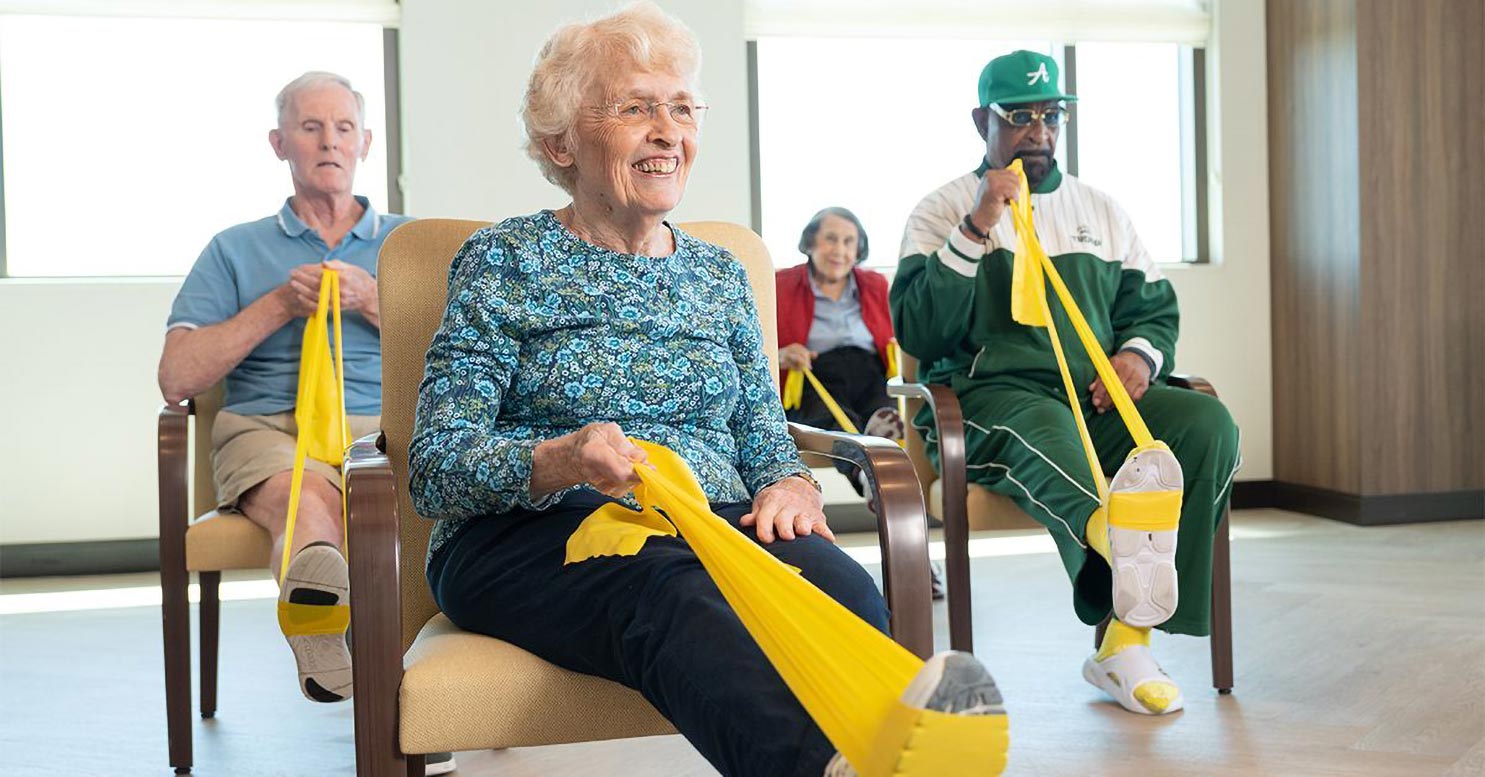
EXERT included nearly 300 sedentary older adults with mild cognitive impairment who were randomly assigned to either moderate-high intensity aerobic training or lower-intensity stretching, balance, and range of motion activities. Participants completed their assigned exercise 3-4 times per week for 12 months under the supervision of a YMCA trainer, and the study also included regular assessments of cognitive function and brain volume.
Surprising outcomes and new insights
“EXERT is a landmark study because it’s the largest rigorous trial of exercise ever conducted in adults with mild cognitive impairment,” said Laura Baker, Ph.D., principal investigator of the EXERT study and professor of gerontology and geriatric medicine at Wake Forest University School of Medicine. “Exercise has well-documented benefits to nearly every aspect of human health, but we’re still unlocking the full potential of exercise as medicine for older adults with memory problems.

Though the researchers expected to see further cognitive decline in EXERT participants, they actually found that cognitive function remained stable for both exercise groups over the course of the study. This suggests that both lower and higher intensity exercise could slow cognitive decline. Another possible explanation for the results is that participating in research itself, regardless of the treatment, may offer protection against cognitive decline due to the intellectual and social stimulation involved.
Overall, the findings of both studies taken together suggest that exercise may be a promising, safe, and feasible strategy to promote brain health and prevent continued cognitive decline for older adults with mild cognitive impairment.
“While there’s still a lot to learn, these findings show that regular intensity exercise, even at low intensity, could go a long way toward helping older adults slow or delay cognitive decline, and this is promising news for those who are at high risk for dementia,” added Shadyab.
References: “Effects of exercise on cognition and Alzheimer’s biomarkers in a randomized controlled trial of adults with mild cognitive impairment: The EXERT study” by Laura D. Baker, Judy A. Pa, Jeffrey A. Katula, Vahan Aslanyan, David P. Salmon, Diane M. Jacobs, Elizabeth A. Chmelo, Heather Hodge, Rosemary Morrison, Genevieve Matthews, James Brewer, Youngkyoo Jung, Robert A. Rissman, Curtis Taylor, Gabriel C. Léger, Karen Messer, A. Carol Evans, Ozioma C. Okonkwo, Aladdin H. Shadyab, Jingjing Zou, Sheila Jin, Ronald G. Thomas, Jin Zhang, Andrea Z. La Croix, Carl W. Cotman and Howard H. Feldman for the EXERT Study Group, 24 April 2025, Alzheimer’s & Dementia.
DOI: 10.1002/alz.14586
“Effects of exercise versus usual care on older adults with amnestic mild cognitive impairment: EXERT versus ADNI” by Aladdin H. Shadyab, Vahan Aslanyan, Diane M. Jacobs, David P. Salmon, Rosemary Morrison, Jeffrey A. Katula, Shelia Jin, Ronald G. Thomas, Andrea Z. LaCroix, Judy Pa, Carl W. Cotman, Howard H. Feldman and Laura D. Baker for the ADCS EXERT Study Group, 24 April 2025, Alzheimer’s & Dementia.
DOI: 10.1002/alz.70118
The EXERT study was supported through the National Institutes of Health/National Institute on Aging (U19AG010483-25 and AG058644) and by the Brain Research Foundation (BRF ECD-2014-01).
Never miss a breakthrough: Join the SciTechDaily newsletter.
Follow us on Google and Google News.
1 Comment
But not if you do indoor climbing, because then the chemicals will kill your.