
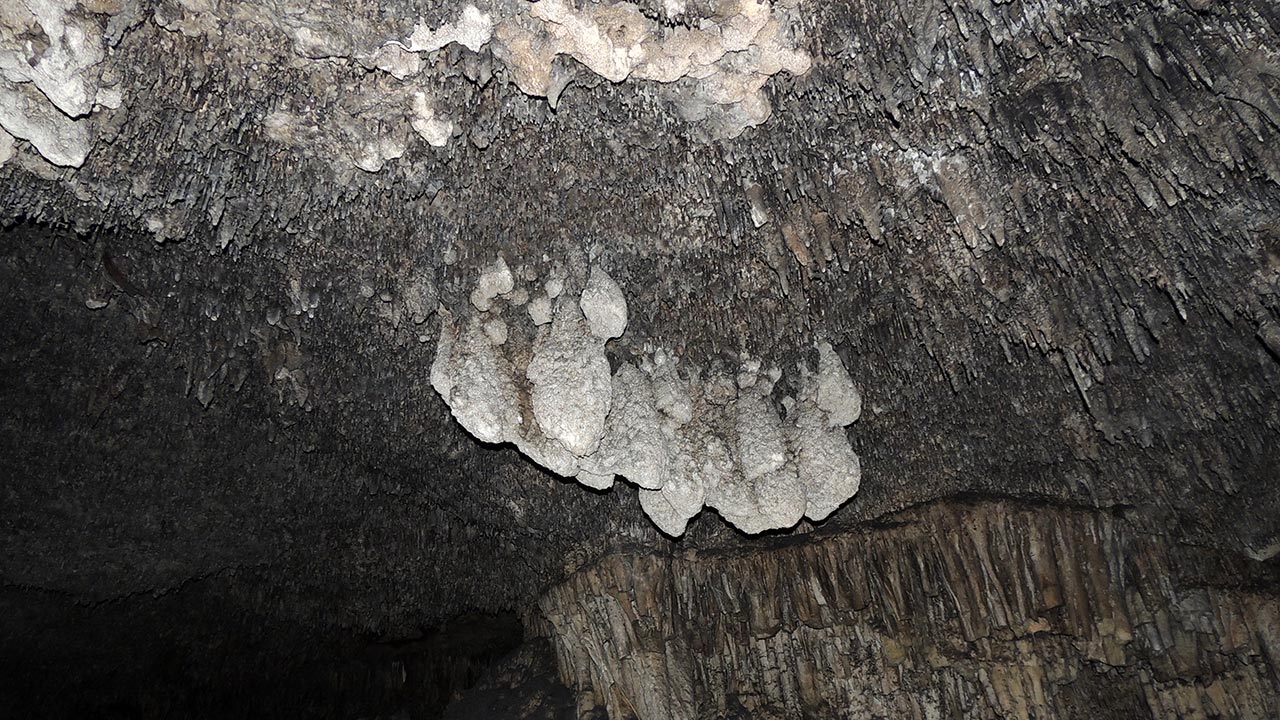
Scientists discover evidence for past high-level sea rise at current atmospheric carbon dioxide levels. Mallorcan cave yields 4-million-year-old geologic evidence providing new insights into magnitude global sea level rise.
An international team of scientists, studying evidence preserved in speleothems in a coastal cave, illustrate that more than three million years ago – a time in which the Earth was two to three degrees Celsius warmer than the pre-industrial era – sea level was as much as 16 meters higher than the present day. Their findings represent significant implications for understanding and predicting the pace of current-day sea level rise amid a warming climate.
The scientists, including Professor Yemane Asmerom and Sr. Research Scientist Victor Polyak from The University of New Mexico, the University of South Florida, Universitat de les Illes Balears, and Columbia University, published their findings in today’s edition of the journal Nature. The analysis of deposits from Artà Cave on the island of Mallorca in the western Mediterranean Sea produced sea levels that serve as a target for future studies of ice sheet stability, ice sheet model calibrations, and projections of future sea-level rise, the scientists said.
Sea level rises as a result of melting ice sheets, such as those that cover Greenland and Antarctica. However, how much and how fast the sea level will rise during warming is a question scientists have worked to answer. Reconstructing ice sheet and sea-level changes during past periods when the climate was naturally warmer than today, provides an Earth’s scale laboratory experiment to study this question according to USF Ph.D. student Oana Dumitru, the lead author, who did much of her dating work at UNM under the guidance of Asmerom and Polyak.
“Constraining models for sea-level rise due to increased warming critically depends on actual measurements of past sea level,” said Polyak. “This study provides very robust measurements of sea-level heights during the Pliocene.”
“We can use knowledge gained from past warm periods to tune ice sheet models that are then used to predict future ice sheet response to current global warming,” said USF Department of Geosciences Professor Bogdan Onac.
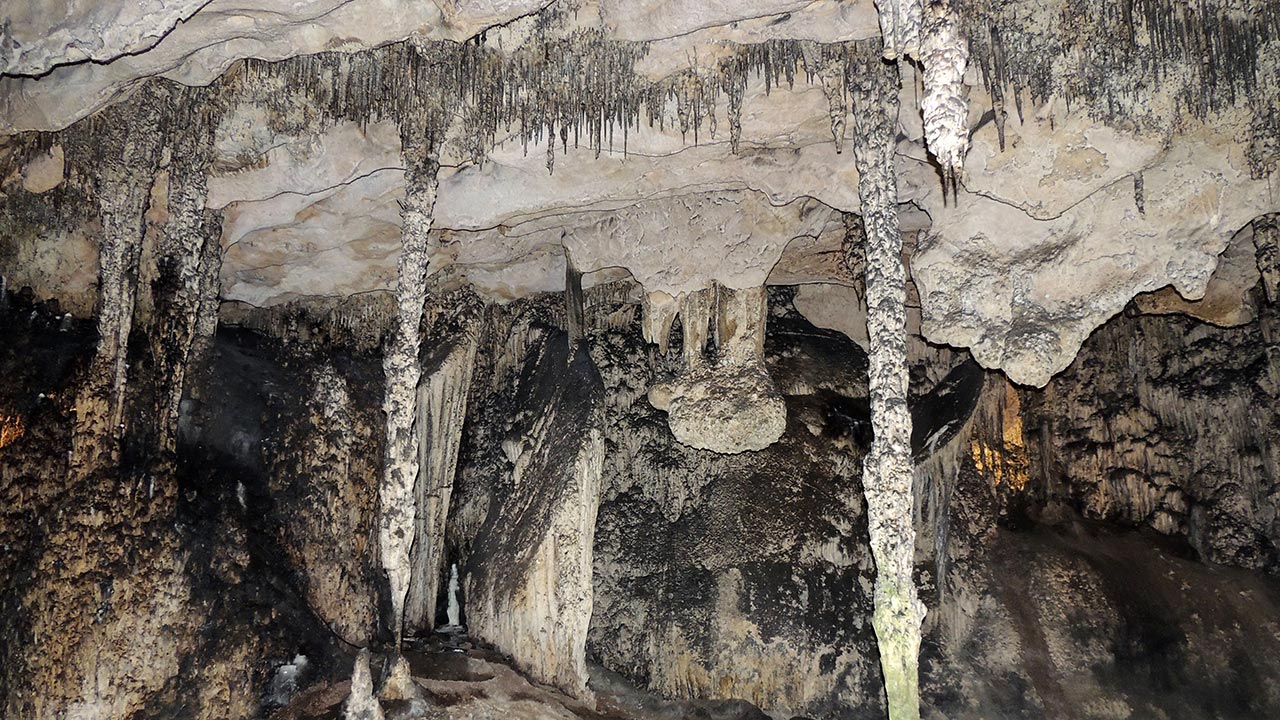
The project focused on cave deposits known as phreatic overgrowths on speleothems. The deposits form in coastal caves at the interface between brackish water and cave air each time the ancient caves were flooded by rising sea levels. In Artà Cave, which is located within 100 meters of the coast, the water table is – and was in the past – coincident with sea level, says Professor Joan J. Fornós of Universitat de les Illes Balears.
The scientists discovered, analyzed, and interpreted six of the geologic formations found at elevations of 22.5 to 32 meters above the present sea level. Careful sampling and laboratory analyses of 70 samples resulted in ages ranging from 4.4 to 3.3 million years old BP (Before Present), indicating that the cave deposits formed during the Pliocene epoch. The ages were determined using uranium-lead radiometric dating in UNM’s Radiogenic Isotope Laboratory.
“This was a unique convergence between an ideally-suited natural setting worked out by the team of cave scientists and the technical developments we have achieved over the years in our lab at The University of New Mexico,” said Asmerom. “Judicious investments in instrumentation and techniques result in these kinds of high-impact dividends.”
“Sea level changes at Artà Cave can be caused by the melting and growing of ice sheets or by uplift or subsidence of the island itself,” said Columbia University Assistant Professor Jacky Austermann, a member of the research team. She used numerical and statistical models to carefully analyze how much uplift or subsidence might have happened since the Pliocene and subtracted this from the elevation of the formations they investigated.
One key interval of particular interest during the Pliocene is the mid-Piacenzian Warm Period – some 3.264 to 3.025 million years ago – when temperatures were 2 to 3º Celsius higher than pre-industrial levels. “The interval also marks the last time the Earth’s atmospheric CO2 was as high as today, providing important clues about what the future holds in the face of current anthropogenic warming,” Onac says.
This study found that during this period, the global mean sea level was as high as 16.2 meters (53.1 feet) (with an uncertainty range of 5.6 to 19.2 meters (18.4 to 63 feet)) above the present. This means that even if atmospheric CO2 stabilizes around current levels, the global mean sea level would still likely rise at least that high, if not higher, the scientists concluded. In fact, it is likely to rise higher because of the increase in the volume of the oceans due to rising temperatures.
“Considering the present-day melt patterns, this extent of sea-level rise would most likely be caused by a collapse of both Greenland and the West Antarctic ice sheets,” Dumitru said.
The authors also measured sea level at 23.5 meters (77.1 feet) higher than present about four million years ago during the Pliocene Climatic Optimum, when global mean temperatures were up to 4°C (39.2°F) higher than pre-industrial levels. “This is a possible scenario if an active and aggressive reduction in greenhouse gases into the atmosphere is not undertaken,” Asmerom said.
Reference: “Constraints on global mean sea level during Pliocene warmth” by Oana A. Dumitru, Jacqueline Austermann, Victor J. Polyak, Joan J. Fornós, Yemane Asmerom, Joaquín Ginés, Angel Ginés and Bogdan P. Onac, 30 August 2019, Nature.
DOI: 10.1038/s41586-019-1543-2
The research team included graduate student and lead author Oana A. Dumitru and Professor Bogdan Onac, both at the School of Geosciences, University of Southern Florida, Professor Jacqueline Austermann, Department of Earth and Environmental Sciences, Columbia University, Senior Research Scientist Victor Polyak and Professor Yemane Asmerom at the Department of Earth and Planetary Sciences, University of New Mexico in Albuquerque, and Professor Joan Fornós, Associate Lecturers Joaquín Ginés and Angel Ginés at the Universitat de les Illes Balears in Mallorca.
This research is the result of a collaborative National Science Foundation (NSF) project between the University of South Florida and the University of New Mexico and part of the bilateral agreement between USF and UIB, and has been funded by NSF and the Spanish State Research Agency.
Never miss a breakthrough: Join the SciTechDaily newsletter.
Follow us on Google and Google News.
6 Comments
Something that occurs to me is that so much melting glacier ice must release a lot of pressure on the land. Wouldn’t the land rise to a certain degree and mitigate some of the sea rise?
The land where the ice is situated would rise, but other land masses wouldn’t rise.
We absolutely love your blog and find most of your post’s to
be exactly I’m looking for. Does one offer guest writers to write content for yourself?
I wouldn’t mind writing a powt or elaborating on a few of
thee subjects you write about here. Again, awesome web log!
What? Did everybody miss, “level was as high as 16.2 meters (with an uncertainty range of 5.6 to 19.2 meters) above present.” When your error factor is HIGHER than calculated change increase- you ain’t got squat! At least this one had the integrity to point out that little mitigating fact. Probably knows the Lunatic Left will ignore that and continue insisting “the sky is falling”.
“She used numerical and statistical models to carefully analyze how much uplift or subsidence might have happened …” I think that it would be more accurate to replace “analyze” with “estimate.” Unfortunately, just telling us telling us that models were used tells us little about the assumptions behind the models or how the models were validated.
Gary V
I think that the estimate uncertainty was stated poorly. I think that what was meant was 16.2 +3.0/-10.5 meters. However, it is poor practice to suggest 3 significant figures of precision when the uncertainty bounds are varying in the tens and units position. It would have been more honest to claim 20 +0/-10 meters, with only the leading digit having significance.