
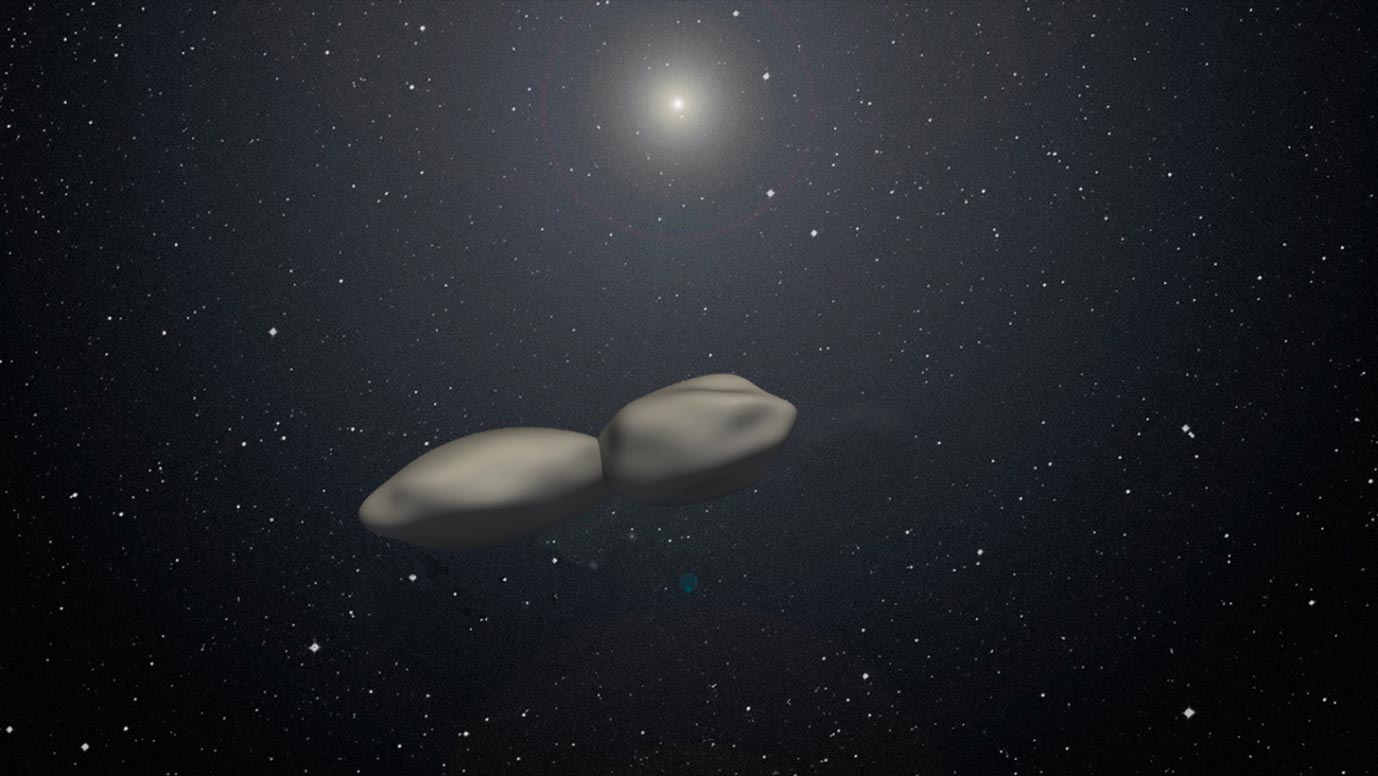
The small Kuiper Belt object (486958) Arrokoth, encountered by NASA’s New Horizons spacecraft on January 1, 2019, is so far the most distant and most primitive object ever explored by a spacecraft. The discoveries from the mission have provided detailed information on the object’s shape, geology, color, and composition, which help people to reshape the knowledge and understanding of planetesimal origin and planet formation.
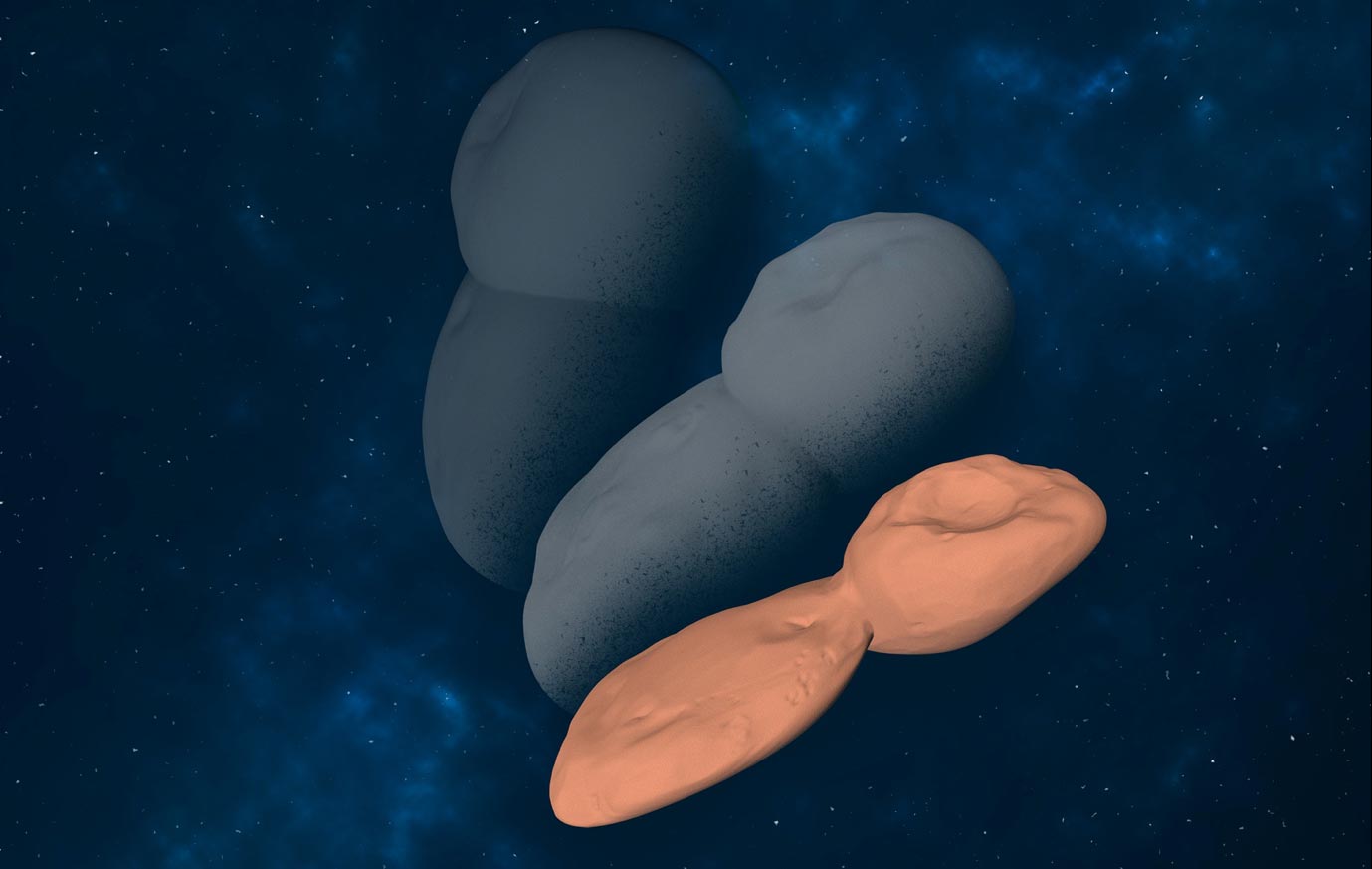
The revealed shape of Arrokoth, which is bi-lobed with highly flattened lobes both aligned to its equatorial plane, is regarded to be the biggest surprise of the flyby. The contact binary is believed to be merged gently by two separate bodies that formed close together and at low velocity, orbited each other. On the other hand, how the flattened lobes formed is still under investigation.
An international research team led by Assoc. Prof. ZHAO Yuhui from the Purple Mountain Observatory (PMO) of the Chinese Academy of Sciences has built and applied a mass-loss-driven shape evolution model (MONET) and suggested that the current flattened shape of Arrokoth could be of evolutionary origin due to volatile outgassing in a timescale of about 1–100 Myr, which provides a natural explanation for the flattening shape of the body.
The study was published in Nature Astronomy on October 5, 2020.
A Science publication led by Dr. Will Grundy from Lowell Observatory suggested an early sublimation history of Arrokoth. During the formation of the solar system, the region where Arrrokoth locates could have been a distinct environment in the cold, dust-shaded midplane of the outer nebula. The low temperatures enabled volatile such as CO and CH4 to freeze onto dust grains and compose planetesimals. When the nebular dust cleared after Arrokoth’s formation, solar illumination would have raised its temperature and hence rapidly driven off the condensed CO and CH4.
Will the sublimation-induced mass loss process change the shape of the body, and how?
The researchers from the PMO and Max Planck Institute for Solar System Research in Germany, started to investigate this topic in 2018, not specifically for (486958) Arrokoth, but for all the small icy bodies in our Solar System. It took three years to develop the numerical tools (MONET model), analyze the observational data from space missions, such as the Rosetta mission of ESA, and investigate how solar-driven mass loss shape the global structure as well as local topography of small bodies.
Their research suggested that even weak solar-driven mass loss rates play an important role in the shape evolution of small icy bodies when sustained over long periods, and the evolved shape highly depends on the configuration of the body’s orbit and spin states.
Starting from the merger of a spherical planetesimal and an oblate one, the flattening of Arrokoth’s shape is a natural outcome due to a favorable combination of its large obliquity, small eccentricity, and mass-loss rate variation with solar flux, resulting in nearly symmetric erosion between north and south hemispheres.
Due to the orientation of Arrokoth, both polar regions experience continuous solar illumination during polar days (with strong mass loss), while the equatorial regions are dominated by diurnal variations year round. Therefore, the polar regions reach higher peak temperatures than the equator and experience more sublimation than the equatorial regions, and hence lead to the flattening.
The flattening process most likely occurred early in the evolution history of the body, and could proceed rather quickly, in a timescale of about 1-100 Myr, during the presence of super volatile ices in the near subsurface layers.
In addition, the researchers self-consistently demonstrated that the induced torques would play a negligible role in the planetesimal’s spin state change during the mass loss phase.
This study suggested that sublimation mass loss could be a ubiquitous process and dominant in shaping the structure of Kuiper Belt Objects (KBOs), granted that there were no catastrophic collision reshaping the body in their later history. Furthermore, while cold classical KBOs reserve their shape sculptured by early outgassing, the structure of Centaurs and Jupiter Family Comets (JFCs) would be further modified by the same scenario once they enter their current orbit configuration from the Kuiper Belt, under sublimation of different volatile species.
Reference: “Sublimation as an effective mechanism for flattened lobes of (486958) Arrokoth” by Y. Zhao, L. Rezac, Y. Skorov, S. C. Hu, N. H. Samarasinha and J.-Y. Li, 5 October 2020, Nature Astronomy.
DOI: 10.1038/s41550-020-01218-7
Never miss a breakthrough: Join the SciTechDaily newsletter.
Follow us on Google and Google News.
1 Comment
Thank you for sharing this article