
Close Menu
    Facebook X (Twitter) Instagram
    SciTechDaily
    • Biology
    • Chemistry
    • Earth
    • Health
    • Physics
    • Science
    • Space
    • Technology
    Facebook X (Twitter) Pinterest YouTube RSS
    SciTechDaily
    Home»Space»Kuiper Belt Object 2014 MU69 Just Got a Lot More Interesting
    Space

    Kuiper Belt Object 2014 MU69 Just Got a Lot More Interesting

    By NASAAugust 4, 2017No Comments4 Mins Read
    Facebook Twitter Pinterest Telegram LinkedIn WhatsApp Email Reddit
    Share
    Facebook Twitter LinkedIn Pinterest Telegram Email Reddit
    Kuiper Belt Object 2014 MU69
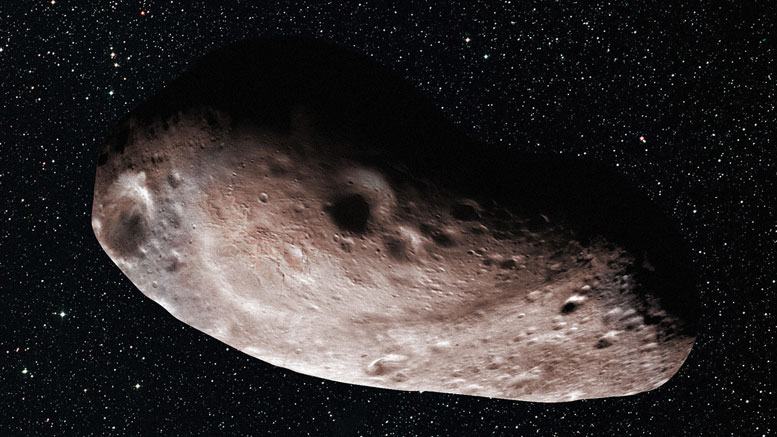
    One artist’s concept of Kuiper Belt object 2014 MU69, the next flyby target for NASA’s New Horizons mission. This binary concept is based on telescope observations made at Patagonia, Argentina on July 17, 2017, when MU69 passed in front of a star. New Horizons theorize that it could be a single body with a large chunk taken out of it, or two bodies that are close together or even touching. Credit: NASA/JHUAPL/SwRI/Alex Parker

    New Horizons’ next target just got a lot more interesting. Astronomers believe that Kuiper Belt object 2014 MU69 may actually be two objects that are close together.

    Could the next flyby target for NASA’s New Horizons spacecraft actually be two targets?

    New Horizons scientists look to answer that question as they sort through new data gathered on the distant Kuiper Belt object (KBO) 2014 MU69, which the spacecraft will fly past on January 1, 2019. That flyby will be the most distant in the history of space exploration, a billion miles beyond Pluto.

    The ancient KBO, which is more than four billion miles (6.5 billion kilometers) from Earth, passed in front of a star on July 17, 2017. A handful of telescopes deployed by the New Horizons team in a remote part of Patagonia, Argentina were in the right place at the right time to catch its fleeting shadow — an event known as an occultation – and were able to capture important data to help mission flyby planners better determine the spacecraft trajectory and understand the size, shape, orbit, and environment around MU69.

    Based on these new occultation observations, team members say MU69 may not be not a lone spherical object, but suspect it could be an “extreme prolate spheroid” – think of a skinny football – or even a binary pair. The odd shape has scientists thinking two bodies may be orbiting very close together or even touching – what’s known as a close or contact binary – or perhaps they’re observing a single body with a large chunk taken out of it. The size of MU69 or its components also can be determined from these data. It appears to be no more than 20 miles (30 kilometers) long, or, if a binary, each about 9-12 miles (15-20 kilometers) in diameter.
    Mystery Surrounds Kuiper Belt Object 2014 MU69
    Second artist’s concept of the Kuiper Belt object 2014 MU69, which is the next flyby target for NASA’s New Horizons mission. Scientists speculate that the Kuiper Belt object could be a single body (above) with a large chunk taken out of it, or two bodies (main image) that are close together or even touching. Credit: NASA/JHUAPL/SwRI/Alex Parker

    “This new finding is simply spectacular. The shape of MU69 is truly provocative, and could mean another first for New Horizons going to a binary object in the Kuiper Belt,” said Alan Stern, mission principal investigator from the Southwest Research Institute (SwRI) in Boulder, Colorado. “I could not be happier with the occultation results, which promise a scientific bonanza for the flyby.”

    The July 17 stellar occultation event that gathered these data was the third of a historic set of three ambitious occultation observations for New Horizons. The team used data from the Hubble Space Telescope and European Space Agency’s Gaia satellite to calculate and pinpoint where MU69 would cast a shadow on Earth’s surface. “Both of these space satellites were crucial to the success of the entire occultation campaign,” added Stern.

    Said Marc Buie, the New Horizons co-investigator who led the observation campaign, “These exciting and puzzling results have already been key for our mission planning, but also add to the mysteries surrounding this target leading into the New Horizons encounter with MU69, now less than 17 months away.”

    Never miss a breakthrough: Join the SciTechDaily newsletter.
    Follow us on Google and Google News.

    Astronomy European Space Agency Kuiper Belt New Horizons Popular
    Share. Facebook Twitter Pinterest LinkedIn Email Reddit

    Related Articles

    Meet the Icy World ‘Arrokoth’ From a Billion Miles Beyond Pluto in the Kuiper Belt

    New Horizons Makes First Detection of Kuiper Belt Object Ultima Thule

    New Horizons Captures New Data on Kuiper Belt Object 2014 MU69

    New Mysteries Surround Kuiper Belt Object 2014 MU69

    New XDF Image, The Deepest-Ever View of the Universe

    Hubble Zooms in on the Center of M4

    Hubble Image of Peculiar Galaxy Pair Arp 116

    Images From ESA’s Mars Express Reveals the Features of Ladon Basin

    Herschel Image of the Vela C Region

    Leave A Reply Cancel Reply

    • Facebook
    • Twitter
    • Pinterest
    • YouTube

    Don't Miss a Discovery

    Subscribe for the Latest in Science & Tech!

    Trending News

    Monster Storms on Jupiter Unleash Lightning Beyond Anything on Earth

    Scientists Create “Liquid Gears” That Spin Without Touching

    The Simple Habit That Could Help Prevent Cancer

    Millions Take These IBS Drugs, But a New Study Finds Serious Risks

    Scientists Unlock Hidden Secrets of 2,300-Year-Old Mummies Using Cutting-Edge CT Scanner

    Bread Might Be Making You Gain Weight Even Without Eating More Calories

    Scientists Discover Massive Magma Reservoir Beneath Tuscany

    Europe’s Most Active Volcano Just Got Stranger – Here’s Why Scientists Are Rethinking It

    Follow SciTechDaily
    • Facebook
    • Twitter
    • YouTube
    • Pinterest
    • Newsletter
    • RSS
    SciTech News
    • Biology News
    • Chemistry News
    • Earth News
    • Health News
    • Physics News
    • Science News
    • Space News
    • Technology News
    Recent Posts
    • New Brain Discovery Challenges Long-Held Theory of Teenage Brain Development
    • Sharks Are Overheating as Warming Oceans Push Them to the Edge
    • Scientists Discover Plants “Scream” – We Just Couldn’t Hear Them Until Now
    • 25-Year Study Uncovers Hidden Paths and Early Warning Signs of Blood Cancer
    • Not Just Snoring – New Research Reveals Sleep Apnea May Be Damaging Your Muscles
    Copyright © 1998 - 2026 SciTechDaily. All Rights Reserved.
    • Science News
    • About
    • Contact
    • Editorial Board
    • Privacy Policy
    • Terms of Use

    Type above and press Enter to search. Press Esc to cancel.