
Close Menu
    Facebook X (Twitter) Instagram
    SciTechDaily
    • Biology
    • Chemistry
    • Earth
    • Health
    • Physics
    • Science
    • Space
    • Technology
    Facebook X (Twitter) Pinterest YouTube RSS
    SciTechDaily
    Home»Physics»Experimental Evidence That Stars May Generate Sound
    Physics

    Experimental Evidence That Stars May Generate Sound

    By University of YorkMarch 23, 2015No Comments3 Mins Read
    Facebook Twitter Pinterest Telegram LinkedIn WhatsApp Email Reddit
    Share
    Facebook Twitter LinkedIn Pinterest Telegram Email Reddit
    Evidence That Stars May Generate Sound
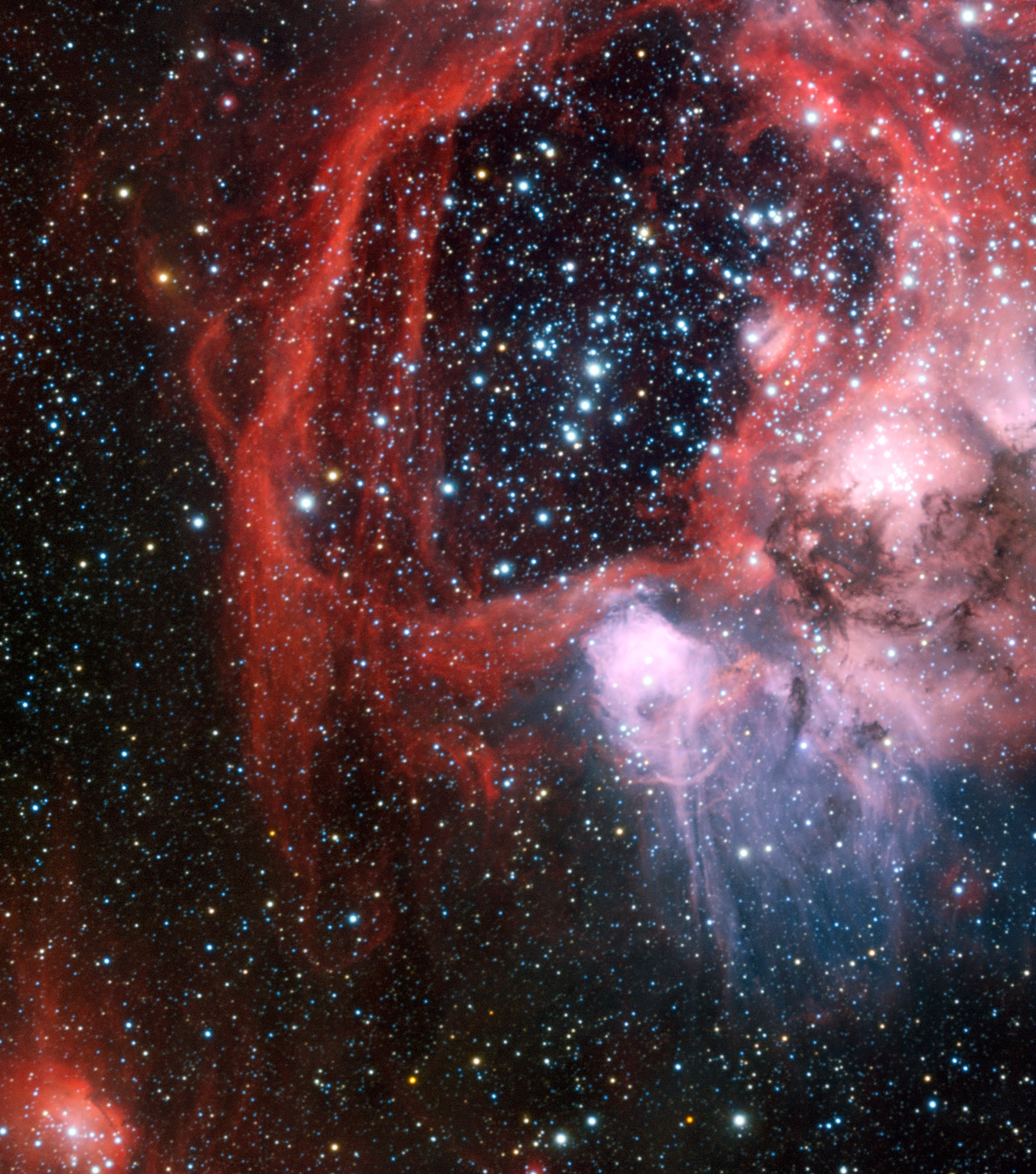
    Star formation in the Large Magellanic Cloud. ESO/Manu Mejias Credit: ESO/Manu Mejias

    A chance discovery by a team of physicists has provided experimental evidence that stars may generate sound.

    The study of fluids in motion – now known as hydrodynamics – goes back to the Egyptians, so it is not often that new discoveries are made. However, when examining the interaction of an ultra-intense laser with a plasma target, the team observed something unexpected.

    Scientists including Dr John Pasley, of the York Plasma Institute in the Department of Physics at York, realized that in the trillionth of a second after the laser strikes, plasma flowed rapidly from areas of high density to more stagnant regions of low density, in such a way that it created something like a traffic jam. Plasma piled up at the interface between the high and low-density regions, generating a series of pressure pulses: a sound wave.

    However, the sound generated was at such a high frequency that it would have left even bats and dolphins struggling! With a frequency of nearly a trillion hertz, the sound generated was not only unexpected, but was also close to the highest frequency possible in such a material – six million times higher than that which can be heard by any mammal!

    Dr. Pasley, who worked with scientists from the Tata Institute of Fundamental Research in Mumbai, India, and the Science and Technology Facilities Council’s Central Laser Facility in Oxfordshire, said: “One of the few locations in nature where we believe this effect would occur is at the surface of stars. When they are accumulating new material stars could generate sound in a very similar manner to that which we observed in the laboratory – so the stars might be singing – but, since sound cannot propagate through the vacuum of space, no one can hear them.”

    The technique used to observe the sound waves in the laboratory works very much like a police speed camera. It allows the scientists to accurately measure how fluid is moving at the point that is struck by the laser on timescales of less than a trillionth of a second.

    Dr. Alex Robinson from the Plasma Physics Group at STFC’s Central Laser Facility developed a numerical model to generate acoustic waves for the experiment. He said, “It was initially hard to determine the origin of the acoustic signals, but our model produced results that compared favorably with the wavelength shifts observed in the experiment. This showed that we had discovered a new way of generating sound from fluid flows. Similar situations could occur in plasma flowing around stars.”

    The research was funded by the Engineering and Physical Sciences Research Council and the Tata Institute of Fundamental Research. It is published in Physical Review Letters.

    Reference: “Terahertz Acoustics in Hot Dense Laser Plasmas” by Amitava Adak, A.P.L. Robinson, Prashant Kumar Singh, Gourab Chatterjee, Amit D. Lad, John Pasley and G. Ravindra Kumar, 17 March 2015, Physical Review Letters.
    DOI: 10.1103/PhysRevLett.114.115001


    Never miss a breakthrough: Join the SciTechDaily newsletter.
    Follow us on Google and Google News.

    Astronomy Astrophysics Popular University of York
    Share. Facebook Twitter Pinterest LinkedIn Email Reddit

    Related Articles

    Plasma “Fireballs” at CERN May Explain the Universe’s Missing Light

    Astronomers Solve 70-Year-Old Cosmic Ray Mystery

    New Theory Suggests We’ve Been Looking for Dark Matter All Wrong

    Rewriting Physics Textbooks: Scientists Propose a Bold New Theory About the Universe’s Origins

    Scientists Propose New Way To Search for Dark Matter

    Solar Surprise: Scientists Discover Unprecedented High-Energy Light Coming From the Sun

    Upgraded LIGO Reactivated: Resumes Unraveling Universe’s Secrets With Enhanced Gravitational Wave Detection

    Theoretical Physicists Suggest Dark Matter May Be Massive

    Theoretical Physicists Reveal the Turbulent Nature of Black Holes

    Leave A Reply Cancel Reply

    • Facebook
    • Twitter
    • Pinterest
    • YouTube

    Don't Miss a Discovery

    Subscribe for the Latest in Science & Tech!

    Trending News

    289-Million-Year-Old Reptile Mummy Reveals Origin of Human Breathing System

    New Brain Discovery Challenges Long-Held Theory of Teenage Brain Development

    Scientists Discover Plants “Scream” – We Just Couldn’t Hear Them Until Now

    Scientists Discover a Surprising Reason Intermittent Fasting Extends Life

    This Simple Fruit Wash Could Make Produce Safer and Last Days Longer

    Scientists Say Adding This Unusual Seafood to Your Diet Could Reverse Signs of Aging

    Scientists Say a Hidden Structure May Exist Inside Earth’s Core

    Doctors Surprised by the Power of a Simple Drug Against Colon Cancer

    Follow SciTechDaily
    • Facebook
    • Twitter
    • YouTube
    • Pinterest
    • Newsletter
    • RSS
    SciTech News
    • Biology News
    • Chemistry News
    • Earth News
    • Health News
    • Physics News
    • Science News
    • Space News
    • Technology News
    Recent Posts
    • Scientists Propose Radical New Way To Detect Alien Life – Without Traditional Biosignatures
    • Scientists Just Discovered Light Can Actually Slow Plant Growth
    • Scientists Finally Solved One of Water’s Biggest Mysteries
    • 7,000-Year-Old DNA Rewrites the Story of the “Neolithic Revolution”
    • Missing Medieval Relic of Legendary English King Found After Being Missing for 40 Years
    Copyright © 1998 - 2026 SciTechDaily. All Rights Reserved.
    • Science News
    • About
    • Contact
    • Editorial Board
    • Privacy Policy
    • Terms of Use

    Type above and press Enter to search. Press Esc to cancel.