
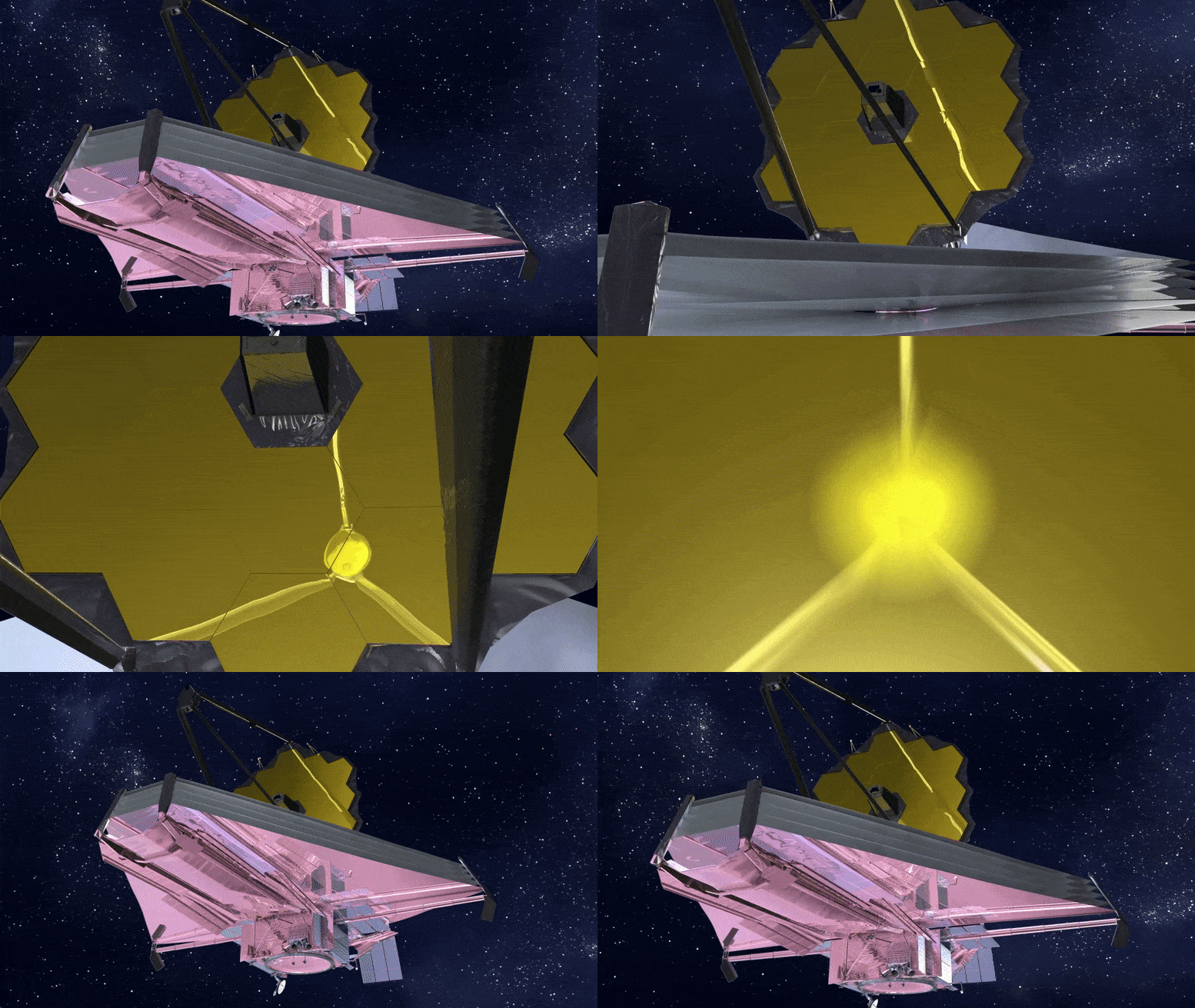
After the James Webb Space Telescope’s first year in service, astronomers are awash in new observations that illuminate the oldest stars and galaxies.
In its first year on the job, NASA’s James Webb Space Telescope has performed in ways that can only be described as stellar.
Launched at the tail end of 2021 after years of delays, the observatory — NASA’s largest and most expensive space telescope to date — has been living up to its hype. Last July, the public got a first look at the telescope’s power, when astronomers released one of the first images taken by the observatory, showing a cluster of spinning galaxies, each one captured in spectacular, luminous detail from 4.6 billion light years away.
Since then, JWST has peeled back more layers of cosmic dust to reveal stars, planets, galaxies, and other astrophysical structures with unprecedented clarity, both in our immediate galaxy and out to the farthest, earliest moments in time.
JWST recently hit its one-year anniversary, and scientists marked the milestone this week with a five-day conference at MIT dubbed “First Light.” The meeting brought together more than 150 astronomers from around the world, many of whom have worked directly with JWST data, looking for signs of the universe’s earliest light. The meeting included a public event at the MIT Museum, where astronomers shared their experiences of working with the telescope. Conference organizer Anna-Christina Eilers, a Pappalardo Fellow in MIT’s Kavli Institute for Astrophysics and Space Research, gave MIT News some highlights of what astronomers have learned in JWST’s first year of observations, and what more the telescope could reveal in the coming years.

Q: What have astronomers seen so far of the universe’s “first light”?
A: Looking for the first light means that we are trying to look back in time at the very distant universe to try to see the light from the first objects that existed in the universe. And JWST has really allowed us to push this limit further back in time, so we are now able to pierce through the universe further than before.
JWST revealed a whole range of really surprising discoveries about the early universe. For instance, we found massive galaxies within the first few hundred million years of cosmic time. So, you’re looking back more than 13 billion years in time. We found galaxies that are a lot more massive, have a lot more stars, and are more evolved than what we had anticipated from our models for galaxy evolution. Similarly, we find supermassive black holes, which reside in the center of every galaxy, that are a lot more massive than our current models predict they could be at this very early cosmic time. These findings have opened more questions than they gave answers, because now we are trying to figure out how these galaxies and black holes can evolve to grow so rapidly in a very short amount of available cosmic time.
One of the major results that JWST has enabled is that for the first time we can now actually see the light of the host galaxies of quasars. Quasars are supermassive black holes in the center of galaxies that are actively growing and accreting material from their surroundings, and that accretion process makes these black holes incredibly luminous. Therefore, quasars are the most luminous objects that we know in the universe, and we can observe them at the largest distances and see them at the very beginning of cosmic time. A question that has always been unanswered is: What does the host galaxy of those quasars look like? Are they already really massive, which poses some challenges to the formation of these objects? Are the black holes growing first, and then the galaxies catch up later? That’s something we can study now for the first time.
Overall, it’s surprising that we have these very evolved objects at a time when we expected the universe to be in its infancy and to not have very many evolved objects at all. I don’t think anyone had expected to see so much stuff at such early cosmic times.
Q: What have people learned about how the telescope works in its first year?
A: The telescope is really outperforming on almost every level. It’s a lot more sensitive and has a lot more capabilities than people had imagined. For instance, for the program I’ve been working on in the past year, we were looking at quasar fields in the early universe, and we were expecting to find a few tens of galaxies in the field. The telescope allowed us to detect more than 100 galaxies in these fields, which is almost a factor of 10 higher than we anticipated.
It allows us to think more ambitiously and more adventurously in how we can use the telescope. The science proposals for the next year of observing are more creative and ambitious in what we want to try.
Q: What are you hoping to see in the second year of observations?
A: The program that I’m particularly excited about is aiming to understand how these very early supermassive black holes form. The question of how these black holes evolve from very small stellar remnants to these billion-solar-mass black holes, in a very short amount of cosmic time, has been really puzzling us. And now we find with JWST even more supermassive black holes in the very early universe, which is making the problem more challenging to explain.
The whole community had been waiting for decades for the instrument to launch, and now JWST is really revolutionizing our field. For this week, it’s a great time to bring people together to understand what the telescope’s first data looks like and what people have learned about how the instruments work. I hope that we will have a lot of good discussions about new ideas and results at this conference.
Never miss a breakthrough: Join the SciTechDaily newsletter.
Follow us on Google and Google News.