

Newly discovered feathers were crucial to how Archaeopteryx was able to fly.
Archaeopteryx is the fossil that helped confirm Darwin’s theory of evolution. It is the oldest known fossil bird and provides strong evidence that all birds, including those alive today, are a type of dinosaur. Although the first Archaeopteryx fossil was discovered more than 160 years ago, scientists continue to uncover new details about this ancient species.
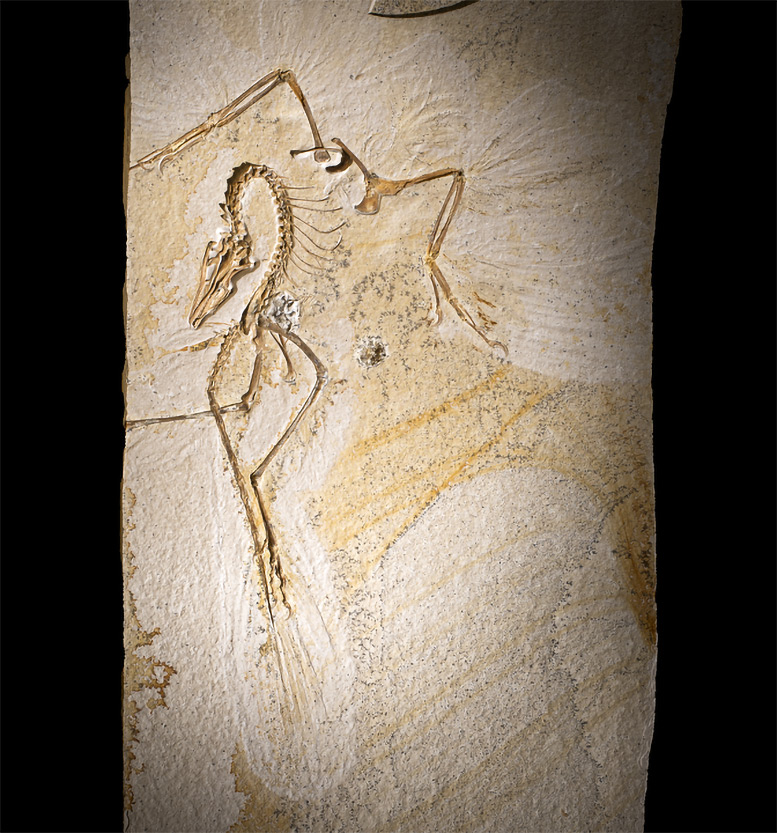
In a new study published in Nature, researchers described the latest Archaeopteryx fossil to enter the public scientific record: the Chicago Archaeopteryx, which went on display at the Field Museum in 2024. Thanks to the careful work of the scientists who prepared the specimen, it preserves more soft tissue and fine skeletal details than any other Archaeopteryx fossil. Notably, it includes a set of feathers never before seen in the species, which help explain how it was able to fly, unlike many of its dinosaur relatives.
Like all Archaeopteryx fossils, the Chicago specimen was discovered in limestone deposits near Solnhofen, Germany. It was originally found by a private fossil collector sometime before 1990 and remained in private hands until a coalition of supporters helped the Field Museum acquire it. The fossil arrived at the museum in August 2022.
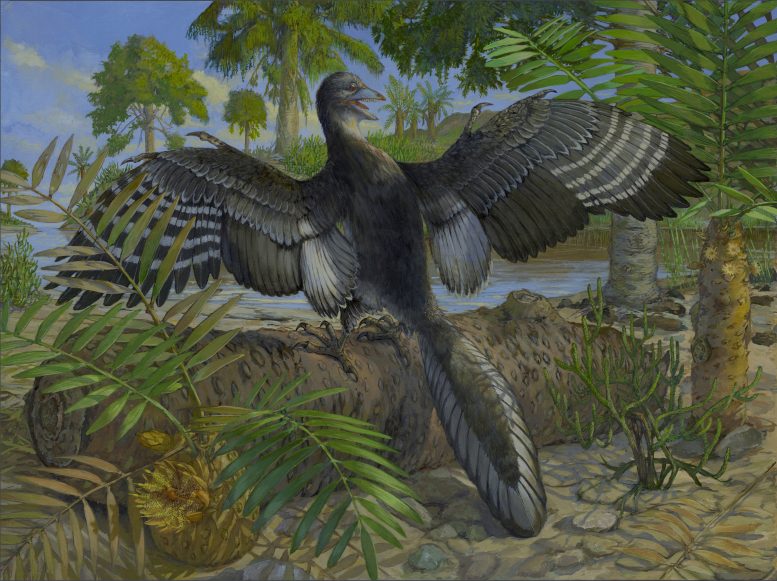
“When we first got our Archaeopteryx, I was like, this is very, very, very cool, and I was beyond excited. But at the same time, Archaeopteryx has been known for over 160 years, so I wasn’t sure what new things we would be able to learn,” says Jingmai O’Connor, the Field Museum’s associate curator of fossil reptiles and lead author of the paper. “But our specimen is so well-preserved and so well-prepared that we’re actually learning a ton of new information, from the tip of its snout to the tip of its tail.”
Challenges of fossil preparation
Archaeopteryx lived around 150 million years ago during the Jurassic Period and was a small animal. The Chicago specimen is the smallest one discovered so far, about the size of a pigeon. Its fragile, hollow bones are preserved in a slab of very hard limestone. “When you have such a delicate fossil, you can’t completely remove it from the surrounding rock matrix the way you do with something big and solid like a T. rex,” says O’Connor. “So when we prepared it, we carefully chipped away the bits of rock covering the fossil.”
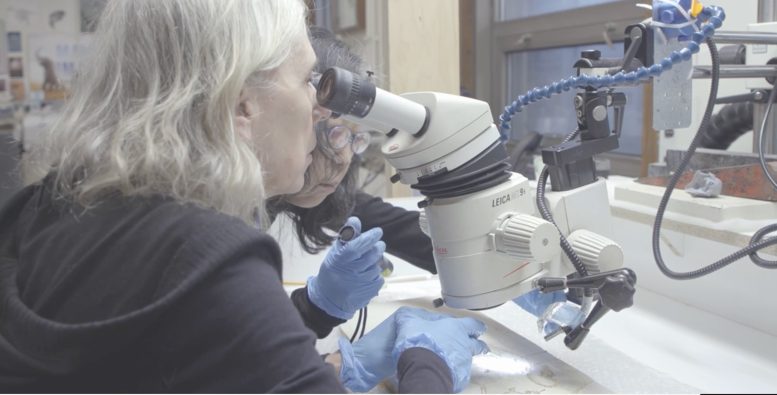
A team of fossil preparators, led by the Field Museum’s chief fossil preparator Akiko Shinya, spent over a year working on the Chicago Archaeopteryx. The work was incredibly detailed. Even seeing where the fossil ended and the rock matrix began was a challenge, because the preserved bones and tissues are nearly the same color as the surrounding rock. The CT scan was also used to better delineate the boundaries of the fossil.
“A CT scanner is essentially a machine that takes a series of X-rays, which it uses to build a three-dimensional image, based on differences in density. It lets you see inside things,” says O’Connor. “CT scanning was very important for our preparation process— it let us know things like, the bone is exactly 3.2 millimeters below the surface of the rock, which let us know exactly how far we could go before we would hit the bone. This is the first time a complete Archaeopteryx has been CT scanned and the data made available.”
UV light reveals hidden soft tissues
The team was further guided by the use of UV light to illuminate pieces of the fossil’s skeleton and even its soft tissues, like scales on the bottom of the toes. “Previous studies have shown that there’s something in the chemical composition of Solnhofen fossils that makes the soft tissues fluoresce, or glow under UV light,” says O’Connor. “So our amazing prep team utilized UV light periodically through the preparation process to make sure that they weren’t accidentally removing any soft tissues that you can’t see with the naked eye.”
This careful, technology-guided preparation led to more fine details being preserved in the Chicago Archaeopteryx than in any other specimen. “We’re lucky in that this specimen happens to be extremely well-preserved, but we can also see features that probably were preserved in other specimens, but which didn’t make it through cruder preparation processes in the past,” says O’Connor. “Having the preparation of this specimen done by scientists whose goal was to preserve as much tissue and bone as possible made a huge difference.”
Focus on key anatomical features
While there’s a lot to learn from the Chicago Archaeopteryx, in this paper, O’Connor and her team focused on a few areas in particular: the head, the hands and feet, and the wing feathers.
“The bones in the roof of the mouth help us learn about the evolution of something called cranial kinesis— a feature in modern birds that lets the beak move independently from the braincase. That might not sound exciting, but to people who study bird evolution, it’s really important, because it’s been hypothesized that being able to evolve specialized skulls for different ecological niches might have helped birds evolve into more than 11,000 species today,” says O’Connor. Meanwhile, soft tissues preserved in the Chicago Archaeopteryx’s hands and feet bolster ideas that Archaeopteryx spent a lot of its time walking on the ground and might even have been able to climb trees.
The Chicago Archaeopteryx‘s wing feathers factor into a long-standing scientific debate about the origins of flight in dinosaurs. “Archaeopteryx isn’t the first dinosaur to have feathers, or the first dinosaur to have ‘wings.’ But we think it’s the earliest known dinosaur that was able to use its feathers to fly,” says O’Connor. “This is actually my favorite part of the paper, the part that provides evidence that Archaeopteryx was using its feathered wings for flying.”
Tertial feathers fill the aerodynamic gap
The key to Archaeopteryx’s flight might be a set of feathers never before seen in a member of its species: a long set of feathers on the upper arm, called tertials.
“Compared to most living birds, Archaeopteryx has a very long upper arm bone,” says O’Connor. “And if you’re trying to fly, having a long upper arm bone can create a gap between the long primary and secondary feathers of the wing and the rest of your body. If air passes through that gap, that disrupts the lift you’re generating, and you can’t fly.”
However, modern birds have evolved a solution to this problem: a shorter upper arm bones, and a set of tertial feathers to fill the gap between the bird’s body and the rest of its wing.
“Our specimen is the first Archaeopteryx that was preserved and prepared in such a way that we can see its long tertial feathers,” says O’Connor. “These feathers are missing in feathered dinosaurs that are closely related to birds but aren’t quite birds. Their wing feathers stop at the elbow. That tells us that these non-avian dinosaurs couldn’t fly, but Archaeopteryx could. This also adds to evidence that suggests dinosaurs evolved flight more than once—which I think is super exciting.”
O’Connor says that this initial study is just the beginning for the Chicago Archaeopteryx. “We’re learning something exciting and new from just about every part of the body that we have preserved. And this paper is really just the tip of the iceberg,” she says.
Reference: “Chicago Archaeopteryx informs on the early evolution of the avian bauplan” by Jingmai O’Connor, Alexander Clark, Pei-Chen Kuo, Yosef Kiat, Matteo Fabbri, Akiko Shinya, Constance Van Beek, Jing Lu, Min Wang and Han Hu, 14 May 2025, Nature.
DOI: 10.1038/s41586-025-08912-4
Never miss a breakthrough: Join the SciTechDaily newsletter.
Follow us on Google and Google News.
6 Comments
I love reading about new discoveries about old science and new discoveries for new science.
What I don’t love are those who have something that can change our view of past theories or hypothesis of who, what, why, or how in science and hold on to it until the biggest buyer acquires it.
Greed is the worst in the science world when it stops our understanding.
Of course, who am l?
The problem you speak of could be addressed by having the government provide tax rebates for people who make their specimens available for examination by professionals, who have small budgets for purchasing. I think that most owners would like to have their specimen professionally prepared, documented, and possibly named after them. However, I suspect that would result in more specimens available for examination than paleontologists willing or able to conduct the analysis. Alternatively, we could let the specimens remain in the ground and degrade over time. I think it is far better to encourage amateur collectors who will retrieve and protect them. Look for a positive solution rather than just complain that paleontologists can’t afford to compete with rich people. Without a financial incentive, there would be far fewer fossils collected.
God sure created some interesting creatures.
All of the articles I have seen on this negligently neglect to mention what wavelength(s) of UV EMR were used in the detection of feathers and flesh. Inquiring minds would like to know. It is possible that their results could be improved upon by optimizing the band(s) used. They might be removing and destroying important information.
All of the articles I have seen on this negligently neglect to mention what wavelength(s) of UV EMR were used in the detection of feathers and flesh. Inquiring minds would like to know. The Nature article suggests in a figure caption that UVA, B, and C were used simultaneously, but it is not made explicit. It is possible that their results could be improved upon by optimizing the band(s) used. They might be removing and destroying important information.
I’ve got a fossilized eye of a Arch X so much detail if got 400 mil fossilized egg and a sea creature these guys from dish cable asked if they could take pics of them and they could not believe there eyes what they were seeing I need take them to a geo