
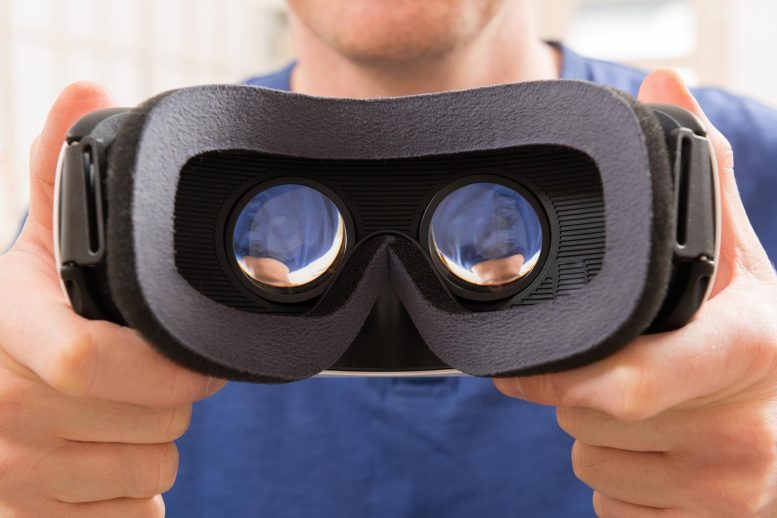
A new VR headset lets patients use eye gaze to explore calming virtual worlds during MRI scans, easing anxiety and reducing sedation.
Researchers from King’s College London have created a novel interactive VR system to be used by patients when undertaking an MRI.
In a new paper published in Scientific Reports, the researchers say they hope this advancement will make it easier for those who find having a MRI scan challenging, such as children, people with cognitive difficulties, or those who suffer from claustrophobia or anxiety.
In normal circumstances, MRI scans fail in up to 50 percent of children under 5 years of age, which means that hospitals often rely on sedative medication or even anesthesia to get children successfully scanned.
These measures are time-consuming and expensive and have their own associated risks. From a neuroscience point of view, it also means that MRI-based studies of brain function are generally only ever studied in these vulnerable populations during an artificially induced sleep state, so may not be representative of how the brain works in normal circumstances.
Lead researcher Dr. Kun Qian from the School of Biomedical Engineering & Imaging Sciences at King’s College London said having an MRI scan can be quite an alien experience as it involves going into a narrow tunnel, with loud and often strange noises in the background, all while having to stay as still as possible.
“We were keen to find other ways of enabling children and vulnerable people to have an MRI scan,” Dr. Qian said.
Immersion as a Solution
“Our interest in VR specifically came from the simple observation that when someone is using and then immersed in a VR environment, they are entirely unaware of their surroundings. We thought if we could make a system compatible with the MRI environment, it could be a very powerful alternative way to successfully scan these challenging populations.”
To provide patients with an immersive VR environment, the researchers developed a special VR headset that can be safely used inside MRI scanner.
The headset is designed to be light tight, so that the user cannot see their surrounding environment at all and is unaware of visual reminders of their position.
Once the system is properly positioned, the system’s projector is immediately live, providing immersive content and the VR experience is then continuous from that point onwards until the patient is removed at the end of the examination.
The researchers say this and other measures are highly effective at removing the sense of being inside the MRI scanner, as their visual scene is completely replaced with the VR environment and through creating congruence with the other sensations that are perceived during MRI examinations such as scanner noise, table movement and table vibration.
So far, this has been done by including elements in the visual scene that indicate that construction work is in progress in the virtual world, which could account for scanner noise and vibration.
One of the main novelties with this system is that the users can interact with the virtual world just with eye gaze – how we do things in our day-to-day lives.
Currently, there are no other such MRI-compatible systems which combine a VR presentation system with intuitive interaction in this way.
Navigation and Communication by Looking
Using their gaze (i.e., simply looking at objects or areas in the VR environment), users can navigate through the virtual world, select content such as films and games, play games, and initiate or terminate a video link to their companion or carer.
The latter means that an anxious patient can interact at will with a companion or carer at any time during their examination via a webcam with microphone and a display monitor installed in the console area.
The researchers say the next steps for the system is to develop content and test it with patients.
“Developing the right content is crucial, as for the system to be effective it needs to maintain a subject/patient’s attention and their sense of immersion for as long as possible. As this content is likely to be very different depending on age and cognitive capabilities, getting this right and tailoring it for different clinical and study populations is a key next step,” Dr. Qian said.
Co-author Dr. Tomoki Arichi said: “We are very excited about the possibilities that this system opens up for vulnerable and important populations like children and those with difficulties which might mean they can’t normally have a MRI scan without being put to sleep. Not only could this make an enormous difference for everyday clinical practice, but it also opens the way for us to gain dramatic new insight into how patterns of brain function, behavior, and social skills develop across our lives.”
Reference: “An eye tracking based virtual reality system for use inside magnetic resonance imaging systems” by Kun Qian, Tomoki Arichi, Anthony Price, Sofia Dall’Orso, Jonathan Eden, Yohan Noh, Kawal Rhode, Etienne Burdet, Mark Neil, A. David Edwards and Joseph V. Hajnal, 11 August 2021, Scientific Reports.
DOI: 10.1038/s41598-021-95634-y
Never miss a breakthrough: Join the SciTechDaily newsletter.
Follow us on Google and Google News.