
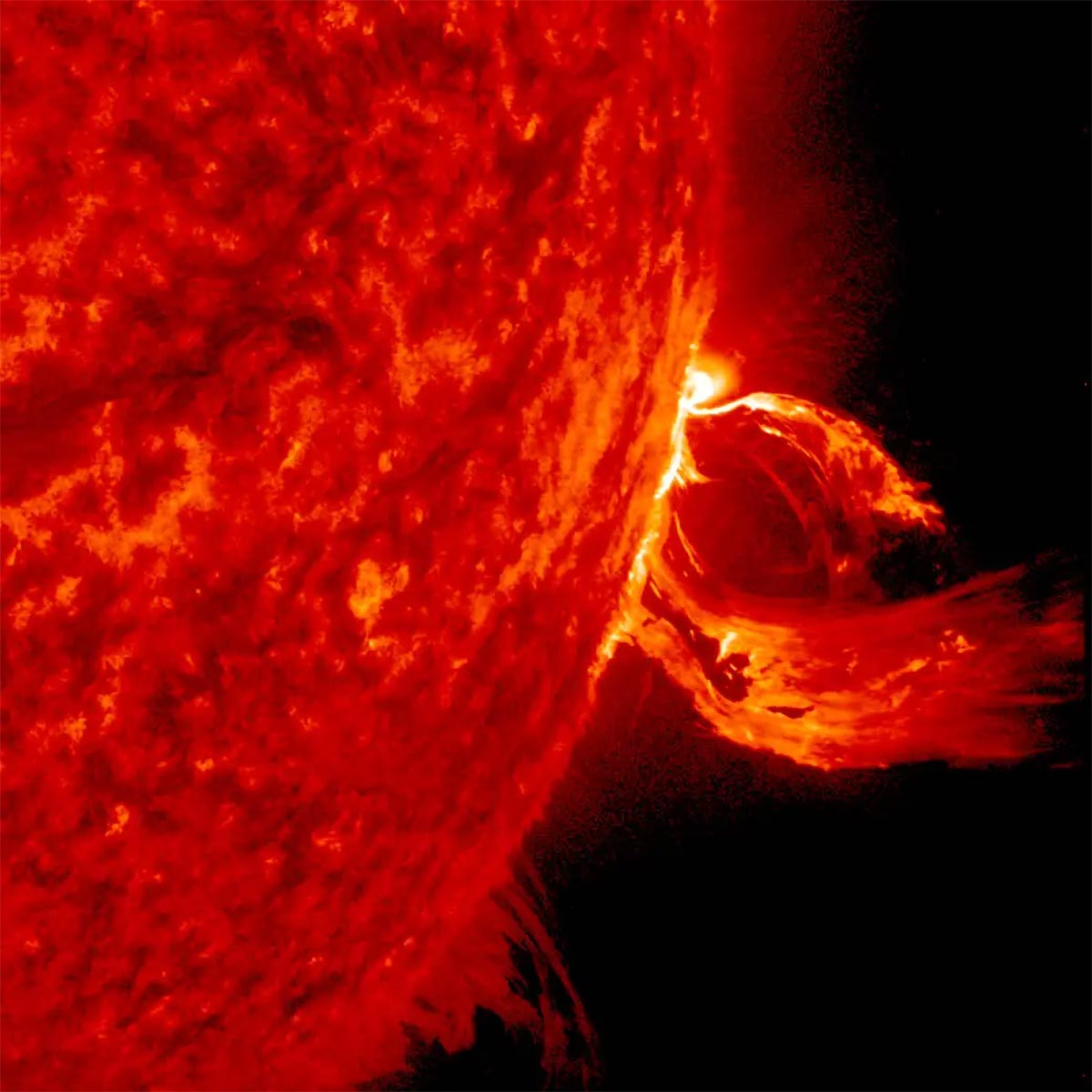
Researchers have developed a method to predict the speed and arrival time of coronal mass ejections (CMEs) before they fully erupt from the Sun.
This advancement utilizes the measurement of the critical height in Active Regions on the Sun to enhance the accuracy of space weather forecasts. These predictions are crucial for protecting Earth’s technological infrastructure from geomagnetic storms that can disrupt satellites, power grids, and communication networks.
Space Weather Forecasting
Space storms could soon be forecasted with greater accuracy than ever before thanks to a big leap forward in our understanding of exactly when a violent solar eruption may hit Earth.
Scientists say it is now possible to predict the precise speed a coronal mass ejection (CME) is traveling at and when it will smash into our planet – even before it has fully erupted from the Sun.
CMEs are bursts of gas and magnetic fields spewed into space from the solar atmosphere.
This clip shows the before, during, and post eruption state of the Active Region AR11158, with the top left panel showing the AR in 171 wavelength, the top right panel a cutout of HMI magnetogram and the bottom panel a running difference movie. Credit: Jhelioviewer
The Impact of Geomagnetic Storms
They can cause geomagnetic storms that have the potential to wreak havoc with terrestrial technology in Earth’s orbit and on its surface, which is why experts across the globe are striving to improve space weather forecasts.
Advancements such as this one could make a huge difference in helping to protect infrastructure that is vital to our everyday lives, according to researchers at Aberystwyth University, who will present their findings on July 19 at the Royal Astronomical Society’s National Astronomy Meeting in Hull.
They made their discovery after studying specific areas on the Sun called ‘Active Regions’, which have strong magnetic fields where CMEs are born. The researchers monitored how these areas changed in the periods before, during, and after an eruption.
This clip shows a coronal mass ejection that erupted from AR11158 on its way to Earth, moving outwards in LASCO c2 and c3 field of view. Credit: Jhelioviewer
The Importance of Critical Height
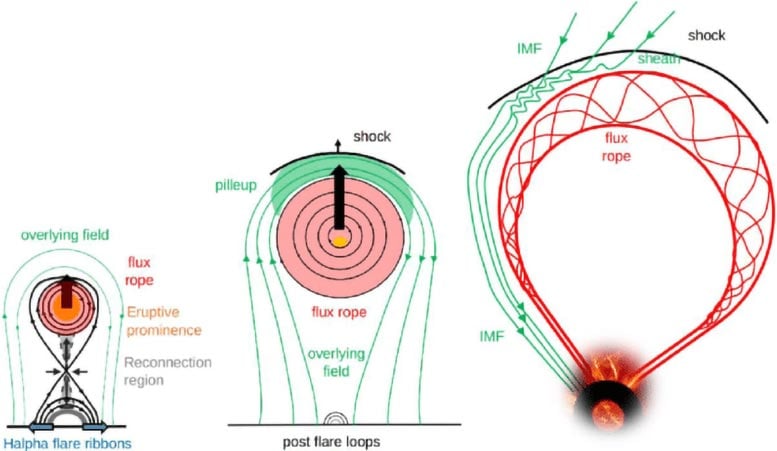
A vital aspect that they looked at was the “critical height” of the Active Regions, which is the height at which the magnetic field becomes unstable and can lead to a CME.
“By measuring how the strength of the magnetic field decreases with height, we can determine this critical height,” said lead researcher Harshita Gandhi, a solar physicist at Aberystwyth University.
“This data can then be used along with a geometric model which is used to track the true speed of CMEs in three dimensions, rather than just two, which is essential for precise predictions.”
She added: “Our findings reveal a strong relationship between the critical height at CME onset and the true CME speed.
Implications for Space Weather Predictions
“This insight allows us to predict the CME’s speed and, consequently, its arrival time on Earth, even before the CME has fully erupted.”
When these CMEs hit the Earth they can trigger a geomagnetic storm which is capable of producing stunning aurorae, often referred to in the northern hemisphere as the Northern Lights.
But the storms also have the potential to disrupt vital systems we rely on daily, including satellites, power grids, and communication networks, which is why scientists worldwide are working hard to improve our ability to better predict when CMEs will hit Earth.
This requires knowing a more accurate speed of the CME shortly after it erupts from the Sun to better provide advance warnings of when it will reach our planet.
Enhancing Forecast Accuracy
Accurate speed predictions enable better estimates of when a CME will reach Earth, providing crucial advance warnings.
“Understanding and using the critical height in our forecasts improves our ability to warn about incoming CMEs, helping to protect the technology that our modern lives depend on,” Gandhi said.
“Our research not only enhances our understanding of the Sun’s explosive behavior but also significantly improves our ability to forecast space weather events.
“This means better preparation and protection for the technological systems we rely on every day.”
Never miss a breakthrough: Join the SciTechDaily newsletter.
Follow us on Google and Google News.