
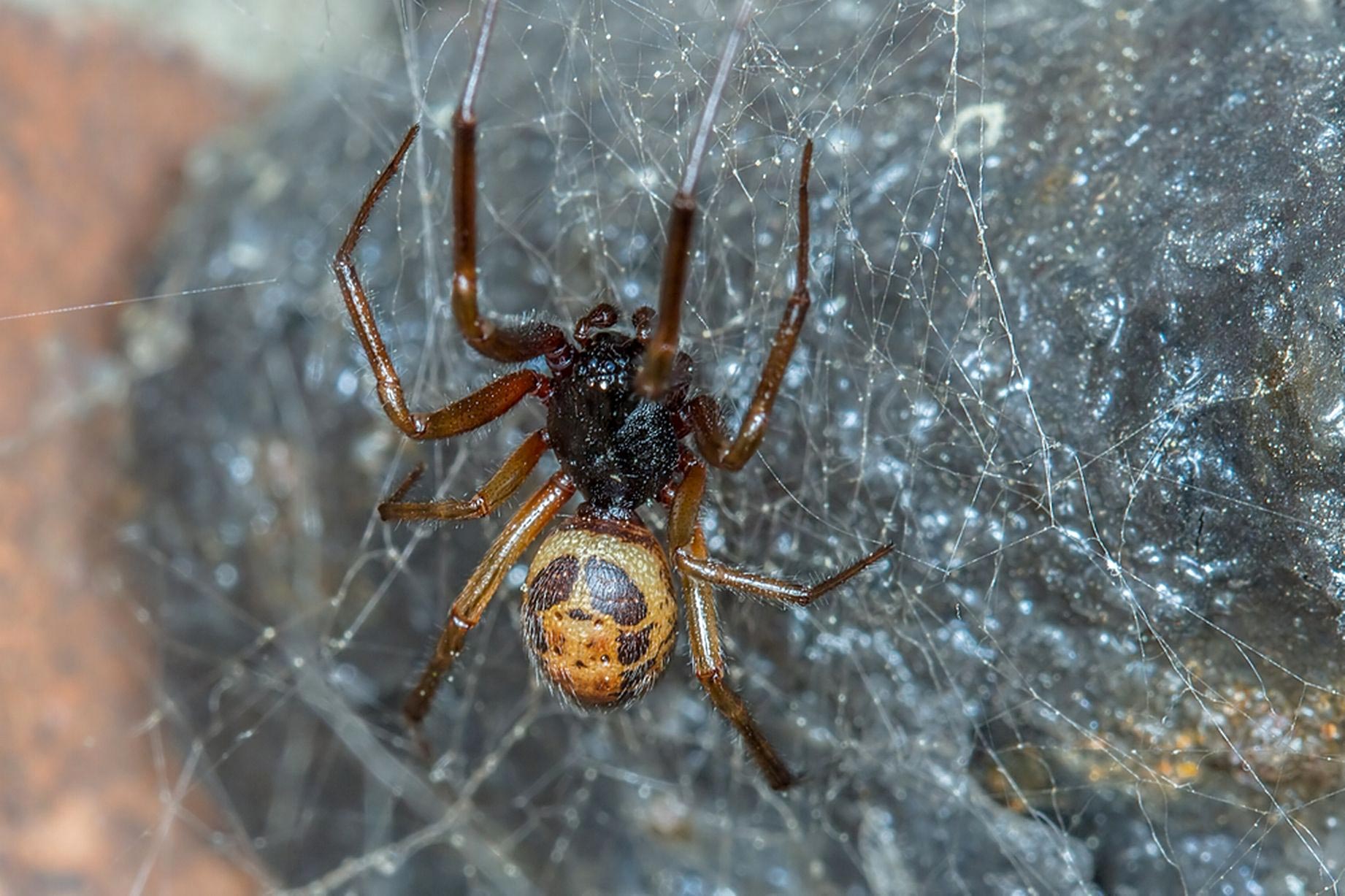
NUI Galway study, published in the international journal Scientific Reports, confirms that spiders carry harmful bacteria and that they can be transmitted when a spider uses its fangs to bite.
A team of zoologists and microbiologists from NUI Galway have published a new study showing that common house spiders carry bacteria susceptible to infecting people, with the Noble False Widow spiders also carrying harmful strains resistant to common antibiotic treatments.
This new research, published in the international journal Scientific Reports, confirms a theory which has been debated among spider and healthcare specialists for many years, and explains a range of symptoms experienced by victims bitten by the invasive noble false widow spider in Ireland and Britain over the past decade.
Australian Black Widows or Funnel Web spiders are well known for their potentially deadly venom, but rare “skin-eating” conditions following seemingly harmless European and North American spider bites were thought to be the result of secondary infections caused by the victim scratching and probing the bite site with contaminated fingers. This new study shows that not only do spiders carry harmful bacteria, but those germs can be transmitted when a spider uses its fangs to bite.
Furthermore, many spiders have been shown to have venom with antibacterial activity and it is often debated as to whether the venom would neutralize bacteria at the bite site, but this also demonstrates, at least for the Noble False Widow, that the venom does not inhibit bacteria.
Dr. Aoife Boyd, Director of the Pathogenic Mechanisms Group at NUI Galway’s School of Natural Sciences, and senior author of the study, said: “The diversity of microbes never ceases to amaze me. The power to survive and thrive in every environment is shown here by the presence of antimicrobial resistance bacteria even in spider venom. Antimicrobial resistance (AMR) is an urgent and growing problem worldwide. A One Health approach interconnecting human, animal, and environmental health is the only way to tackle the problem.”
Dr. John Dunbar, Zoologist at the Ryan Institute’s Venom System Lab in NUI Galway, said: “About 10 species of spiders common in North-western Europe have fangs strong enough to pierce human skin and deliver venom, but only one of them, the recent invasive noble false widow spider, is considered of medical importance. Most of the time, a spider bite results in some redness and pain.
“In some cases, however, victims seem to develop long-lasting infections for which strong antibiotic treatment – and sometimes a hospital stay – are necessary. It is this increasing range expansion and massive rise in dense populations of false widow spiders around urbanized areas across Ireland and Britain that has seen a rise in bites with some severe envenomation symptoms but also infections, which in some cases proved even difficult to treat with antibiotics.”
Neyaz Kahn, co-lead author of the study and PhD student at the Pathogenic Mechanisms Group in NUI Galway’s School of Natural Sciences, said: “Our study demonstrates that spiders are not just venomous but are also carriers of dangerous bacteria capable of producing severe infections. The biggest threat is that some of these bacteria are multi-drug resistant, making them particularly difficult to treat with regular medicine. This is something that health care professionals should consider from now on.”
Reference: “Synanthropic spiders, including the global invasive noble false widow Steatoda nobilis, are reservoirs for medically important and antibiotic resistant bacteria” by John P. Dunbar, Neyaz A. Khan, Cathy L. Abberton, Pearce Brosnan, Jennifer Murphy, Sam Afoullouss, Vincent O’Flaherty, Michel M. Dugon and Aoife Boyd, 1 December 2020, Scientific Reports.
DOI: 10.1038/s41598-020-77839-9
Never miss a breakthrough: Join the SciTechDaily newsletter.
Follow us on Google and Google News.