
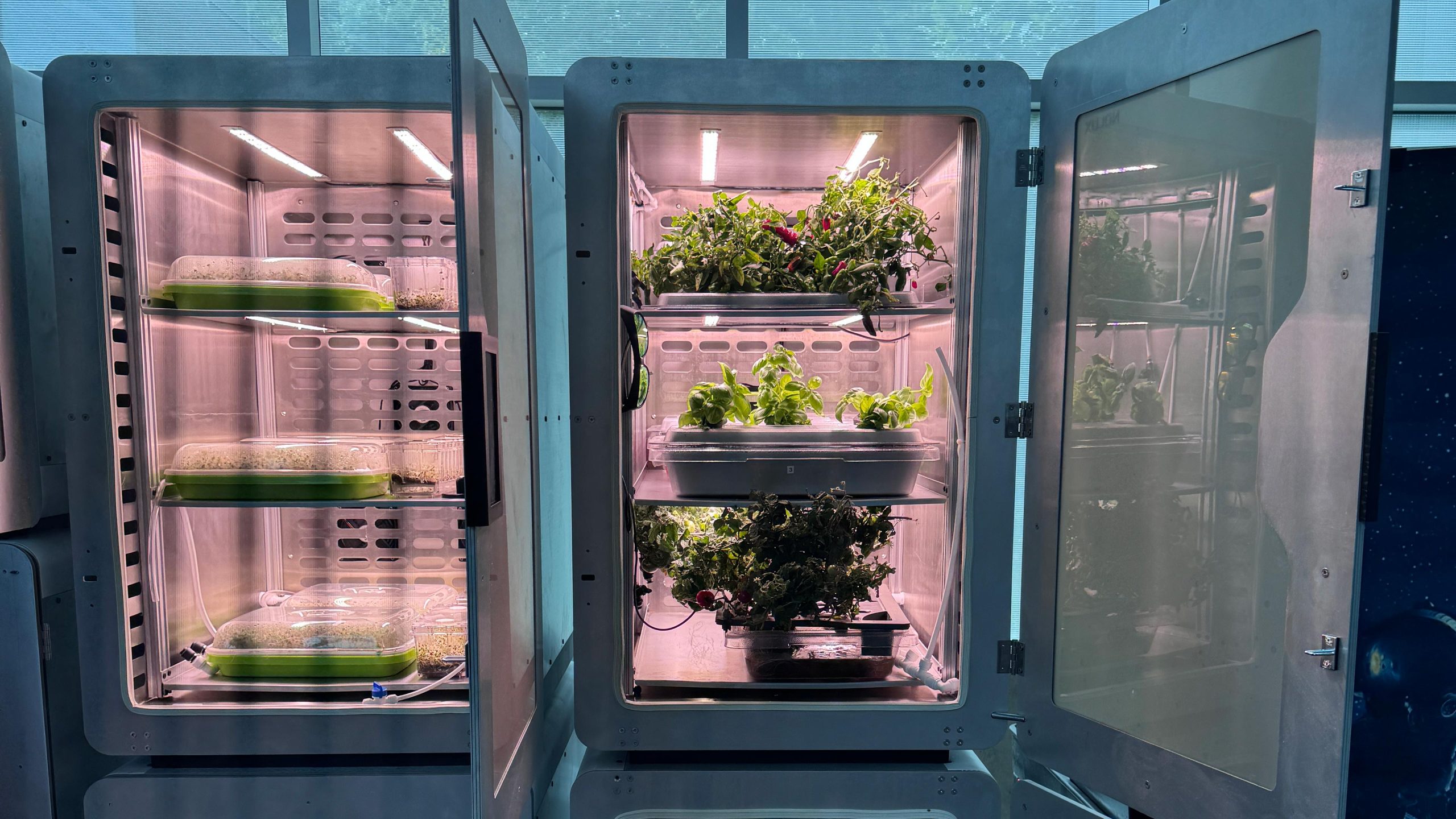
Bioengineers propose “electro-agriculture,” a method that replaces photosynthesis with a solar-powered reaction converting CO2 into acetate, potentially reducing U.S. agricultural land needs by 94% and supporting controlled indoor farming.
Initial experiments focus on genetically modified acetate-consuming plants like tomatoes and lettuce, with potential future applications in space agriculture.
Revolutionary Electro-Agriculture
Photosynthesis, the natural process that powers most life on Earth, is surprisingly inefficient—plants only convert about 1% of the light they absorb into usable chemical energy. Now, bioengineers have proposed a groundbreaking alternative method of food production they call “electro-agriculture.”
Published in the journal Joule on October 23, their research suggests a solar-powered method that skips photosynthesis altogether. Instead, it directly converts CO₂ into a nutrient-rich organic molecule that genetically modified plants could “consume” as food. According to the researchers, if electro-agriculture were used to grow all food in the United States, it could reduce the land needed for farming by a remarkable 94%. This technology might even enable food production in space.
Indoor Farming: The Future of Agriculture
“If we don’t need to grow plants with sunlight anymore, then we can decouple agriculture from the environment and grow food in indoor, controlled environments,” explains corresponding author and biological engineer Robert Jinkerson of the University of California, Riverside. “I think that we need to move agriculture into the next phase of technology, and producing it in a controlled way that is decoupled from nature has to be the next step.”

Electro-agriculture would mean replacing agricultural fields with multi-story buildings. Solar panels on or near the buildings would absorb the sun’s radiation, and this energy would power a chemical reaction between CO2 and water to produce acetate—a molecule similar to acetic acid, the main component in vinegar. The acetate would then be used to feed plants that are grown hydroponically. The method could also be used to grow other food-producing organisms, since acetate is naturally used by mushrooms, yeast, and algae.
Engineering Acetate-Eating Plants
“The whole point of this new process to try to boost the efficiency of photosynthesis,” says senior author Feng Jiao, an electrochemist at Washington University in St. Louis. “Right now, we are at about 4% efficiency, which is already four times higher than for photosynthesis, and because everything is more efficient with this method, the CO2 footprint associated with the production of the food becomes much smaller.”
To genetically engineer acetate-eating plants, the researchers are taking advantage of a metabolic pathway that germinating plants use to break down food stored in their seeds. This pathway is switched off once plants become capable of photosynthesis, but switching it back on would enable them to use acetate as a source of energy and carbon.
Expanding Applications Beyond Traditional Crops
“We’re trying to turn this pathway back on in adult plants and reawaken their native ability to utilize acetate,” says Jinkerson. “It’s analogous to lactose intolerance in humans—as babies we can digest lactose in milk, but for many people that pathway is turned off when they grow up. It’s kind of the same idea, only for plants.”
The team is focusing their initial research on tomatoes and lettuce but plans to move on to high-calorie staple crops such as cassava, sweet potatoes, and grain crops in the future. Currently, they’ve managed to engineer plants that can use acetate in addition to photosynthesis, but they ultimately aim to engineer plants that can obtain all of their necessary energy from acetate, meaning that they would not need any light themselves.
“For plants, we’re still in the research-and-development phase of trying to get them to utilize acetate as their carbon source, because plants have not evolved to grow this way, but we’re making progress,” says Jinkerson. “Mushrooms and yeast and algae, however, can be grown like this today, so I think that those applications could be commercialized first, and plants will come later down the line.”
Enhancing Efficiency for Future Sustainability
The researchers also plan to continue refining their method of acetate production to make the carbon fixation system even more efficient.
“This is just the first step for this research, and I think there’s a hope that its efficiency and cost will be significantly improved in the near future,” says Jiao.
Reference: “Electro-agriculture: Revolutionizing farming for a sustainable future” by Bradie S. Crandall, Marcus Harland-Dunaway, Robert E. Jinkerson and Feng Jiao, 23 October 2024, Joule.
DOI: 10.1016/j.joule.2024.09.011
Never miss a breakthrough: Join the SciTechDaily newsletter.
Follow us on Google and Google News.
5 Comments
This just makes farming and raw materials more expensive
The part about multi-story buildings puzzles me. Just because the plants don’t need sunlight doesn’t mean they have to be raised in the dark. Building and maintaining all that infrastructure is pointless if you can just continue growing plants on already dedicated fields.
Can they ensure isolation from normal non-engineered crops to prevent cross-breeding so we don’t have crop failure if acetate is unavailable or engineer the plant to be able to use acetate when it is available but switch to natural processes when it is not?
More plastics are used.
Is phsn really only 1% efficient? By what standard? Certainly building all those skyscrapers to grow enough wheat/potatoes/sugarcane/soybeans will block out the sun, so the need for indoor farming will become inevitable. Indoor agriculture (including hydroponics) is too expensive for any crop that either grows underground or whose value is measured in cents per sq m and not dollars. Yet those are the crops that sustain us….