
Close Menu
    Facebook X (Twitter) Instagram
    SciTechDaily
    • Biology
    • Chemistry
    • Earth
    • Health
    • Physics
    • Science
    • Space
    • Technology
    Facebook X (Twitter) Pinterest YouTube RSS
    SciTechDaily
    Home»Technology»Fast Next-Generation Displays Possible With New Photonic Liquid Crystals
    Technology

    Fast Next-Generation Displays Possible With New Photonic Liquid Crystals

    By Penn StateNovember 7, 2019No Comments3 Mins Read
    Facebook Twitter Pinterest Telegram LinkedIn WhatsApp Email Reddit
    Share
    Facebook Twitter LinkedIn Pinterest Telegram Email Reddit
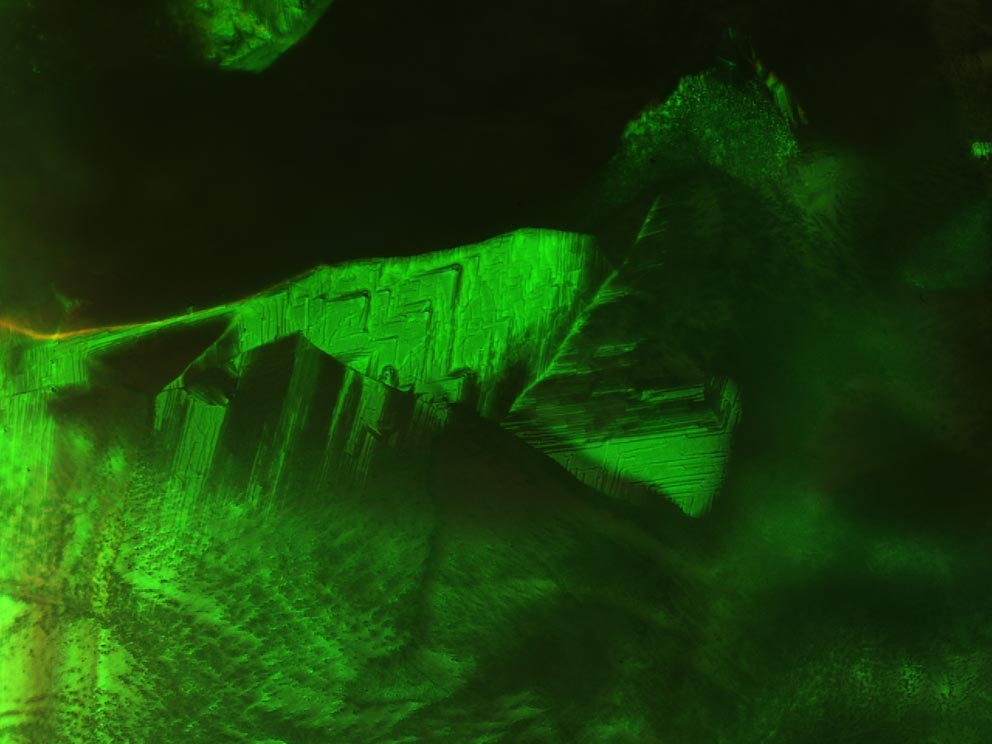
    Blue-Phase Liquid Crystal
    This is a close-up image of a mm-size Blue-phase liquid crystal during its formation stage. Credit: Khoo Lab, Penn State

    A new technique to change the structure of liquid crystals could lead to the development of fast-responding liquid crystals suitable for next-generation displays — 3D, augmented and virtual reality — and advanced photonic applications such as mirrorless lasers, bio-sensors, and fast/slow light generation, according to an international team of researchers from Penn State, the Air Force Research Laboratory and the National Sun Yat-sen University, Taiwan.

    “The liquid crystals we are working with are called blue-phase liquid crystals,” said Iam Choon Khoo, the William E. Leonhard Professor of Electrical Engineering, who is the corresponding author for this article. “The most important thing about this research is the fundamental understanding of what happens when you apply a field, which has led to the development of Repetitively-Applied Field technique. We believe that this method is almost a universal template that can be used for reconfiguring many similar types of liquid crystals and soft matter.”

    Blue-phase liquid crystals typically self-assemble into a cubic photonic-crystal structure. The researchers believed that by creating other structures they could develop properties not present in the current form. After nearly two years of experimentation, they realized that by applying an intermittent electrical field and allowing the system to relax between applications and to dissipate accumulated heat, they could slowly coax the crystals into stable and field-free orthorhombic and tetragonal structures.

    The resulting liquid crystals show a photonic band gap that can be tailored to anywhere within the visible spectrum, and possess fast responses necessary for a variety of next-generation displays and advanced photonic applications. The addition of a polymer to the crystals could stabilize them in a wide temperature range, from freezing to nearly boiling point compared to their typical pristine counterparts that are stable in only a 5-degree range. The polymer scaffold also speeds up the switching response.

    In the latest research, the team is applying the lessons learned in this study to create new crystal structures and orientations using the electric field from a laser source.  

    ###

    Reference: “Reconfiguration of three-dimensional liquid-crystalline photonic crystals by electrostriction” by Duan-Yi Guo, Chun-Wei Chen, Cheng-Chang Li, Hung-Chang Jau, Keng-Hsien Lin, Ting-Mao Feng, Chun-Ta Wang, Timothy J. Bunning, Iam Choon Khoo and Tsung-Hsien Lin, 28 October 2018, Nature Materials.
    DOI: 10.1038/s41563-019-0512-3

    The Asian Office of Aerospace Research and Development, the Air Force Office of Scientific Research; and the Ministry of Science and Technology, Taiwan, funded this work.

    Never miss a breakthrough: Join the SciTechDaily newsletter.
    Follow us on Google and Google News.

    Materials Science Penn State University
    Share. Facebook Twitter Pinterest LinkedIn Email Reddit

    Related Articles

    “Seeing” Non-Uniformities in 2D Materials May Lead to Tiny New Medical Sensors

    2D Heterostructures Rolled Like Sushi May Lead to Ultra Miniaturized Electronics

    Two Layers Are Better Than One for Efficient Solar Cells – Affordable, Thin Film Solar Cells With 34% Efficiency

    Nanostructure of Mosquito Eye Could Help Engineer Enhanced Water Repellent Coatings

    Microscopic 3D Printed Donut “Micro Swimmers” Mimic Biological Behavior

    Solar Cell Performance Boosted by Biological Material That Mimics Photosynthesis

    New Acoustic Device Separates Tumor Cells from Blood Cells

    Scientists Develop Super-Stretchable Yarn Made of Graphene

    Triangular Layers of Tungsten Disulfide May Have Applications in Optical Technology

    Leave A Reply Cancel Reply

    • Facebook
    • Twitter
    • Pinterest
    • YouTube

    Don't Miss a Discovery

    Subscribe for the Latest in Science & Tech!

    Trending News

    First-of-Its-Kind Discovery: Homer’s Iliad Found Embedded in a 1,600-Year-Old Egyptian Mummy

    Beyond Inflammation: Scientists Uncover New Cause of Persistent Rheumatoid Arthritis

    A Simple Molecule Could Unlock Safer, Easier Weight Loss

    Scientists Just Built a Quantum Battery That Charges Almost Instantly

    Researchers Unveil Groundbreaking Sustainable Solution to Vitamin B12 Deficiency

    Millions of People Have Osteopenia Without Realizing It – Here’s What You Need To Know

    Researchers Discover Boosting a Single Protein Helps the Brain Fight Alzheimer’s

    World-First Study Reveals Human Hearts Can Regenerate After a Heart Attack

    Follow SciTechDaily
    • Facebook
    • Twitter
    • YouTube
    • Pinterest
    • Newsletter
    • RSS
    SciTech News
    • Biology News
    • Chemistry News
    • Earth News
    • Health News
    • Physics News
    • Science News
    • Space News
    • Technology News
    Recent Posts
    • NASA Powers Down Voyager 1 Instrument As It Fights To Survive Deep Space
    • Physicists Propose Strange Experiment Where Time Goes Quantum
    • Scientists Flip Immune System “Switch,” Uncover Surprising Path To Stop Gut Inflammation
    • Magnesium Magic: New Drug Melts Fat Even on a High-Fat, High-Sugar Diet
    • Weight-Loss Drugs Like Ozempic May Come With an Unexpected Cost
    Copyright © 1998 - 2026 SciTechDaily. All Rights Reserved.
    • Science News
    • About
    • Contact
    • Editorial Board
    • Privacy Policy
    • Terms of Use

    Type above and press Enter to search. Press Esc to cancel.