

Doctoral candidate Nina Andrejevic combines spectroscopy and machine learning techniques to identify novel and valuable properties in matter.
Born into a family of architects, Nina Andrejevic loved creating drawings of her home and other buildings while a child in Serbia. She and her twin sister shared this passion, along with an appetite for math and science. Over time, these interests converged into a scholarly path that shares some attributes with the family profession, according to Andrejevic, a doctoral candidate in materials science and engineering at MIT.
“Architecture is both a creative and technical field, where you try to optimize features you want for certain kinds of functionality, like the size of a building, or the layout of different rooms in a home,” she says. Andrejevic’s work in machine learning resembles that of architects, she believes: “We start from an empty site — a mathematical model that has random parameters — and our goal is to train this model, called a neural network, to have the functionality we desire.”
Andrejevic is a doctoral advisee of Mingda Li, an assistant professor in the Department of Nuclear Science and Engineering. As a research assistant in Li’s Quantum Measurement Group, she is training her machine-learning models to hunt for new and useful traits in materials. Her work with the lab has landed in such major journals as Nature Communications, Advanced Science, Physical Review Letters, and Nano Letters.
One area of special interest to her group is that of topological materials. “These materials are an exotic phase of matter that can transport electrons on the surface without energy loss,” she says. “This makes them highly interesting for making more energy-efficient technologies.”
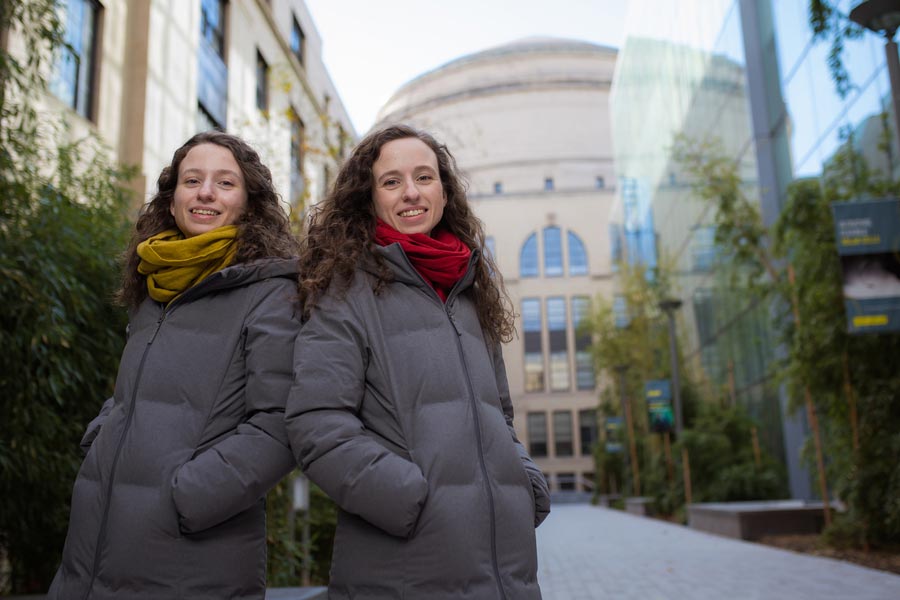
With her sister Jovana, a doctoral candidate in applied physics at Harvard University, Andrejevic has developed a method for testing material samples to predict the presence of topological characteristics that is faster and more versatile than other methods.
If the ultimate goal is “producing better-performing, energy-saving technologies,” she says, “we must first know which materials make good candidates for these applications, and that’s something our research can help confirm.”
Teaming Up
The seeds for this research were planted more than a year ago. “My sister and I always said it would be cool to do a project together, and when Mingda suggested this study of topological materials, it occurred to me that we could make this a formal collaboration,” says Andrejevic. The sisters are more similar than most twins, she notes, sharing many academic interests. “Being a twin is a huge part of my life and we work together well, helping each other in areas we don’t understand.”
Andrejevic’s dissertation work, which encompasses several projects, uses specialized spectroscopic techniques and data analysis, bolstered by machine learning, which can find patterns in vast amounts of data more efficiently than even the most high-throughput computers.
“The unifying thread among all my projects is this idea of trying to accelerate or improve our understanding when applying these characterization tools, and to thereby obtain more useful information than we can with more traditional or approximate models,” she says. The twins’ research on topological materials serves as a case in point.
In order to tease out novel and potentially useful properties of materials, researchers must interrogate them at the atomic and quantum scales. Neutron and photon spectroscopic techniques can help capture previously unidentified structures and dynamics, and determine how heat, electric or magnetic fields, and mechanical stress affect materials at the Lilliputian level. The laws governing this realm, where materials do not behave as they might at the macro-scale, are those of quantum mechanics.
Current experimental approaches to identifying topological materials are challenging technically and inexact, potentially excluding viable candidates. The sisters believed they could avoid these pitfalls using a widely applied imaging technique, called X-ray absorption spectroscopy (XAS), and paired with a trained neural network. XAS sends focused X-ray beams into matter to help map its geometry and electron structure. The radiation data it provides offers a signature unique to the sampled material.
“We wanted to develop a neural network that could identify topology from a material’s XAS signature, a much more accessible measurement than that of other approaches,” says Andrejevic. “This would hopefully allow us to screen a much broader category of potential topological materials.”
Over months, the researchers fed their neural network information from two databases: one contained materials theoretically predicted to be topological, and the other contained X-ray absorption data for a broad range of materials. “When properly trained, the model should serve as tool where it reads new XAS signatures it hasn’t seen before, and tells if you if the material that produced the spectrum is topological,” Andrejevic explains.
The research duo’s technique has demonstrated promising results, which they have already published in a preprint, “Machine learning spectral indicators of topology.” “For me, the thrill with these machine-learning projects is seeing some underlying patterns and being able to understand those in terms of physical quantities,” says Andrejevic.
Moving Toward Materials Studies
It was during her first year at Cornell University that Andrejevic first experienced the pleasure of peering at matter on an intimate level. After a course in nanoscience and nanoengineering, she joined a research group imaging materials at the atomic scale. “I feel I’m a very visual person, and this idea of being able to see things that up to that point were just equations or concepts — that was really exciting,” she says. “This experience moved me closer to the field of materials science.”
Machine learning, pivotal to Andrejevic’s doctoral work, will be central to her life after MIT. When she graduates this winter, she heads straight for Argonne National Laboratory, where she has won a prestigious Maria Goeppert Mayer Fellowship, awarded “internationally to outstanding doctoral scientists and engineers who are at early points in promising careers.” “We’ll be trying to design physics-informed neural networks, with a focus on quantum materials,” she says.
This will mean saying goodbye to her sister, from whom she has never been separated for long. “It will be very different,” says Andrejevic. But, she adds, “I do hope that Jovana and I will collaborate more in the future, no matter the distance!”
Never miss a breakthrough: Join the SciTechDaily newsletter.
Follow us on Google and Google News.