
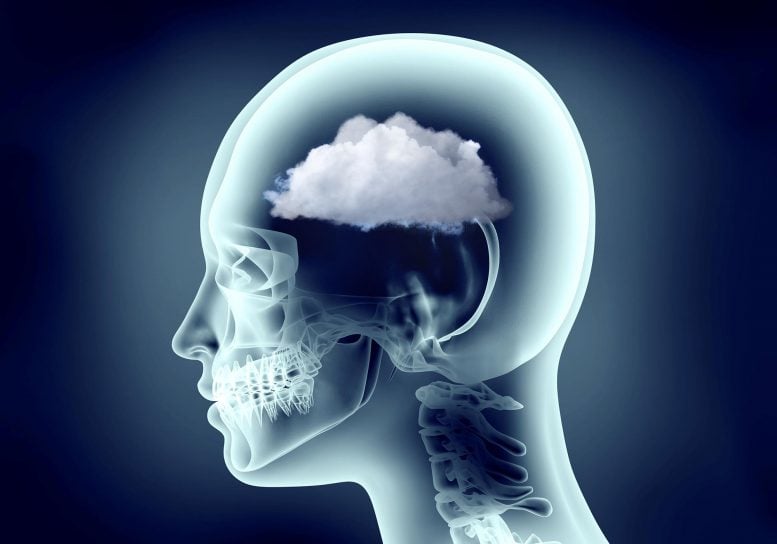
It’s 9:00 a.m., and you’re at your desk. You’ve got a ton of work to do, but you just can’t seem to focus on it. Your eyesight’s fine — you can see the words on the page or screen in front of you, but for some reason they’re just… not going in.
You’re not sick, hungover, or preoccupied, and you got plenty of sleep last night — so you know it’s not that. It isn’t just a case of the Mondays either, because — well, it’s Tuesday.
Yup, you’ve got brain fog.
What is Brain Fog?
Brain fog isn’t a medical condition, but rather a generalized feeling of being unfocused, spaced out, and lacking mental clarity. It can be caused by any number of underlying health issues — including long COVID[1] — so you should definitely see a doctor if it’s become a chronic problem for you.
That said, we all get it from time to time, and it’s usually nothing to worry about. But that doesn’t make it any less uncomfortable and inconvenient, especially when you’ve got stuff to do that requires your full attention.
5 Ways to Fight the Fog
If your doctor has ruled out any serious health concerns, it’s likely your brain just isn’t functioning at the peak of its performance capacity. Fortunately, there are a few things that can help you achieve the mental tune-up you need. (Consult your doctor before adopting an exercise regimen or taking a dietary supplement.) Here are five of them:
Exercise
Take a hike, buddy!
There’s nothing like fresh air and exercise — even a quick stroll through the park — to blow away the cobwebs. Studies have shown that physical activity improves cognitive function by reducing cortisol (stress hormone) levels, and that physical fitness promotes growth in the hippocampus — the part of the brain responsible for learning and memory.[2]
But we don’t need studies to tell us what we already know through common sense. Your brain is an organ like any other; it needs a good supply of oxygenated blood to be at the top of its game, and a brisk walk in nature is a tried-and-true way to fill your lungs with clean air and get your heart pumping.
But if that doesn’t help…
Caffeine
…there’s always coffee.
“I can’t get anything done until I’ve had my morning coffee!” We’ve all heard it — and probably said it — at some point in our working lives. And there’s a reason for that; the caffeine in a good ol’ cup of joe (between 40 and 150mg per serving) is a stimulant that temporarily improves lower cognitive functions like attention, vigilance, and reaction time. Around 80 percent of adult Americans depend on it to get through their daily workload.[3]
But caffeine is only a quick fix for mental underperformance, and too much of it can have the opposite effect, making you jittery and distracted.
L-Theanine
If you’re not a fan of coffee, consider a refreshing cup of green tea.
Green tea is caffeinated too, but much less so (about 33mg per serving). Rich in antioxidants, it also contains a high concentration (~25mg) of L-theanine — an amino acid with proven neuroenhancement benefits.
In a recent Japanese clinical trial, a single dose of L-theanine was found not only to increase the subjects’ reaction time, but to improve their scores on memory tests as well.[4] It’s also a neuroprotective agent — meaning that it fortifies the brain against degeneration — according to a study published in the Journal of Neuroscience, whose authors suggested that L-theanine could one day be harnessed as a therapy for substance abuse-related brain damage.[5]
Mangiferin
The mango leaf extract mangiferin was all the rage when it hit the supplements market under the trade name Zynamite back in 2018 — and rightly so.
Touted by the manufacturer, Nektium, as a caffeine-free nootropic that boosts cognition, mental performance, and reactivity, as well as reducing fatigue,[6] mangiferin has been dubbed “a natural miracle” by an international team of scientists who studied its many health benefits, which may even include the potential to prevent brain cancer.[7] Pending further clinical investigation, medical researchers think mangiferin shows promise as an effective treatment for neurodegenerative disorders like Alzheimer’s and Parkinson’s.[8]
Unlike caffeine, mangiferin has no known cardiovascular side effects, so it shouldn’t give you the jitters you get from drinking too much coffee.[9]
Salidroside
Salidroside is another plant-derived nootropic — a bioactive compound found in the adaptogenic herb Rhodiola rosea (roseroot). This, too, is being talked about as a side-effect-free candidate for neurological rehabilitation therapy.[10]
A 2009 scientific review of salidroside-rich roseroot extract SHR-5 by the Swedish Herbal Institute concluded that there was “strong scientific evidence” that SHR-5 “improved attention, cognitive function, and mental performance” in human subjects,[11] while pure salidroside’s powerful neuroprotective effects are well documented in preclinical tests on rodents.[12]
Many commercially available roseroot supplements contain only trace amounts of salidroside, however, so be sure to check that it’s specifically mentioned on the label.
Concluding Advice
When it comes to brain fog, most people haven’t the foggiest idea what to do about it. Fortunately, having read this blog, you’re not one of them!
Of all the fog-fighting methods listed above, you should definitely try getting more exercise first. But if you’re still battling with brain fog, and your doctor gives the go-ahead, natural nootropics like L-theanine, mangiferin, and salidroside are showing real promise as potent brain-boosters that can help improve mental clarity when you need it most.
References:
- health.harvard.edu/blog/brain-fog-memory-and-attention-after-covid-19-202203172707
- ncbi.nlm.nih.gov/pmc/articles/PMC6234274/
- sciencedirect.com/science/article/pii/S0149763416300690
- liebertpub.com/doi/10.1089/jmf.2020.4803
- jneurosci.org/content/41/4/739.long
- nektium.com/zynamite/
- lipidworld.biomedcentral.com/articles/10.1186/s12944-017-0449-y
- sciencedirect.com/science/article/abs/pii/S1043661819304360
- sciencedirect.com/science/article/pii/S0378874119345416
- dovepress.com/pharmacological-activities-mechanisms-of-action-and-safety-of-salidros-peer-reviewed-fulltext-article-DDDT
- doi.org/10.2174/157488409789375311
- link.springer.com/article/10.1007/s10571-020-00801-w
Never miss a breakthrough: Join the SciTechDaily newsletter.
Follow us on Google and Google News.