
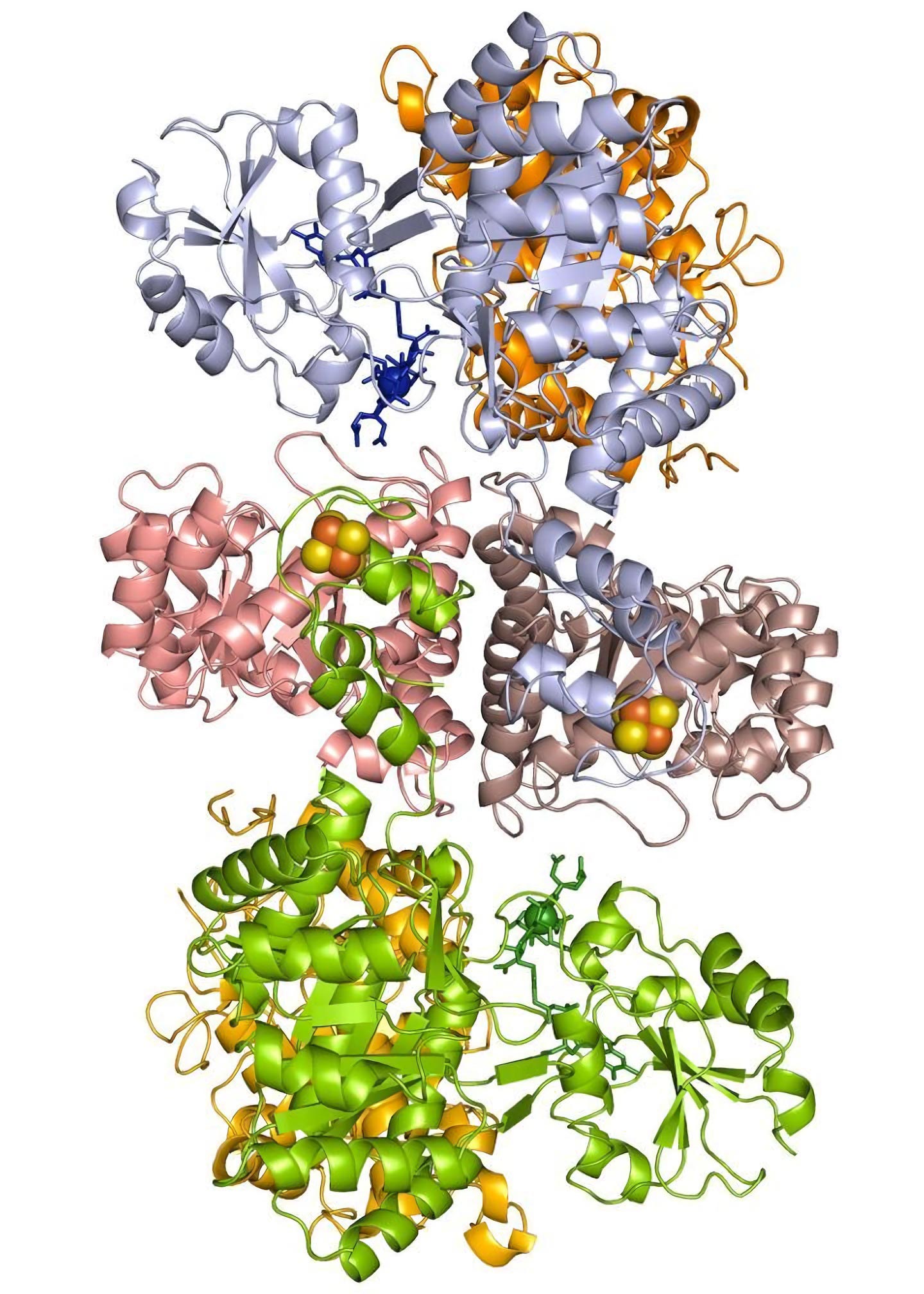
A newly published report documents the first full 3-D images of B12 interacting with other molecules during the reaction known as methyltransfer. This reaction is vital for human cells and bacteria cells that consume carbon dioxide and carbon monoxide.
You see it listed on the side of your cereal box and your multivitamin bottle. It’s vitamin B12, part of a nutritious diet like all those other vitamins and minerals.
But when it gets inside your body, new research suggests, B12 turns into a gymnast.
In a paper published recently in the journal Nature, scientists from the University of Michigan Health System and the Massachusetts Institute of Technology report they have created the first full 3-D images of B12 and its partner molecules twisting and contorting as part of a crucial reaction called methyltransfer.
That reaction is vital both in the cells of the human body and, in a slightly different way, in the cells of bacteria that consume carbon dioxide and carbon monoxide. That includes bacteria that live in the guts of humans, cows and other animals, and help with digestion. The new research was done using B12 complexes from another type of carbon dioxide-munching bacteria found in the murky bottoms of ponds.
The 3-D images produced by the team show for the first time the intricate molecular juggling needed for B12 to serve its biologically essential function. They reveal a multi-stage process involving what the researchers call an elaborate protein framework – a surprisingly complicated mechanism for such a critical reaction.
U-M Medical School professor and co-author Stephen Ragsdale, Ph.D., notes that this transfer reaction is important to understand because of its importance to human health. It also has potential implications for the development of new fuels that might become alternative renewable energy sources.
“Without this transfer of single carbon units involving B12, and its partner B9 (otherwise known as folic acid), heart disease and birth defects might be far more common,” explains Ragsdale, a professor of biological chemistry. “Similarly, the bacteria that rely on this reaction would be unable to consume carbon dioxide or carbon monoxide to stay alive – and to remove gas from our guts or our atmosphere. So it’s important on many levels.”
In such bacteria, called anaerobes, the reaction is part of a larger process called the Wood-Ljungdahl pathway. It’s what enables the organisms to live off of carbon monoxide, a gas that is toxic to other living things, and carbon dioxide, which is a greenhouse gas directly linked to climate change. Ragsdale notes that industry is currently looking at harnessing the Wood-Ljungdahl pathway to help generate liquid fuels and chemicals.
In addition to his Medical School post, Ragsdale is a member of the faculty of the U-M Energy Institute.
In the images created by the team, the scientists show how the complex of molecules contorts into multiple conformations — first to activate, then to protect, and then to perform catalysis on the B12 molecule. They had isolated the complex from Moorella thermoacetica bacteria, which are used as models for studying this type of reaction.
The images were produced by aiming intense beams of X-rays at crystallized forms of the protein complex and painstakingly determining the position of every atom inside.
“This paper provides an understanding of the remarkable conformational movements that occur during one of the key steps in this microbial process, the step that involves the generation of the first in a series of organometallic intermediates that lead to the production of the key metabolic intermediate, acetyl-CoA,” the authors note.
Senior author Catherine L. Drennan from MIT and the Howard Hughes Medical Institute, who received her Ph.D. at the U-M Medical School, adds, “We expected that this methyl-handoff between B vitamins must involve some type of conformational change, but the dramatic rearrangements that we have observed surprised even us.”
In addition to Ragsdale and Drennan, the research team included the first author, Yan Kung, from MIT, and co-authors include U-M’s Gunes Bender, MIT’s Nozomi Ando, former MIT researchers Tzanko Doukov and Leah C. Blasiak, and the University of Nebraska’s Javier Seravalli.
The research was funded by the National Institutes of Health and the MIT Energy Initiative. Two U.S. Department of Energy-funded synchrotron facilities were used to produce the crystallographic images: the Advanced Photon Source and its Northeastern Collaborative Access Team beamlines supported by NIH, and the Advanced Light Source. The atomic coordinates for the structures published by the team are deposited in the Protein Data Bank under accession codes 4DJD, 4DJE and 4DJF.
Reference: “Visualizing molecular juggling within a B12-dependent methyltransferase complex” by Yan Kung, Nozomi Ando, Tzanko I. Doukov, Leah C. Blasiak, Güneş Bender, Javier Seravalli, Stephen W. Ragsdale and Catherine L. Drennan, 14 March 2012, Nature.
DOI: 10.1038/nature10916
Never miss a breakthrough: Join the SciTechDaily newsletter.
Follow us on Google and Google News.