
Close Menu
    Facebook X (Twitter) Instagram
    SciTechDaily
    • Biology
    • Chemistry
    • Earth
    • Health
    • Physics
    • Science
    • Space
    • Technology
    Facebook X (Twitter) Pinterest YouTube RSS
    SciTechDaily
    Home»Space»First Optical Measurements of Milky Way’s Mysterious Fermi Bubbles
    Space

    First Optical Measurements of Milky Way’s Mysterious Fermi Bubbles

    By University of Wisconsin-Madison,June 3, 20202 Comments3 Mins Read
    Facebook Twitter Pinterest Telegram LinkedIn WhatsApp Email Reddit
    Share
    Facebook Twitter LinkedIn Pinterest Telegram Email Reddit
    Fermi Bubbles WHAM Telescope
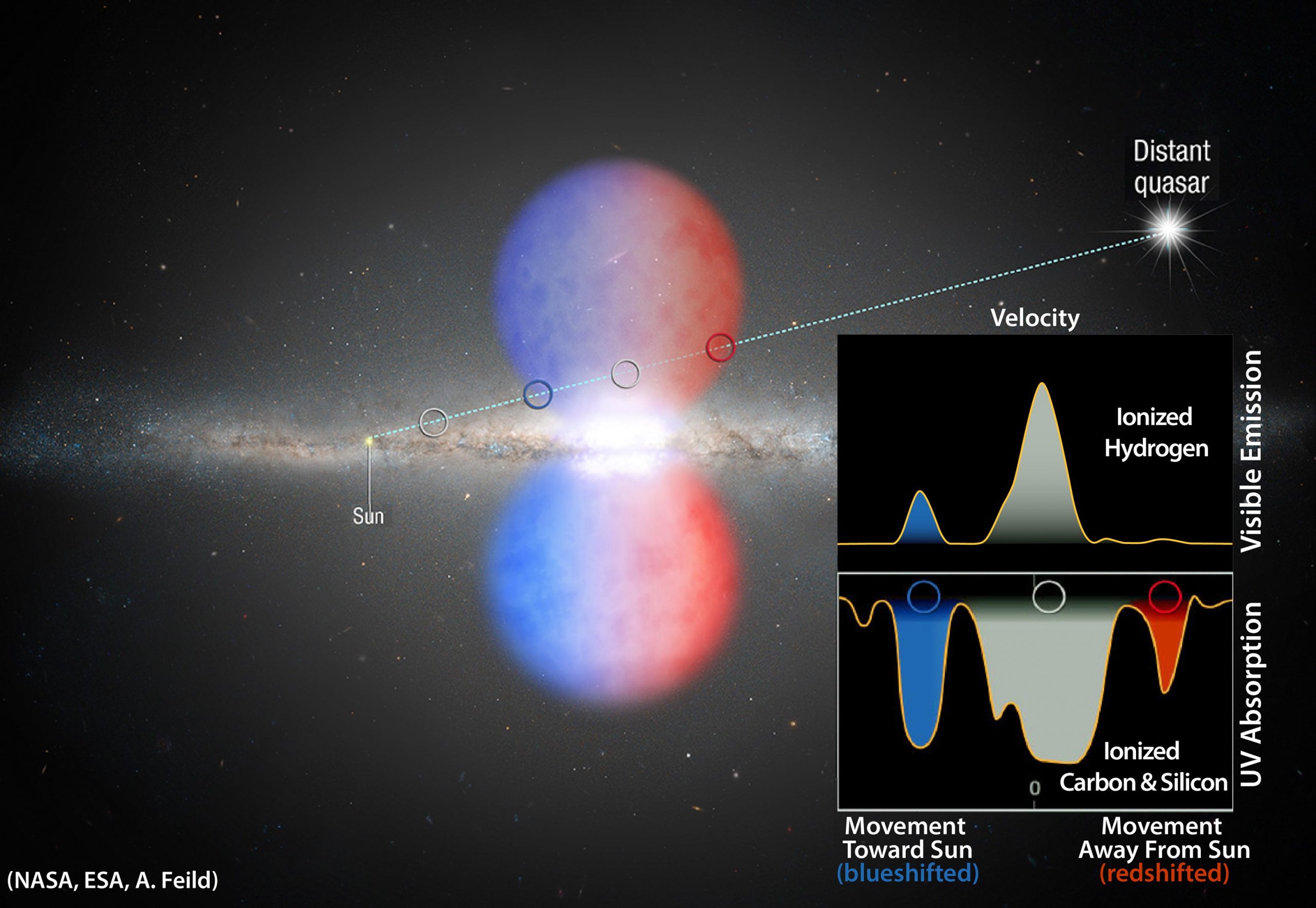
    Fermi Bubbles: Astronomers used the WHAM telescope to measure huge outflows of gas extending from the Milky Way’s center known as the Fermi Bubbles. They were able to measure the velocity, density, and pressure of the gas for the first time, confirming and extending previous measurements made by using a distant quasar as a light source to look through and measure the gas. Credit: Images by Dhanesh Krishnarao and NASA

    Using the Wisconsin H-Alpha Mapper telescope, astronomers have for the first time measured the Fermi Bubbles in the visible light spectrum. The Fermi Bubbles are two enormous outflows of high-energy gas that emanate from the Milky Way and the finding refines our understanding of the properties of these mysterious blobs.

    The research team from the University of Wisconsin-Madison, UW-Whitewater and Embry-Riddle Aeronautical University measured the emission of light from hydrogen and nitrogen in the Fermi Bubbles at the same position as recent ultraviolet absorption measurements made by the Hubble Telescope.

    “We combined those two measurements of emission and absorption to estimate the density, pressure, and temperature of the ionized gas, and that lets us better understand where this gas is coming from,” says Dhanesh Krishnarao, lead author of the new study and an astronomy graduate student at UW-Madison.

    The researchers announced their findings on June 3 at the 236th meeting of the American Astronomical Society, which was held virtually for the first time since 1899, in response to the COVID-19 pandemic.

    Extending 25,000 light years both above and below the center of the Milky Way, the Fermi Bubbles were discovered in 2010 by the Fermi Gamma Ray Telescope. These faint but highly energetic outflows of gas are racing away from the center of the Milky Way at millions of miles per hour. But while the origin of the phenomenon has been inferred to date back several million years ago, the events that produced the bubbles remain a mystery.

    Now, with new measurements of the density and pressure of the ionized gas, researchers can test models of the Fermi Bubbles against observations.

    “The other significant thing is that we now have the possibility of measuring the density and pressure and the velocity structure in many locations,” with the all-sky WHAM telescope, says Bob Benjamin, a professor of astronomy at UW-Whitewater and co-author of the study. “We can do an extensive mapping effort across the Fermi Bubbles above and below the plane of the galaxy to see if the models that people have developed are holding up. Because, unlike the ultraviolet data, we’re not limited to just specific lines of sight.”

    Matt Haffner, professor of physics and astronomy at Embry-Riddle Aeronautical University and a co-author of the report, says the work demonstrates the usefulness of the WHAM telescope, developed at UW-Madison, to tell us more about the workings of the Milky Way. The central region of our home galaxy has long been difficult to study because of gas blocking out the view, but WHAM has provided new opportunities to gather the kind of information we have for distant galaxies.

    “There are regions of the galaxy we can target with very sensitive instruments like WHAM to get this kind of new information toward the center that previously we are only able to do in the infrared and radio,” says Haffner. “We can make comparisons to other galaxies by making the same kind of measurements towards the center of the Milky Way.”

    Never miss a breakthrough: Join the SciTechDaily newsletter.
    Follow us on Google and Google News.

    Astronomy Astrophysics Fermi Bubbles Hubble Space Telescope Popular University of Wisconsin-Madison
    Share. Facebook Twitter Pinterest LinkedIn Email Reddit

    Related Articles

    COS Observations Show Gas in Fermi Bubbles Moving at 2 Million Miles Per Hour

    Unique Features of Spiral Galaxy Messier 106

    Hubble and VLA View Elliptical Galaxy Hercules A

    WASP-12 b, A Planet Being Consumed By Its Own Sun

    Hubble Views What Is Probably the Most Distant Known Galaxy

    New Study Revives Doubted Exoplanet Fomalhaut b

    Scientists Search for Quasar’s “Missing” Galaxy

    NASA Data Reveals Significant Changes in Exoplanet’s Atmosphere

    Lonestar Supercomputer Helps Explore Dark Matter

    2 Comments

    1. kamir bouchareb st on November 16, 2020 12:30 am

      nice topic

      Reply
    2. kamir bouchareb st on November 16, 2020 12:53 am

      good article

      Reply
    Leave A Reply Cancel Reply

    • Facebook
    • Twitter
    • Pinterest
    • YouTube

    Don't Miss a Discovery

    Subscribe for the Latest in Science & Tech!

    Trending News

    Scientists Recreate a Nuclear Fireball and Uncover Fallout’s Hidden Chemistry

    These Tiny Gut Particles Could Be Accelerating Aging Throughout the Body

    Doctors Changed One Thing and Weight Gain Stopped

    Magnetic Fields May Solve a Longstanding Binary Star Mystery

    The Probiotic Breakthrough for Natural Anxiety Relief and Better Mental Health

    Animal vs. Plant Protein: Scientists Found a Surprising Nutritional Difference

    According to Scientists, This Simple Dietary Change Is Linked to Lower Depression Scores

    Researchers Discover a Hidden Vitamin D Problem That Persists Year-Round

    Follow SciTechDaily
    • Facebook
    • Twitter
    • YouTube
    • Pinterest
    • Newsletter
    • RSS
    SciTech News
    • Biology News
    • Chemistry News
    • Earth News
    • Health News
    • Physics News
    • Science News
    • Space News
    • Technology News
    Recent Posts
    • Scientists Reveal What Happened When 12 People Were Trapped Together in Antarctica for 10 Months
    • Buried for 1.7 Billion Years: These Ancient Fossils May Rewrite the Story of Complex Life
    • NASA Spots Giant Ocean Swell Signaling a Potential El Niño Comeback
    • The “Impossible” Earthquake Beneath Utah Was Real After All
    • Scientists Uncover Why Walking Gets Slower and More Exhausting As We Age
    Copyright © 1998 - 2026 SciTechDaily. All Rights Reserved.
    • Science News
    • About
    • Contact
    • Editorial Board
    • Privacy Policy
    • Terms of Use

    Type above and press Enter to search. Press Esc to cancel.