
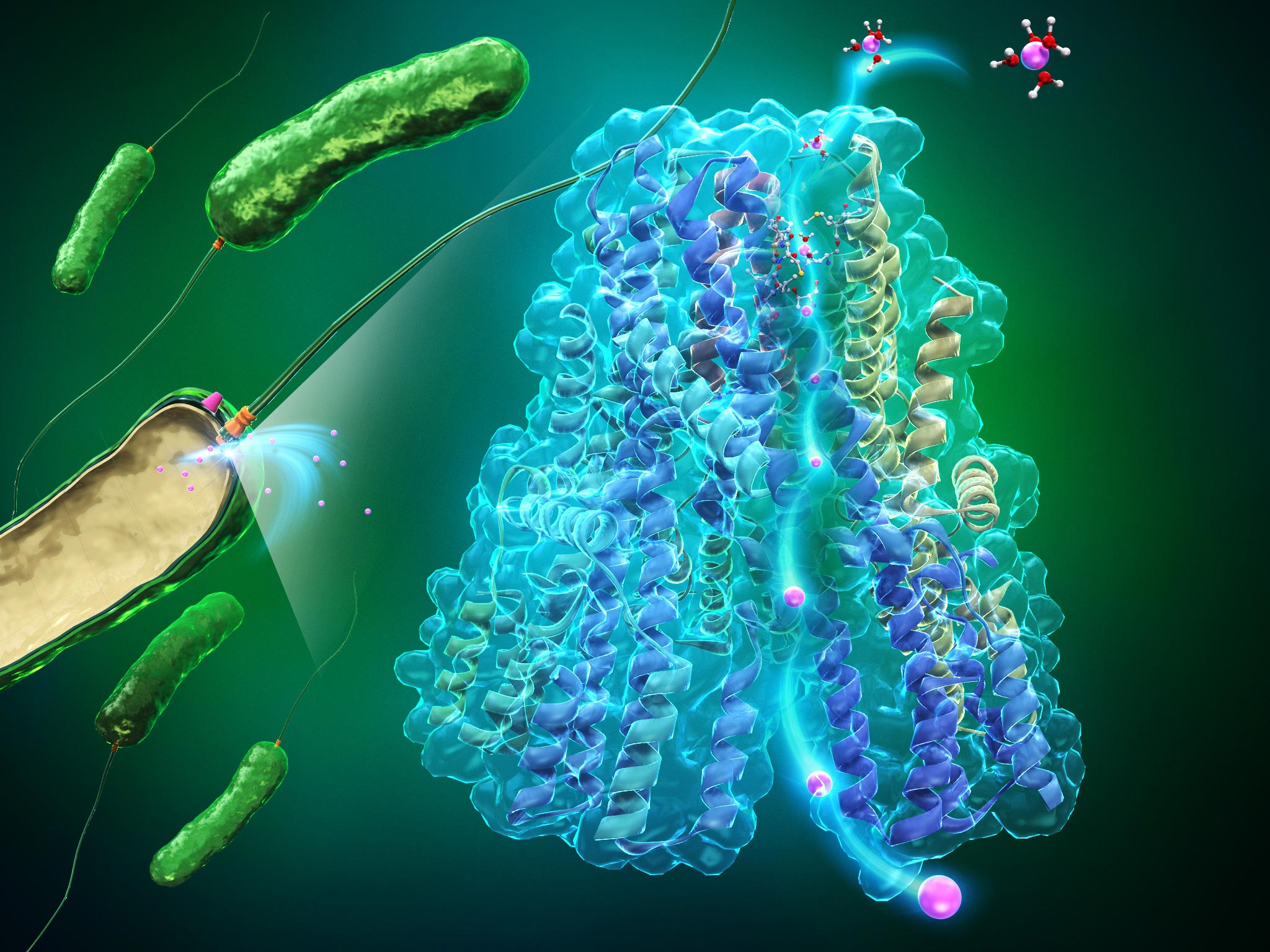
Electron microscopy images reveal crucial structures and mechanisms within the molecular machinery that certain bacteria use for propulsion.
When discussing motors, most people think of those in vehicles or machines. However, biological motors have existed for millions of years in microorganisms. Many bacteria use tail-like structures called flagella, which rotate to propel them through fluids. This movement is driven by a protein complex known as the flagellar motor.
The flagellar motor has two key components: the rotor and the stators. The rotor, a large rotating structure anchored to the cell membrane, drives flagellum movement. The stators, smaller structures surrounding the rotor, contain ion pathways that transport protons or sodium ions, depending on the bacterial species. As these charged particles pass through, the stators undergo structural changes that exert force on the rotor, causing it to spin. While extensive research has focused on the stators, the exact structure and function of their ion pathways remain unclear.
A Closer Look at the Flagellar Motor in Vibrio alginolyticus
Against this backdrop, a research team led by Assistant Professor Tatsuro Nishikino from Nagoya Institute of Technology analyzed the flagellar motor in the bacterial species Vibrio alginolyticus. Other members of the team included Norihiro Takekawa and Katsumi Imada from Osaka University, Jun-ichi Kishikawa from Kyoto Institute of Technology, and Seiji Kojima from Nagoya University. Their findings were published in Proceedings of the National Academy of Sciences of the United States of America on December 30, 2024.
This video presents a study in which, using cryo-electron microscopy, researchers determined the structure and mechanisms of a key component in the flagellar motor, which bacteria use to turn their flagella and move. Credit: Tatsuro Nishikino from Nagoya Institute of Technology
The researchers employed cryo-electron microscopy (CryoEM), a powerful technique that captures high-resolution images of biomolecules by rapidly freezing them and imaging them with an electron microscope. Using CryoEM on normal and genetically modified V. alginolyticus, the team took snapshots of stator complexes in different states and identified key molecular cavities for sodium ions.
Based on the results, the team proposed a model describing how sodium ions flow through the stator. Briefly put, the subunits that form the stators in Vibrio alginolyticus, arranged in a ring, act as size-based filters that allow the intake of sodium ions—but not other ions—into the identified cavities. The researchers also determined the mechanisms by which phenamil, an ion-channel blocker, inhibits the flow of sodium ions through the stator.
Proposed Model of Sodium Ion Flow
The findings of this study could have important medical implications.
“Flagellar-based movement is involved in infections and toxicity of some species of pathogenic bacteria. One motivation behind this study was finding ways of inactivating such bacteria by restricting their movement. Thus, understanding the molecular mechanism of flagellar motility will be key for achieving this,” remarks Tatsuro.
Moreover, knowledge of flagellar motors could lead to innovative designs for microscopic machines. “Flagellar motors are molecular nanomachines with a diameter of roughly 45 nm and an energy conversion efficiency of approximately 100%. Our findings are a big step to clarify their torque-generation mechanisms, which would be essential for the engineering of nanoscale molecular motors,” concludes Tatsuro.
Let us hope further studies clarify all the details of these amazing natural machines!
Reference: “Structural insight into sodium ion pathway in the bacterial flagellar stator from marine Vibrio” by Tatsuro Nishikino, Norihiro Takekawa, Jun-ichi Kishikawa, Mika Hirose, Seiji Kojima, Michio Homma, Takayuki Kato and Katsumi Imada, 30 December 2024, Proceedings of the National Academy of Sciences.
DOI: 10.1073/pnas.2415713122
Never miss a breakthrough: Join the SciTechDaily newsletter.
Follow us on Google and Google News.