
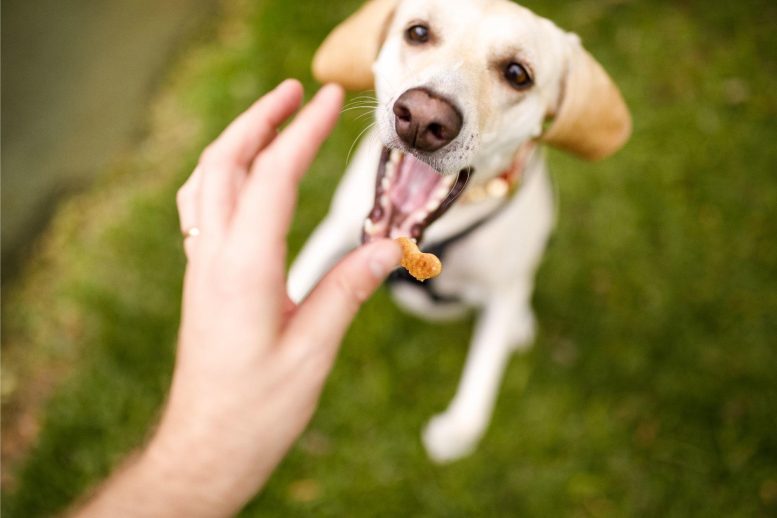
A study from the University of Florida found that 90% of dogs prefer food over toys, even when the toy is their favorite.
Man’s best friend is as treat-obsessed as we all thought.
In a recent study conducted by psychologists at the University of Florida, 90% of dogs opted for food over their favorite toys. During the experiment, which mirrored a training scenario, the dogs were given a choice between their favorite food and favorite toy. The majority showed a greater inclination towards the food reward.
“I was surprised, but nobody’s looked at how dogs will work for toys versus food before,” said Nicole Dorey, a lecturer in the UF Department of Psychology who performed the study with her students and other collaborators.
Experiment Details
The researchers recruited 10 pet dogs from the local area. Each dog was shown six food items – including treats, cheese, carrots, and hot dogs — and six toys, such as a tennis ball, a squeak toy, a plastic bone, or a stuffed animal. Each dog then had a chance to choose their favorite food and favorite toy.
In another set of experiments, the dogs had to work harder and harder for their reward. Most dogs gave up earlier when offered a preferred toy reward than when given their favorite treat.
Comparing Preferences
Other studies have shown that dogs might prefer human attention to food.
“I think the next study should look at all three – attention, food, and toys – and what dogs really like best when training,” Dorey said.
Some dog trainers suggest using toys instead of food in training to avoid excess calories and to make the experience more fun for the dog. If dog owners want to follow this advice, the key is to not have toys competing with food, say the researchers.
“You can definitely train your dog with toys if you start really early,” Dorey said. “This is what’s done with search and rescue dogs, they start really early with toys as a reinforcer.”
Reference: “Efficacy of Edible and Leisure Reinforcers with Domestic Dogs” by Xenabeth A. Lazaro, John M. Winter, Jonathan K. Fernand, David J. Cox and Nicole R. Dorey, 30 September 2023, Animals.
DOI: 10.3390/ani13193073
The study was led by undergraduate UF students Xenabeth Lazaro and John Winter, who have since graduated. Collaborators from the Florida Institute of Technology and Johns Hopkins University also contributed.
Never miss a breakthrough: Join the SciTechDaily newsletter.
Follow us on Google and Google News.
1 Comment
I believe that dogs are actually a lot like people,in that when it comes to random humans that they may not have spent an awful lot of time around. Tendancy is often getting to know them a little bit at a time, and don’t just have a first impression sort of thing. But some dogs have a much better intuition than others which goes without saying. Having said that I believe that if a dog has a bond with his owner and meets a new person when they are all intermingling, the dog would tend to be sensitive to his person’s emotional vibes. Either laid back, or anxious… and that definitely puts most dogs in sword in a standby protective mode their person. Just some of my observations I know that there are a lot more variables that play into it, but that’s just sort of my general idea is about it.