

Human activities are significantly impacting the preservation of marine fossils, with effects that both obscure and clarify our historical understanding of ecosystems. Advances in research methods are helping scientists navigate these complexities to better conserve and restore marine environments.
Recent research reveals that human activities are dramatically changing how marine organisms are preserved, leading to lasting impacts that can both enhance and degrade the fossil record.
“We are not only changing the environment; we’re also changing the nature of the record that archives this information,” said Michal Kowalewski, the Thompson chair of invertebrate paleontology at the Florida Museum of Natural History. “These changes can be both good and bad. On one hand, human activities can prevent the fossil record from preserving useful information about ongoing changes. In other situations, human actions can actually enhance the quality of the currently forming fossil record, thereby providing more information.”
If not properly accounted for, these effects on the fossil record can lead to misinterpretation of data vital for conservation efforts. Humans began altering ecosystems long before they began systematically studying them. In many places, the only way scientists can know what an ecosystem looked like before the arrival of humans is to look back at the recent fossil record.
“We use fossils in conservation to understand the transition from natural, pristine environments to the ones we have today,” Kowalewski said. When scientists know what a degraded ecosystem looked like before it was altered, they know what to aim for when trying to restore it.
Kowalewski and his colleagues specialize in marine paleoecology and co-authored the study with a focus on fossil beds in the world’s oceans. In these environments, the authors say, there are several interconnected factors that influence fossilization, including the rate at which sediment accumulates on the seafloor, the extent to which animals burrow through the sediment, the depth at which remains are buried, and how quickly certain fossils disintegrate over time.
The Effect of Bottom Trawling
All of these factors can and have been influenced by humans. The practice of bottom trawling, in which a net is dragged along the seafloor, mixes, and churns sediment, infusing it with oxygen that breaks down organic remains.
On a global scale, bottom trawling is estimated to kick up as much sediment into the water column as is deposited into oceans from all of the world’s rivers.
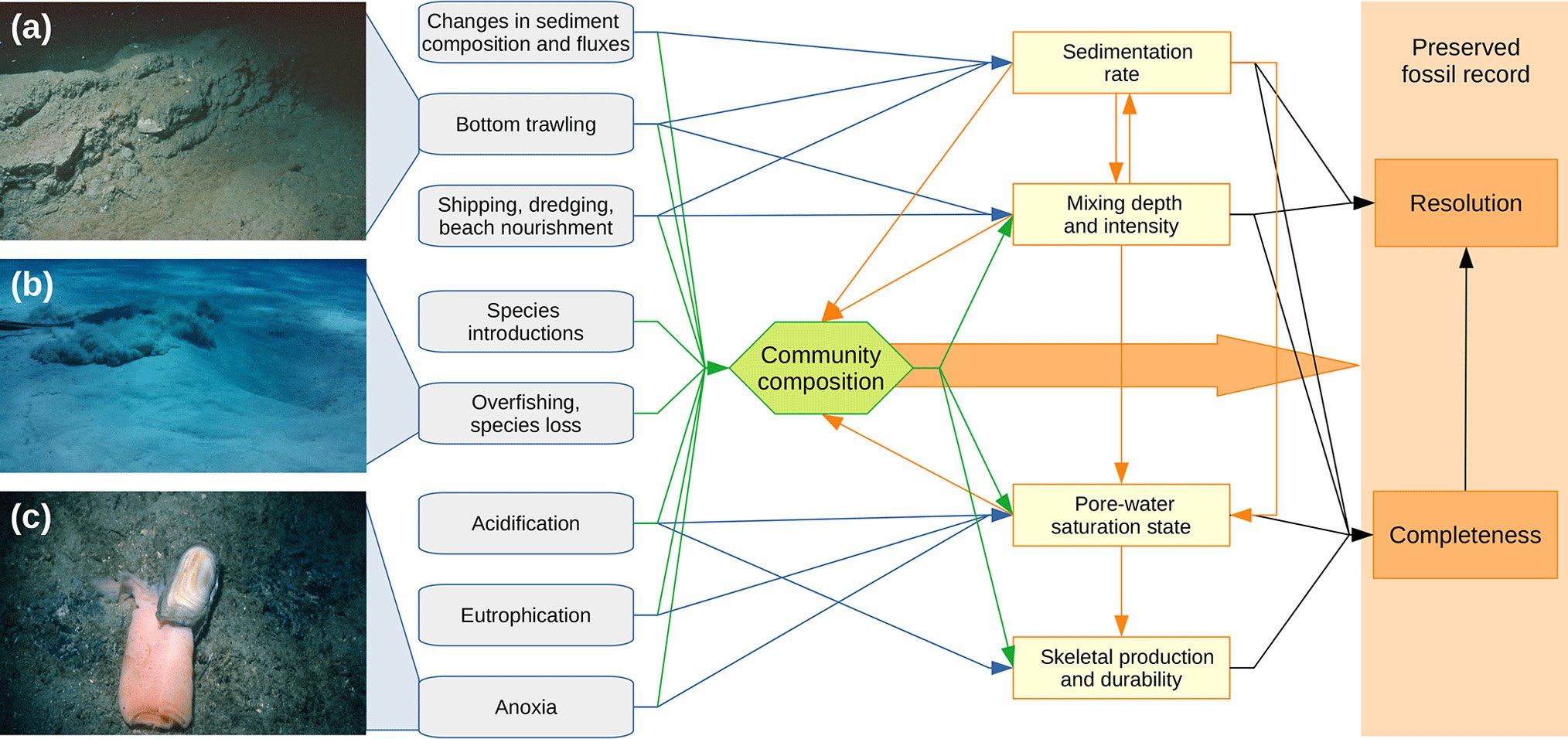
“I was surprised when working on this study that the impacts of bottom trawling are so widespread,” said lead author Rafal Nawrot, a paleontologist at the University of Vienna. Nawrot studies changes in marine ecosystems that have occurred since the last ice age, a field in which knowing the various factors that help or hinder fossilization is critical.
He recounted one study in which he and colleagues found a distinct lack of large shells from sediment cores drilled into the seafloor. “Given what we now know about the intensity of trawling in some of the areas we were working in, this pattern may just be an artifact of their removal by nets dragged through the seafloor.”
Unintended Consequences of Human Actions
Alterations to the fossil record can be indirect as well. Local extinctions caused by human activity and the introduction of invasive species can both prevent and improve the process of fossilization. The authors give the example of red king crabs (Paralithodes camtschaticus), which were intentionally introduced to the Barents Sea between Russia and Finland in the 1960s. There they had few natural predators, and their population exploded. Red king crabs eat just about anything they can get their claws on and crush the shells of their prey. This caused a steep reduction in the number of burrowing invertebrates, which oxygenate sediments.
Fewer burrowing organisms mean less oxygen in the sediment, which means better preservation. But more shell-crushing crabs means there are fewer shells capable of being preserved. Without the right historical context, future paleontologists trying to sort out this sequence of events may walk away flummoxed.
These and other human-driven changes can be especially difficult to interpret because they mimic natural processes like erosion or species migrations. In some cases, human activity can erase fossil archives entirely or confound research efforts by adding tons of foreign material to an environment.
“Certain processes don’t occur naturally at all, like beach replenishment,” Kowalewski said. When portions of a beach are washed away by hurricanes or rising sea levels, local authorities often pay for ships to haul sediment from deep-water environments — where natural erosion is negligible — to the shoreline, fossils and all.
In other cases, the fossils themselves are the target for relocation.
“Oysters that lived hundreds of thousands of years ago may be removed from one area and added to the modern seafloor of another to facilitate the restoration of present-day oyster reefs,” Kowalewski said.
So how do scientists begin to disentangle the various natural and human forces that influence fossilization? It’s complicated, Nawrot said. “It depends on the goal of the study, but there are ways to circumvent these problems.”
One strategy that’s recently become more feasible to implement is radiocarbon dating. Scientists use this method to estimate the age of relatively young fossils, but until recently high costs meant it could only be used sparingly. When analyzing a sediment core drilled in modern seafloors, in which organisms at the top may be thousands of years younger than those at the bottom, researchers would typically select only a few fossils for radiocarbon dating. This provided reliable information but poor resolution, and if the sediment had been unknowingly mixed by bottom trawling, the results could be misleading.
“You wouldn’t be aware of this problem unless you sampled multiple specimens per layer, which isn’t a widespread approach. We think it should be used much more often,” Nawrot said.
Researchers will also need to get more creative with the types of statistical analyses they use to interpret data. These sorts of methods take time to develop and test, but they’re slowly becoming more common, and scientists are inching closer to a better understanding of how humans affect the historical archive of life on Earth.
“Changes in the geological record can be fingerprints of human activity and may themselves reveal something about the history of an ecosystem,” Kowalewski said.
Reference: “Ideas and perspectives: Human impacts alter the marine fossil record” by Rafał Nawrot, Martin Zuschin, Adam Tomašových, Michał Kowalewski and Daniele Scarponi, 3 May 2024, Biogeosciences.
DOI: 10.5194/bg-21-2177-2024
Funding: U.S. National Science Foundation, Agentúra na Podporu Výskumu a Vývoja, Vedecká Grantová Agentúra MŠVVaŠ SR a SAV, Italian Ministry of University and Research
Never miss a breakthrough: Join the SciTechDaily newsletter.
Follow us on Google and Google News.