

Fossils from China’s Turpan-Hami Basin reveal it was a rare land refuge during the end-Permian extinction, with fast ecosystem recovery driven by stable climate conditions.
A new study has found that a region in China’s Turpan-Hami Basin acted as a refugium, or “life oasis”, for terrestrial plants during the end-Permian mass extinction, the most severe biodiversity crisis since the Cambrian period.
Published in Science Advances, the research challenges the common belief that land-based ecosystems were as heavily impacted as marine environments during this extinction event.
Led by Prof. Feng Liu of the Nanjing Institute of Geology and Palaeontology (NIGPAS) at the Chinese Academy of Sciences, the study presents the first clear fossil evidence of a terrestrial plant community that remained largely unaffected during the crisis. This stable ecosystem supported continuous plant evolution and enabled rapid ecological recovery after the extinction ended.
Pockets of Resilience During Global Crisis
The team’s findings suggest that some land areas were shielded from the worst effects of the extinction, creating pockets of resilience that played a crucial role in the rebound of life on Earth.
The end-Permian mass extinction, which occurred approximately 252 million years ago, wiped out over 80% of marine species, and its impact on land has long been debated. One prevailing theory suggests that volcanic eruptions in Siberia triggered widespread terrestrial devastation through wildfires, acid rain, and toxic gases.

Evidence for this includes the successive extinction of characteristic Gigantopteris flora in South China and typical Glossopteris flora across Gondwanaland around the end-Permian mass extinction.
However, the opposing camp argues that these catastrophic effects were limited by latitude and atmospheric circulation. Some fossil discoveries even suggest that certain Mesozoic plants existed before the extinction event, pointing to uninterrupted evolution.
South Taodonggou: A Window into Survival
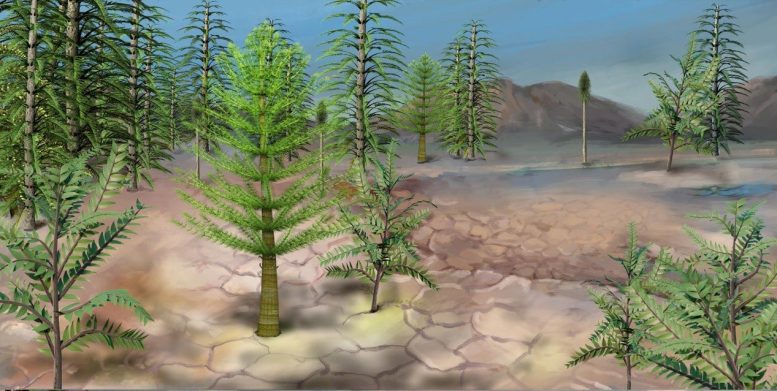
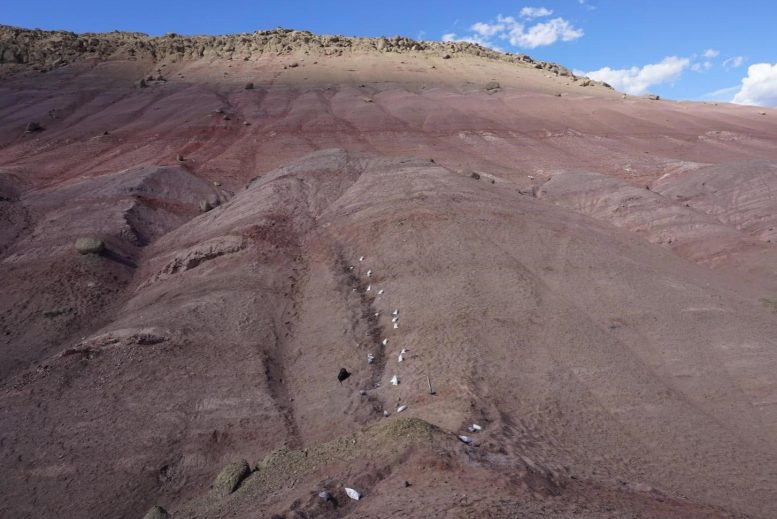
The South Taodonggou section in Xinjiang offers a unique perspective. Detailed analysis of fossil pollen and spores, along with precise dating methods from a Bayesian age model developed by Professor Wan Yang of the Missouri University of Science and Technology, have revealed a continuous record of riparian fern fields and coniferous forests thriving from 160,000 years before the extinction began until 160,000 years after it ended.
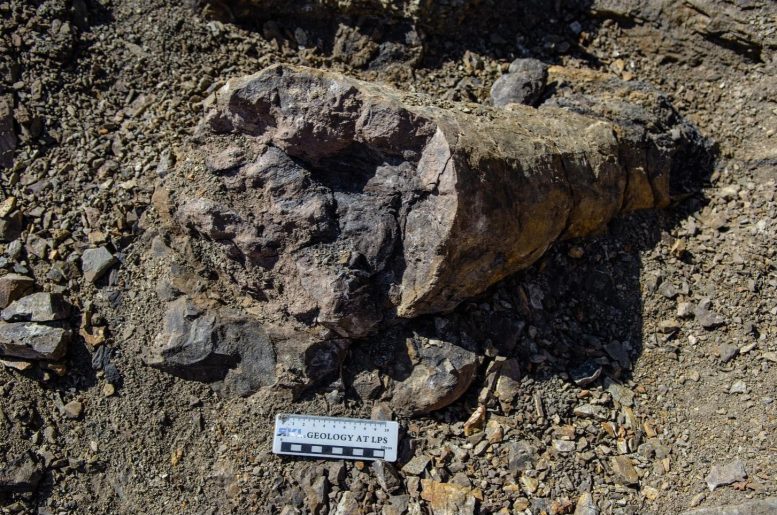
“The presence of intact tree trunks and fern stems further confirms that these microfossils represent local vegetation, not transported remnants,” said Professor Mingli Wan from NIGPAS.
Although some plant species disappeared locally, the researchers found that the overall extinction rate of spore and pollen species in the South Taodonggou section was possibly only about 21%—far lower than the marine extinction rate during the same period. This conclusion was based on the discovery of many “missing” species in Early Triassic strata elsewhere, indicating temporary migration rather than permanent extinction.
Rapid Ecosystem Recovery and Tetrapod Diversity
This stable vegetation base was crucial for the rapid recovery of the local ecosystem. Fossil evidence shows that within just 75,000 years after the extinction ended, the area supported diverse tetrapods, including herbivorous Lystrosaurus and carnivorous chroniosuchians, demonstrating a quick return to a complex food web.
This discovery contrasts with the previous understanding that ecosystem recovery after the end-Permian extinction took over a million years. The new evidence suggests local ecological diversity in this area recovered more than ten times faster than in other regions.
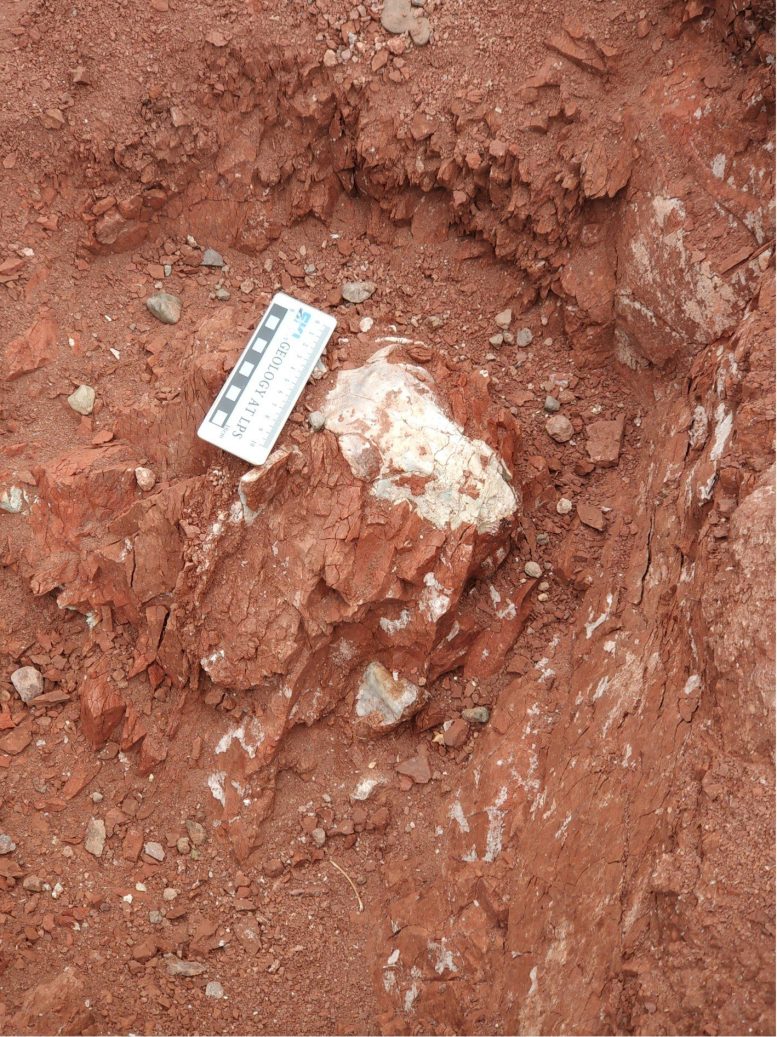
The researchers cited the region’s stable, semi-humid climate as crucial to its biological resilience. According to analysis of paleosol matrices, the region consistently received about 1000 mm of rainfall per year during this time. Due to its consistent precipitation, South Taodonggou offered more abundant vegetation and a more habitable environment than other regions following the end-Permian mass extinction, providing vital support for migrating animals.
Despite its proximity to the volcanic activity that triggered the end-Permian extinction, the Turpan-Hami Basin provided a safe haven for terrestrial life, demonstrating that even seemingly dangerous locations can harbor crucial biodiversity.
“This suggests that local climate and geographic factors can create surprising pockets of resilience, offering hope for conservation efforts in the face of global environmental change,” said Professor Feng Liu from NIGPAS.
In light of current concerns about a potential sixth mass extinction driven by human activity, the discovery of this “Life oasis” highlights the importance of identifying and protecting such natural refugia.
Reference: “Refugium amidst ruins: Unearthing the lost flora that escaped the end-Permian mass extinction” by Huiping Peng, Wan Yang, Mingli Wan, Jun Liu and Feng Liu, 12 March 2025, Science Advances.
DOI: 10.1126/sciadv.ads5614
This work was supported by the National Natural Science Foundation of China, the National Key R&D Program of China, the Second Tibetan Plateau Scientific Expedition and Research Program and the US National Science Foundation.
Never miss a breakthrough: Join the SciTechDaily newsletter.
Follow us on Google and Google News.