
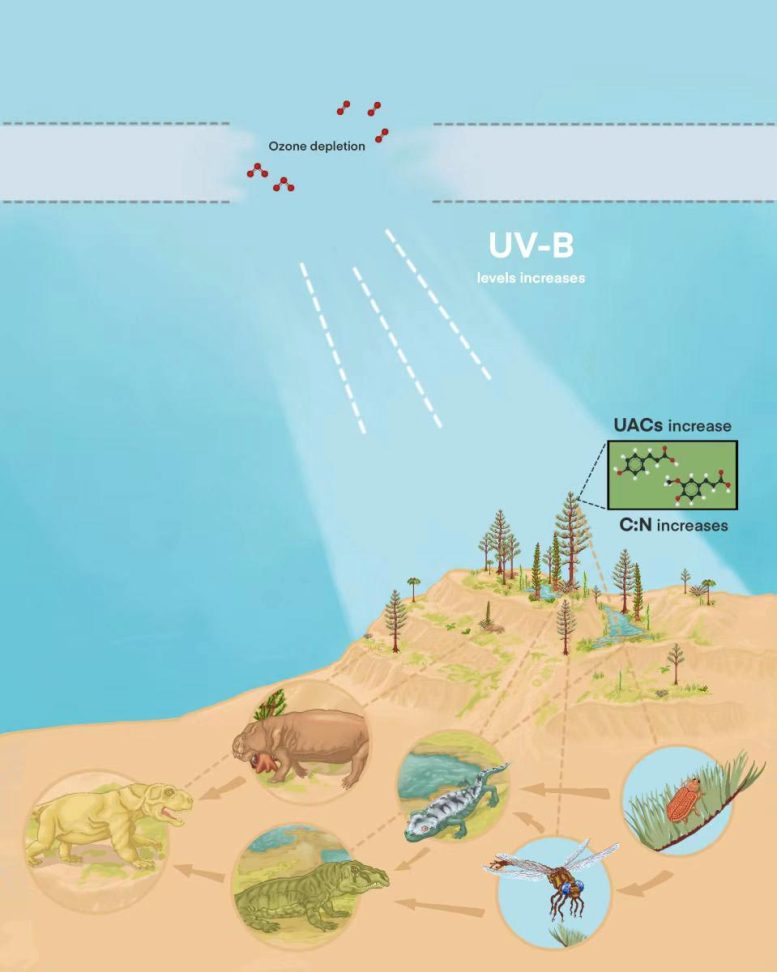
Fossil pollen from the end-Permian extinction reveals increased UV-B protection compounds, linking volcanic activity, ozone loss, and ecosystem collapse during Earth’s most severe mass extinction.
Scientists from China, Germany, and the UK led by Prof. LIU Feng from the Nanjing Institute of Geology and Palaeontology of the Chinese Academy of Sciences (NIGPAS) have revealed that pollen preserved in 250-million-year-old rocks contains abundant compounds that function like sunscreen but are produced by plants to protect themselves from harmful ultraviolet (UV-B) radiation.
The presence of these compounds suggests that a pulse of UV-B played an essential role in the end-Permian mass extinction event.
The study was published in Science Advances on January 6.
The Role of Volcanism in Mass Extinction
The end-Permian mass extinction event (250 million years ago) is the most severe of the big five mass extinction events, with the loss of ~80% of marine and terrestrial species. This catastrophic loss of biodiversity resulted from a palaeoclimate emergency triggered by continental-scale volcanism that covers much of modern-day Siberia. The volcanic activity drove the release into the atmosphere of massive amounts of carbon that had been locked up in Earth’s interior, thus generating large-scale greenhouse warming.
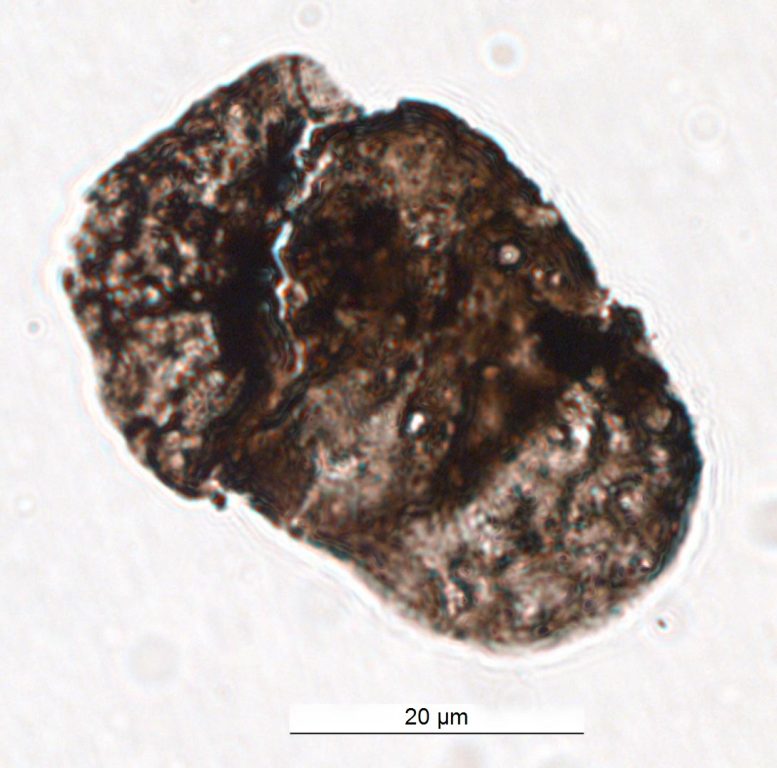
Accompanying this global warming event was a collapse of the Earth’s ozone layer. Support for this theory comes from the abundant occurrence of malformed spores and pollen grains that testify to an influx of mutagenic UV irradiation.
Plants require sunlight for photosynthesis but need to protect themselves and particularly their pollen from the harmful effects of UV-B radiation. “To do so, plants load the outer walls of pollen grains with compounds that function like sunscreen to protect vulnerable cells to ensure successful reproduction. Without the ‘sunscreen’ compounds, forests could have been sterilized, leading to the collapse of the terrestrial ecosystem,” said Prof. Barry Lomax from the University of Nottingham.
Evidence of Ozone Collapse and UV-B Stress
“We have developed a method to detect these phenolic compounds in fossil pollen grains (Alisporites-type) recovered from southern Tibet and detected much higher concentrations in those grains that were produced during the end-Permian mass extinction and peak phase of volcanic activity,” said Prof. LIU.
The researchers found an increase in UV-B-absorbing compounds (UACs) that coincided with a spike in mercury concentration and a decrease in carbon isotopes in the latest Permian deposits, suggesting a close temporal link between large-scale volcanic eruptions, global carbon- and mercury-cycle perturbations, and ozone-layer disruption.
Far-Reaching Impacts on Earth’s Ecosystem
Elevated UV-B levels exerted far-reaching and long-lasting impacts on the entire Earth system. Recent modeling studies have demonstrated that elevated UV-B stress reduced plant biomass and terrestrial carbon storage, thus exacerbating global warming.
In addition, increased concentration of phenolic compounds also makes plant tissue less easily digestible, making a hostile environment even more challenging for herbivores.
“Volcanism on such a cataclysmic scale influences all aspects of the Earth system, from direct chemical changes in the atmosphere, through changes in carbon sequestration rates, to reducing the volume of nutritious food sources available for animals,” said Dr. Wes Fraser from Oxford Brookes University.
For more on this research, see New Discovery Reveals UV Radiation Played a Part in Mass Extinction Events.
Reference: “Dying in the Sun: direct evidence for elevated UV-B radiation at the end-Permian mass extinction” by Feng Liu, Huiping Peng, John E. A. Marshall, Barry H. Lomax, Benjamin Bomfleur, Matthew S. Kent, Wesley T. Fraser and Phillip E. Jardine, 6 January 2023, Science Advances.
DOI: 10.1126/sciadv.abo6102
Never miss a breakthrough: Join the SciTechDaily newsletter.
Follow us on Google and Google News.
1 Comment
“To do so, plants load the outer walls of pollen grains with compounds that function like sunscreen to protect vulnerable cells to ensure successful reproduction. Without the ‘sunscreen’ compounds, forests could have been sterilized, leading to the collapse of the terrestrial ecosystem,”
The question that should be asked is, “How and why did plants evolve UV protection?” It suggests frequent or prolonged exposure to UV not long after plants colonized the land.